
Hard water leaves a chalky film on taps, shower screens and kettles that makes everything look tired. You don’t need a pricier spray or a weekend deep clean. You need two minutes, a bottle of white vinegar, and a tiny tweak that changes everything.
The morning light hit the shower glass and every streak flashed back at me. The kettle coughed to a boil, rattling over a crust of scale like gravel under a tyre. I’d wiped, rinsed, muttered, repeated. Nothing stuck. Then a neighbour, mug in hand, showed me a faster way to make vinegar punch far above its weight. We stood by the sink, stopwatch running, microwave humming, bottle ready. Two minutes later, the taps were hissing gently as the white bloom melted off like snow in rain. Steam curled. I smiled without trying. In the background, the radio mumbled school run traffic and a weather warning for drizzle. Real life. Real mess. And a tiny ritual that fits between emails. The clock was ticking.
Why this works on limescale — and how to make it work faster
Hard water leaves calcium carbonate behind every time it dries. Those white maps on chrome and glass aren’t dirt. They’re rock. Vinegar eats rock because acetic acid reacts with calcium carbonate and breaks it down into dissolved salts and a little CO₂ fizz. Warmer acid bites faster, and time on the surface matters more than elbow grease. That’s why a simple warm soak beats a frantic scrub. When you nudge acidity and temperature, you stack the odds in your favour.
I saw it most starkly in a rental with a surprise inspection. The bathroom tap had a white collar like a chalk scarf. I slid a warm vinegar-soaked cloth round the base, set a timer for five minutes, and brewed tea. When I peeled it off, the metal shone like a new coin. Another time, I popped a shower head into a bag of warm vinegar and watched the spray holes burp tiny bubbles. In the UK, around 60% of homes sit in hard-water areas; scale can even bump kettle energy use by up to 25%.
Here’s the chemistry in plain terms. Acetic acid from vinegar and citric acid from lemon react with limescale to form soluble calcium salts. Warmer liquid moves faster, so it reaches the scale quickly and keeps reacting. A single drop of washing-up liquid lowers surface tension so the acid wets every nook instead of beading and sliding off. Keep the solution strong — dilution weakens the bite — and let it sit. Think soak, not scrub. The hardest part is resisting the urge to wipe too soon.
The two-minute anti-limescale vinegar: mix, warm, spray
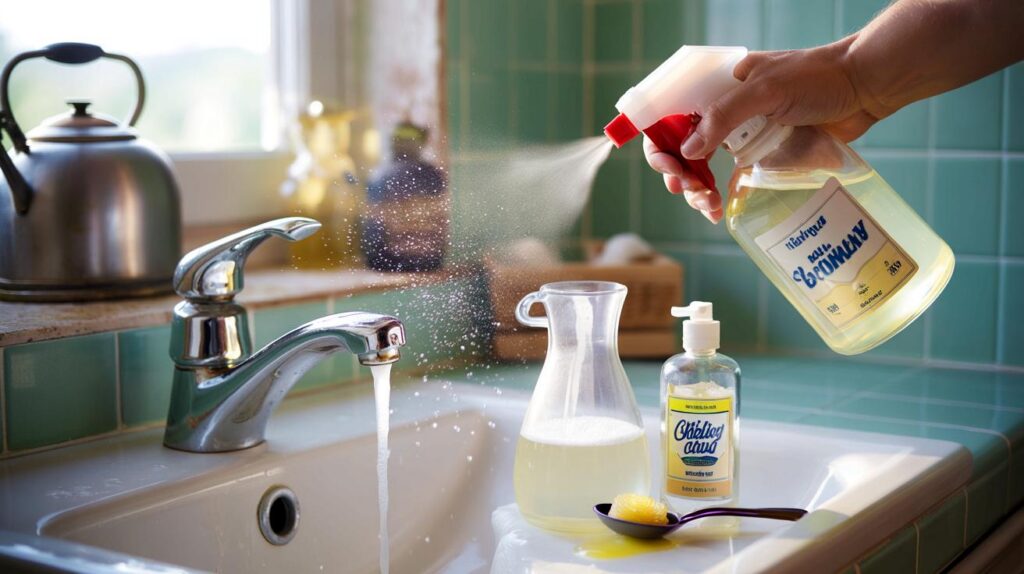
Two-minute anti-limescale mix, step by step. Pour 200 ml white vinegar (8–10% acidity) into a microwave-safe jug. Heat for 30–45 seconds until warm, not boiling. Add 1 flat teaspoon citric acid powder and 4–5 drops washing-up liquid. Swirl gently, funnel into a spray bottle, cap, and you’re live. Spray on taps, shower glass, tiles, kettle exteriors, even the loo rim. Leave it to work while you make a coffee.
A few guardrails keep this foolproof. Don’t flood with water — you want acid strength, not volume. Skip bicarbonate of soda here; it neutralises acid and kills the fizz you need. Keep it off marble, limestone, travertine, and other acid-sensitive stone. Be gentle on plated finishes already scratched to the brass. Ventilate if you’re sensitive to vinegar tang, and wear light gloves if your skin runs dry. Let’s be honest: no one really does this every day. Pick one small target, spray, walk away, come back smiling.
This little brew earns its place under the sink, and it’s kind to your budget.
“Limescale isn’t grime — it’s chemistry. Give acid time to meet rock, and muscle becomes optional,” said a London plumber who’s seen every kind of tap.
Test on a hidden spot first and keep one rule in big letters: Never mix vinegar with bleach. Pin this quick box for speed:
- Recipe: 200 ml white vinegar + 1 tsp citric acid + 4–5 drops washing-up liquid
- Warm to hand-hot for faster action
- Contact time: 3–10 minutes, then rinse and buff
- Great on taps, shower heads, glass, tiles, kettle outsides
- Avoid natural stone, unsealed grout, and cast iron
What changes when your fix takes two minutes
When the solution takes less time to make than a voice note, you actually use it. We’ve all had that moment when you catch the bathroom light at a brutal angle and — ouch — see the chalk halo around every fitting. With a warm, boosted vinegar ready, you can spray, step away, and let chemistry work while life carries on. Little wins stack up.
You might notice the kettle sounds cleaner and boils quicker. The shower glass stops catching the light in a bad way. Guests think you’ve deep cleaned, when you just nudged the routine. *It feels oddly satisfying to watch the fizz.* And because you’re not buying a separate limescale spray every month, your cupboard looks calmer too. Small ritual. Big mood shift.
| Point clé | Détail | Intérêt pour le lecteur |
|---|---|---|
| Warm + strong acid | White vinegar 8–10% + a pinch of citric acid, warmed | Faster reaction, less scrubbing |
| Contact time beats force | 3–10 minutes on glass, taps, shower heads | Cleaner finish with minimal effort |
| Safety and limits | No bleach mix, avoid natural stone, test first | Protects surfaces and health |
FAQ :
- Can I use any vinegar?Choose clear white vinegar at 8–10% acidity. Malt vinegar smells stronger and can stain pale grout.
- Will it damage chrome?On intact chrome, no. On pitted or flaking chrome, limit contact time and rinse; acids can creep into tiny faults.
- What about my kettle interior?Fill to cover the scale with straight vinegar, bring just to a heated standstill, leave 20 minutes, then rinse twice. No soap inside the kettle.
- Is citric acid essential?Vinegar alone works. Citric acid simply adds bite and speeds things up. If you don’t have it, warm vinegar plus a drop of detergent still does the job.
- Can I store the mix?Yes, up to a month in a labelled spray bottle. Keep it cool and away from kids and pets. If it smells off or separates oddly, make a fresh batch.



Ça marche, merçi !
Chauffer le vinaigre au micro-ondes, c’est vraiment safe ? J’ai peur des vapeures et des éclaboussures chaudes. Vous conseillez d’ouvrir la fenetre combien de temps ?