
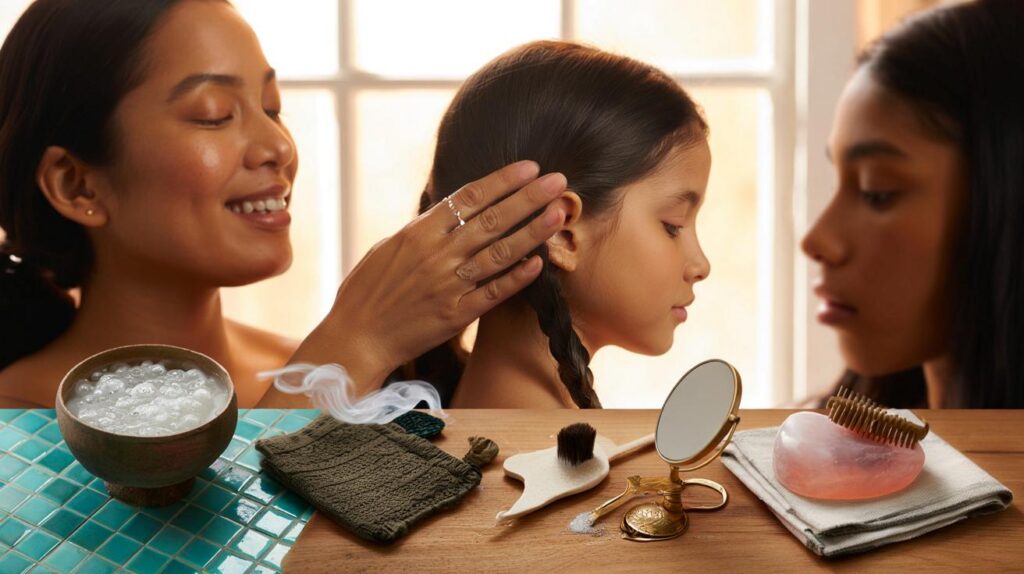
The kettle clicks off. A mother rubs a few drops of warm coconut oil between her palms and the kitchen fills with a soft, sweet echo of her own childhood. Her daughter sits on a stool, flicking through photos on a phone, sleeves rolled to avoid the oily glow. Across town, a Moroccan grandmother steams a bowl of water and black soap, while in a flat upstairs a Chinese aunt coaxes a sliver of rose quartz along a jawline. None of them are reading instructions. They’re remembering. The gestures live in the hands long before they land on the face. What we inherit isn’t just features. It’s rhythm, scent, touch. Five little routines that travelled across oceans and kitchens, stitched to stories and seasons. A small choreography of care, passed down in whispers and practical jokes. You can almost hear the chorus of “Not like that.” You lean in.
Five quiet rituals that outlived trends
Across continents, mothers teach beauty the way they teach table manners: by doing it, again and again, until it feels like home. Five gestures surface in kitchen light and bathroom steam. Oiling and braiding hair. Rinsing with rice water. Scrubbing in a hammam with black soap and a kessa glove. Tracing kohl along the lash line. Sliding a gua sha stone over sleepy skin. They’re ordinary and ceremonial at once. A ritual can be quick, but it holds time. The point isn’t perfection. It’s the shared pause, the touch, the smell that says, “You belong here.”
In Mumbai, Sunday evenings still hum with hair oiling: amla and coconut warmed in a steel bowl, fingers counting out three-parting strokes. In Fes, the hammam is a weekly loop — eucalyptus air, olive-paste soap, then the satisfying roll of dead skin under a brisk glove. A grandmother in Kyoto sifts cloudy rice water and saves it for a calming rinse. A Cairo aunt fingers a stub of kajal and a mirror that’s seen weddings and exams. A Brixton niece keeps a rose-quartz gua sha in the fridge and uses it before early shifts. **These gestures aren’t museum pieces; they keep adapting to city hours and shared bathrooms.** That’s why they last.
What makes these five rituals so persistent? They’re sensory, inexpensive, and forgiving. They work with what’s already in the cupboard and with what your hands know. They offer control when skin is moody and hair goes its own way. They ask for patience, yet pay you back in calm. There’s science in some of it — oils that soften the cuticle, starches that smooth the skin barrier, gentle massage that moves lymph — but the deeper engine is memory. You remember who showed you. You remember the joke about greasy pillows. You remember the first time the kessa glove shocked you into feeling clean. Habit becomes heritage.
How to try them without losing the soul
Start with hair oiling. Warm a teaspoon of coconut, argan, or mustard oil between your hands, then press from mid-lengths to ends, finishing with a slow scalp massage, before a loose braid and a gentle cleanse in the morning. Save the milky water from rinsed rice, let it sit 20 minutes, strain, chill, use as a five-minute skin or hair rinse, then follow with plain water. For a home hammam, run a hot shower till the room steams, smooth on Moroccan black soap, wait three minutes, then sweep skin with a kessa glove in long, light strokes. Line eyes with clean kohl along the waterline’s outer third. End with a cool gua sha: oil the face, then glide from centre to edge, always upward, always slow.
Common stumbles happen in the rush. We all have experienced that moment where the oil was too much, the glove too rough, the rice water forgotten in the fridge. Breathe. Go smaller. A pea-sized puddle of oil is plenty for most hair. The kessa wants patience, not force. Rice water works fresh; treat it like milk. Kohl belongs to the lash line, not the tear duct. Gua sha rewards consistency, a few minutes a few times a week. **Let’s be honest: nobody really does that every day.** Listen for the part of the ritual that brings relief — the warmth of the oil, the steam’s hush, the cold stone on puffy mornings — and do that first. *This is not about perfection.*
Beauty wisdom often arrives as a line you’ve heard a hundred times and only understand at thirty-five.
“What you do with your hands will show on your face,” my mother told me, twisting a braid with the care you give a promise.
Keep an easy crib sheet near the mirror:
- Hair oiling: warm, press, braid, wash.
- Rice water: soak, strain, chill, rinse, smile.
- Hammam at home: steam, soap, wait, glove, rinse.
- Kohl: sharpen, clean, short strokes, outer third.
- Gua sha: oil first, light pressure, upward paths, breathe.
**If it starts to feel like homework, cut it in half and keep the part that makes you kinder to yourself.** The rest can wait.
What these rituals whisper about belonging
Under the oils and stones sits something older than beauty language. Each gesture is a way of saying, “I come from somewhere,” and letting that truth soften the edges of the day. The oil becomes a bedtime story. The steam is a reset button after a hard week. The dark line of kohl is a small badge of boldness. You may tweak the ingredients, switch coconut for argan, use oat water instead of rice, trade a jade roller for your fingertips. The thread stays. **Routines make meaning when they carry fingerprints.** Share the ones you know with a friend who asks. Learn one you didn’t grow up with and give it your own accent. The mirror is bigger when we stand in it together.
| Point clé | Détail | Intérêt pour le lecteur |
|---|---|---|
| Five enduring gestures | Hair oiling, rice water, hammam scrub, kohl lining, gua sha massage | A clear toolkit rooted in lived tradition |
| How to do them | Simple steps you can fit into a busy week | Less guesswork, more calm, quick wins |
| Why they last | Sensory comfort, affordability, and memory | Makes routines feel meaningful, not faddish |
FAQ :
- Are these rituals safe for sensitive skin?If you go slowly and patch-test, many people with sensitive skin enjoy them. Keep pressure light with gua sha, choose fragrance-free oils, and rinse rice water off rather than leaving it on overnight.
- Which oil should I choose for hair oiling?Fine hair likes lightweight oils like argan or grapeseed. Coarser or curly hair often thrives on coconut, amla, or shea blends. Start with a teaspoon and adjust from there.
- Can I store rice water?Use it fresh or within two days from the fridge. If the smell turns sour, pour it away and make a new batch — it’s quick, and your skin will thank you.
- Is traditional kohl safe around the eyes?Stick to modern, tested formulations from reputable brands. Keep the tip clean, avoid the inner corner, and remove gently at night with a non-stinging cleanser.
- Do I need a special stone for gua sha?A smooth tool helps, but the magic is in the glide and direction. If you don’t have one, clean fingers and a drop of oil can deliver a soothing mini-massage.



Quelle belle traversée des gestes! On sent presque l’odeur de l’huile chaude et la vapeur du hammam. J’ai appris l’huilage des cheveux de ma mère au Sénégal et je le fais encore le dimanche soir. Merci d’insister sur le côté mémoire plutôt que perfection — ça deculpabilise. Petite remarque: “transmis de mère en fille” n’exclut pas les garçons, hein; mon frère aussi a appris. Bref, article doux et utile.
Le rinçage à l’eau de riz, vraiment efficace ou effet placebo? Y a t il des études sérieuses (hors anecdotes TikTok) et des risques pour les peaux réactives/rosacée? Je reste un peu septique.