
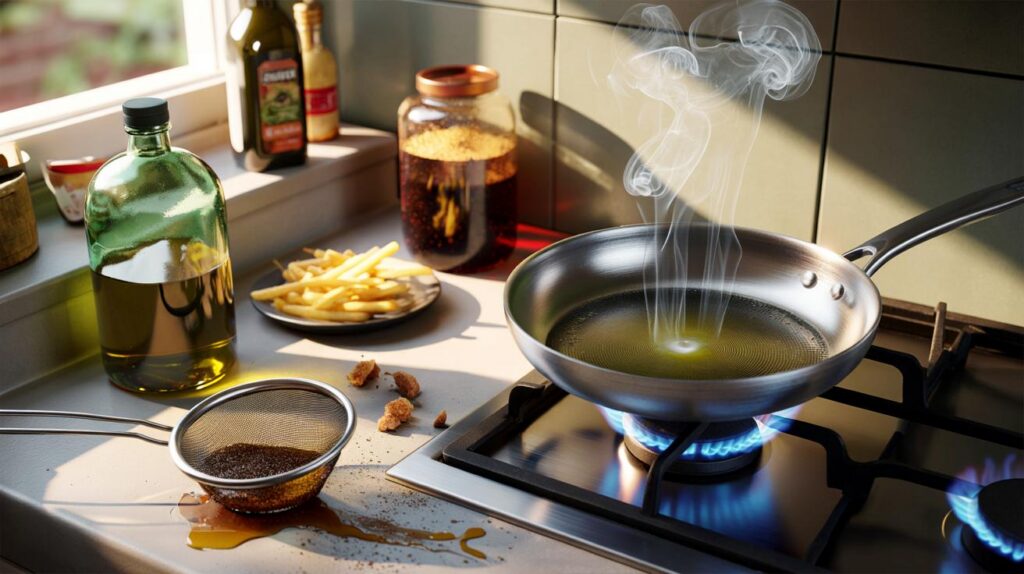
It’s the small everyday slip-ups that flatten flavour and fill the kitchen with that faint, stale fry smell. A bottle left by the hob. A pan left roaring while you hunt for the salt. The “healthy” oil that turns bitter just as your onions are getting sweet. Cooking oil is the quiet backbone of dinner, yet the way we heat, store, and reuse it can swing a meal from golden to grim in minutes. Most of us are winging it, and the oil knows.
Tuesday evening in a narrow London kitchen, the pan’s been warming for “just a sec” that becomes three minutes. The olive oil hits metal and smokes in a thin, ghostly ribbon. The smoke alarm chirps like a bored bird. On the counter sits a dusty bottle of sesame oil from a house move ago, parked behind the balsamic like a forgotten souvenir. The chips go in anyway. The chips tasted like yesterday.
Heat isn’t neutral
Most oils don’t shout until it’s too late. They go from quiet shimmer to acrid smoke fast, and that is where flavour dies. A hot stainless pan, a high flame, and the wrong oil make onions bitter and fish skins tacky instead of crisp. Extra virgin olive oil can absolutely sauté, but it sulks at deep-frying heat. Peanut and high-oleic sunflower thrive where a wok kisses blue flame. **Use heat as an ingredient, not a switch.** Your oil choice decides whether dinner tastes clean or clings to the air like yesterday’s pub.
I set a probe thermometer in a pan on “medium-high” and watched it rocket past 230°C in 90 seconds, which is where many supermarket olive oils start to smoke. Refined rapeseed (canola) is more robust around 220–230°C, while high-oleic sunflower and groundnut (peanut) can sit comfortably in that band. Delicate nut oils like walnut and hazelnut? They’re salad poets, not frying foremen. If your pan looks glassy and the oil shimmers in soft waves, you’re close; if it threads into wisps and smells sharp, you’re already over. Turn the dial with your nose as much as your eyes.
Smoke point isn’t just a chart; it’s chemistry meeting dinner. As oil heats, free fatty acids and tiny impurities start to burn, creating harsh flavours and a sticky film that glues food to the pan. More unsaturated oils break down faster under prolonged high heat, forming off-notes you can’t sauce away. Extra virgin olive oil carries fine for gentle sautéing, roasting veg around 180–190°C, and finishing with a grassy hit, while refined oils carry the heavy lifting at searing and deep-fry range. Think of oil like wine: the wrong bottle won’t poison you, but it will mess with the music.
Storage, reuse, and the health halo
Protect oil from its three enemies: light, heat, and air. Keep bottles in a cupboard, not by the hob, and buy sizes you’ll finish in a few months. Nut and seed oils (walnut, flax, sesame) are happier in the fridge; olive and rapeseed are fine in a cool dark spot. Mark the opening date on the label and decant daily-use oil into a small, opaque bottle for control. After frying, let the oil cool, then strain through a coffee filter to remove burnt crumbs. **Store oils away from light, heat and air.** Your nose will thank you tomorrow.
We’ve all had that moment when a half-price catering tin seemed clever, then went stale before the second barbecue. Reusing oil can be smart, but not endlessly; each round darkens, smells heavier, and lowers the smoke point. Three cycles is a fair ceiling for clean frying at home, fewer if you cooked fish or heavily spiced foods. Label jars “chips x2” or “chicken x1” and retire them when the aroma turns. Let’s be honest: nobody actually does that every day. Still, even one filter-and-label habit will change your frying for the better.
“Healthy” isn’t a halo that survives neglect. Choosing extra virgin for salads and low-heat cooking makes sense, and it’s fine in a gentle pan, yet it won’t make a burnt stir-fry virtuous. High-oleic sunflower or refined rapeseed are reliable for high heat, while toasted sesame and good EVOO shine as finishers. **Filter, label, and retire oil** before taste and texture suffer.
“Oil is a seasoning, not background noise,” a London chef told me. “Treat it like fresh bread: buy what you’ll eat, keep it out of the sun, and don’t pretend it’s immortal.”
- Sniff test: fresh oil smells nutty, grassy or neutral; rancid smells like crayons or putty.
- Quick cue: if oil smokes before food hits the pan, cool the pan or change the oil.
- Fridge rule: nut and seed oils live cold; olive and rapeseed live dark and cool.
- Reuse map: chips and doughs reuse well; fish and spice-heavy fries do not.
- Label love: write oil type, open date, and reuse count on masking tape.
Flavour is the whole point
Even in a tiny kitchen, oil choice is a creative decision. Taste a drop on bread before it hits the pan and you’ll sense where it wants to go: grassy EVOO on tomatoes, roasted groundnut with charred broccoli, buttery ghee with eggs on a slow Sunday. Heat can be tender or wild. Storage can be ritual or thoughtless. Reuse can be thrifty or tired. Taste the oil before the oil tastes your dinner. You’ll start to notice calmer pans, cleaner aromas, and that quiet glow on a Tuesday night when the chips taste like now.
| Point clé | Détail | Intérêt pour le lecteur |
|---|---|---|
| Match oil to heat | Use robust oils (high-oleic sunflower, refined rapeseed, peanut) for high-heat; keep EVOO for low-heat and finishing | Crisper food, fewer burnt notes, less smoke alarm drama |
| Protect from light, heat, air | Store in a cool, dark cupboard; fridge for nut/seed oils; buy smaller bottles, date them | Longer freshness, better flavour, less waste |
| Filter and retire reused oil | Strain after use, label cycles, bin when aroma darkens or foams early | Cleaner frying, safer pans, consistent results |
FAQ :
- Which oil should I use for high-heat frying?High-oleic sunflower, refined rapeseed (canola), or groundnut (peanut) oil handle 180–190°C well and stay neutral in flavour.
- Can I cook with extra virgin olive oil?Yes for sautéing and roasting up to roughly 190°C, and it’s lovely for finishing. Skip it for deep-frying or wok searing.
- How long does oil last after opening?Refined oils often taste fine for 6–12 months if stored dark and cool; delicate nut/seed oils are best within 3–6 months, sooner if warm.
- Should I reuse frying oil?You can, especially after frying chips or doughs. Strain it, label it, and limit to 2–3 uses. Toss it early if it smells heavy or foams.
- What’s the difference between cold-pressed and refined?Cold-pressed keeps more flavour and aroma but can smoke earlier; refined is cleaner-tasting with a higher smoke point for tough jobs.



Super article, merci ! Je laissais toujours la bouteille d’huile collée à la plaque et je me demandais pourquoi tout avait ce goût de vieux chip shop. Je vais dater mes bouteilles et filtrer après les frites, promis. Petite victoire ce soir: j’ai baissé le feu quand l’huile a senti “piquant”, et mes oignons n’ont pas cramé 🙂