
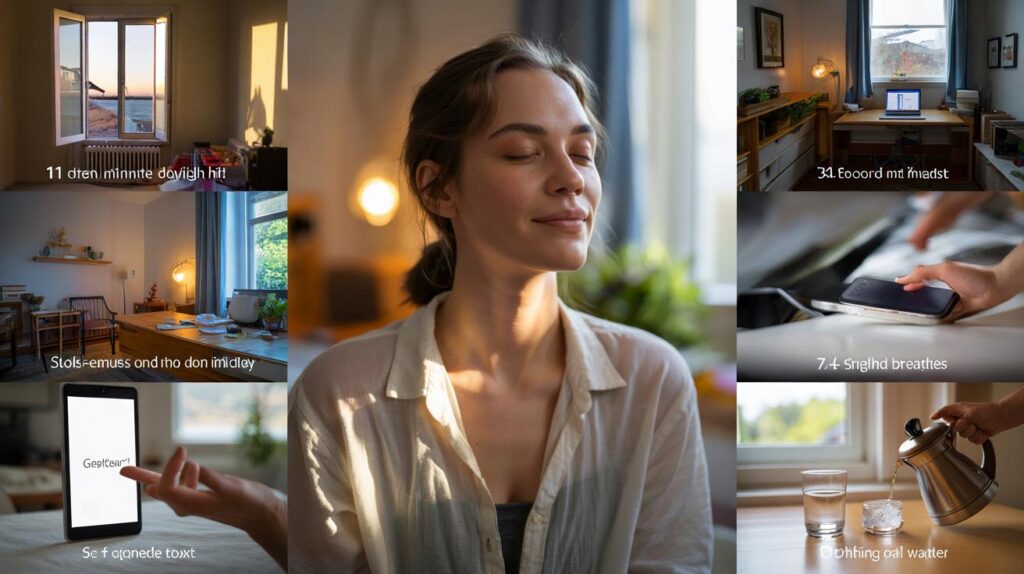
Your day looks full on paper, yet something essential slips through the cracks. Energy drains early, attention shatters by noon, and the small promises you made to yourself don’t happen. The fix rarely lives in grand plans or perfect routines. It lives in the tiny moves you can repeat without thinking.
The 08:17 rattles out of Clapham as a carriage of half-awake faces tilts towards screens. Coffee cups film over. Notifications nudge like midges. A woman near the doors closes her eyes for three breaths, then softens her shoulders. Nothing dramatic. The man across from her stands to stretch his back for eight seconds and smiles at no one in particular. A flicker of steadiness passes through the carriage like a ripple down a pond. We’ve all had that moment when the day starts to run you, not the other way round. Something shifts.
When the day gets loud, go small
Big goals are noisy. Tiny gestures slip under the radar and work anyway. They fit between calls, on the pavement, at the kettle. You don’t need to change your life. You need to change the next minute.
On a rainy Tuesday, a customer service agent I spoke to kept a Post-it at her desk that read “sip-breathe”. Every time her headset beeped, she took one swallow of water and one slow exhale before speaking. She said it stopped her voice from going tight by 11am. Research has linked short bouts of breathwork to calmer heart rhythms within minutes, and the effect stacks fast.
Micro-gestures work because they ask less of your willpower. They piggyback on cues you already meet: doors, taps, emails, kettles. Your brain loves frictionless wins. A 10-second win builds momentum and resets your internal story: from “derailed” to “in motion”. Make space for lighter, not perfect.
7 tiny rituals to weave through your day
Think of these as pocket-sized levers. Each one takes under a minute. Tie them to a cue you meet without fail: the login screen, the bathroom mirror, the fridge light, the red light at the crossing. The cue triggers the gesture, the gesture shifts your state.
Common traps? Trying all seven at once, giving up at the first missed moment, or turning a 30-second idea into a project. Start with one or two. Build a tiny streak—even two days counts. Let it feel almost too easy. Let’s be honest: nobody really does that every day. Aim for most days. That’s more than enough.
Anchor them with a line you can say out loud when needed.
“Small acts, repeated, beat grand overhauls abandoned.”
- One-minute daylight hit: step outside or face a window on waking; breathe, blink, let light set your body clock.
- Shoulder drop reset: inhale, then exhale and drop your shoulders twice; unclench jaw; name one thing you can feel.
- Single-task minute: pick one micro-task—send one email, fold three shirts, delete ten photos—no multitasking, just one minute.
- 30-second tidy loop: pick a radius (desk, sink, bag); restore one square foot; stop on time for a clean win.
- Text a thanks: one sentence of genuine appreciation to a colleague or friend; no emoji needed; hit send.
- 4-4-8 breath: in for four, hold for four, out for eight; two rounds; longer exhale signals safety.
- Water trigger: every time you put the kettle on, drink half a glass; hydrate by stealth.
Leave space for what sticks
The smallest shifts often outlast the shiny ones. The day makes demands; you meet them. These gestures slip into the seams and change the texture of the hours. Not dramatic, just different.
Pick the one that made your shoulders loosen when you read it. Tie it to a moment you meet anyway. Test it for a week. If it works, keep it. If it doesn’t, let it go and try another. The point isn’t perfection. The point is feeling a hair more alive at 3:14pm.
Share one with your team, your flatmate, your sister. Set a tiny challenge. Swap notes at the end of the week. The wins are quiet, but they add up. A steadier morning. A kinder voice in your head. A day that doesn’t just happen to you.
| Point clé | Détail | Intérêt pour le lecteur |
|---|---|---|
| Start micro, anchor to cues | Attach one 30–60 second ritual to everyday triggers | Less effort, more consistency, visible gains |
| Pick feelings over metrics | Use gestures that shift mood, breath, or posture fast | Immediate relief you can sense in your body |
| Stack, don’t overhaul | Add one at a time, test for a week, then keep or swap | Sustainable habits without burnout or guilt |
FAQ :
- What exactly is a “micro-gesture”?A tiny, repeatable action that takes under a minute and nudges your state—calmer, clearer, more present—without needing willpower or equipment.
- How many should I try at once?Start with one. When it feels automatic, add a second. Seven is a library, not a to-do list.
- Do these replace exercise or therapy?No. Think garnish, not main course. They complement bigger supports by stabilising the in-between moments.
- What if I forget all day?Normal. Reset at the next cue—doorways, kettles, calendars. A missed moment isn’t a failure; it’s feedback.
- How soon will I notice a difference?Often the same day. Breath and posture shifts can change your nervous system within minutes. Momentum follows.



Merci pour cet article, super clair. J’ai testé le 4-4-8 ce matin: effet quasi immédiat sur mon stress. Le rappel “petits actes répétés > grands plans” me parle beaucoup. Je vais l’ancrer à l’écran de login et à la bouilloire. Petite question: la “single-task minute” marche t-elle aussi sur des tâches créatives (écrire 3 phrases) ou mieux vaut rester sur des trucs méchaniques ?
Vous citez des recherches sur la respiration, mais où sont les sources ? Un lien vers les études cités serait utile (pas juste “research has linked”). Merci d’avance.