
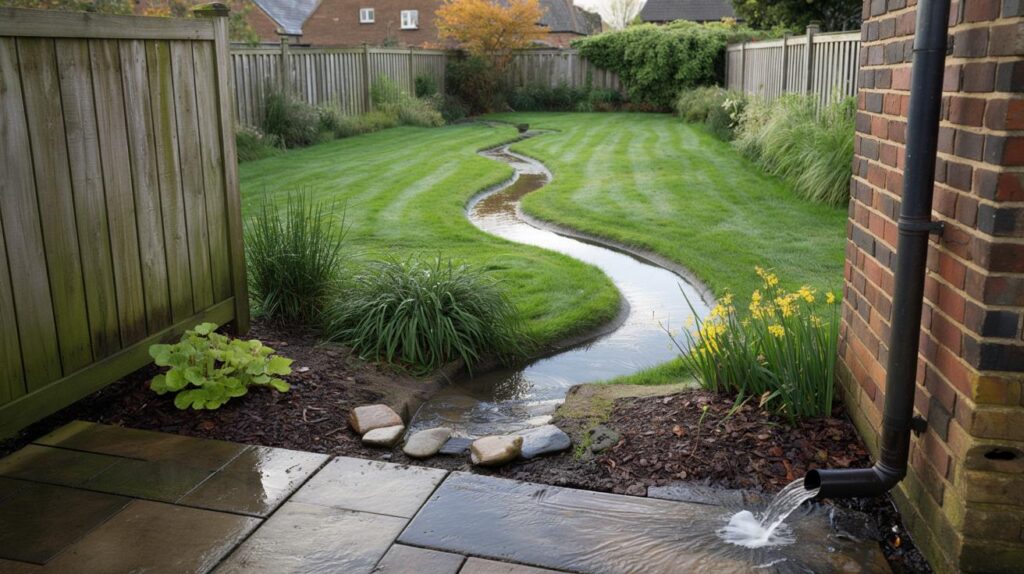
Relentless autumn rain is back, and thousands of home gardens face another season of puddles, sludge and fading borders.
So many of you will watch water sit for days, smothering grass and drowning beds, when one simple, expert move could change the script.
Why gardens drown every autumn
Rain on its own rarely ruins a garden. Saturation builds when soil, layout and footfall stop water from moving and soaking in. Clay ground holds on to moisture like a sponge. Compacted lawns seal shut after a summer of traffic. Flat plots or straight, rigid borders trap run-off where plants can’t use it.
The hidden culprits you can fix fast
- Clay-rich topsoil with poor pore space after dry spells.
- Compaction from mowing, games and pets that seals the surface.
- Hard edges and straight borders that block the water’s path.
- Shallow roots from summer watering that make grass weaker in autumn.
- Downpipes discharging in one spot, forming a persistent sump.
When water lingers, roots lose oxygen. Fungi thrive, leaves yellow, and worms retreat. Birds visit less. The lawn feels spongy one day and concrete-hard the next.
Most gardens can shed standing water with a single feature: a shallow, sinuous swale that guides rain to soak in rather than rush off.
The expert move many skip: a sinuous shallow swale
Forget pricey perforated pipes. A gentle, curving depression—call it a swale, dip or meadow hollow—quietly does the job. You shape it by hand, you plant it once, and the feature works with every shower.
How to build one in 90 minutes
- Mark a lazy S-shape that follows your garden’s natural fall.
- Dig 20–30 cm deep and 40–80 cm wide, feathering edges so a mower can glide over.
- Work a fall of 1–3% along the swale so water moves but never scours.
- Loosen the base with a fork for 10 cm to open pore space.
- Lay a 3–5 cm blanket of leaf mould or composted bark to slow and clean the flow.
- Set a few fist-sized stones at bends to break up surges and give wildlife cover.
- Keep it at least 1.5 m from buildings and check for buried cables before digging.
A 25 cm-deep, 6 m-long swale typically cuts lawn pooling by 40–60% after two or three storms, with parts and mulch under £30.
Why curves beat straight lines
Curves calm water. A straight trench hurries flow, strips soil and leaves the bottom bare. A gentle S-shape spreads rain out, invites it to linger, and lets soil take a drink. Plants along the edge sip the surplus. The rest percolates down instead of racing to your patio.
Plant picks that thrive in damp and make it look designed
Turn the dip into a feature. Choose species that relish periodic wet feet yet stay handsome when dry between showers. Layer heights and textures so the swale reads as a border, not a ditch.
| Plant | Role | Height | Seasonal interest |
|---|---|---|---|
| Carex (sedges) | Year-round structure, fine texture | 30–60 cm | Evergreen mounds, winter form |
| Iris pseudacorus (yellow flag) | Spring drama, strong roots | 80–100 cm | Spring blooms, sword foliage |
| Mentha aquatica (water mint) | Scent, pollinator draw | 40–60 cm | Summer flowers, aromatic stems |
| Hosta | Broad leaves for shade dips | 30–70 cm | Spring to autumn foliage show |
| Filipendula ulmaria (meadowsweet) | Upright plume, fragrance | 90–120 cm | Early summer frothy sprays |
Layout that works, even in tiny plots
Stage plants by thirst and height. Put sedges near the lip so they bind soil and soften edges. Drop water mint and iris into the deepest pockets so they drink the first flush. Tuck hostas into shaded bends. Repeat clumps every 1.5–2 m so the eye reads rhythm rather than randomness. Use bark fines between clumps to keep mud off paths.
Think of the swale as a seasonal border: wet after rain, quietly green the rest of the time, never a sump.
Quick jobs to do today
- Spike compacted lawn with a garden fork at 15 cm intervals; rock the tines to open channels.
- Brush sharp sand and fine compost into the holes to keep them open through winter.
- Lift mower height one notch to protect crowns from splash and fungal spores.
- Attach a short rill or splash tray to downpipes so roof water feeds the swale, not one spot.
- Mulch the swale base with leaves you already have; top up after heavy blows.
What to watch after the first big soak
After the next proper downpour, walk the line. Your swale should hold a shallow sheet for a few hours, then clear. If water sits for days, deepen the lowest third by 3–5 cm and add two stone check points to stall flow. If banks slump, add a row of sedges or a bundle of twiggy prunings pegged with bamboo until roots knit.
Simple measurements that guide tweaks
- Pooling time under 12 hours: keep as is.
- Pooling time 12–24 hours: deepen the base slightly or widen by a spade’s width.
- Pooling time over 24 hours: extend the swale by 1–2 m or create a second, parallel dip.
Costs, time and gains you can bank
Most small gardens manage with one 5–8 m swale. Two people with a spade and rake need 60–90 minutes. Plants from divisions cost nothing. Bagged mulch costs £6–£12. You save on fungicide, lawn repairs and emergency pumping. Expect fewer brown patches, fewer moss blooms and steadier growth into spring.
One weekend, one curve and a few plants can trade ankle-deep puddles for a lawn that firms up between showers.
Risks and how to avoid them
- Do not cut a channel to the pavement; channelling to the road can breach local rules.
- Keep the swale away from foundations, patios and neighbour fences.
- Avoid steep sides; gentle slopes keep children and pets safe and make mowing simple.
- Check before you dig; call your utility marking service if you are unsure.
Seasonal follow-up that keeps the system humming
In early spring, aerate the lawn again, top-dress thin patches with compost and grit, and trim sedges to refresh growth. Through summer, let the swale bake; these plants handle swings. In September, rake out silt that settled at bends and top up the mulch. If you add a second line, weave it like a shallow braid, 1–2 m apart, so both lines share the load during cloudbursts.
Extra pointers for small and sloped gardens
On tight terraces, shrink the profile to 15–20 cm deep and 30–40 cm wide, with a planted bowl at the end that holds a brief pond after rain. On steeper plots, build two or three short swales that step across the slope like contour lines. Each one slows water just enough for the next to take over. In both cases, a 1–3% fall remains the sweet spot for movement without scouring.
If you want to model capacity before you dig, a simple rule of thumb helps: for every 1 mm of rain on 10 m² of roof or lawn, expect 10 litres of water. A 6 m swale, 0.6 m wide and 0.25 m deep, holds about 900 litres when brim-full. You rarely need that much; the mix of storage and infiltration keeps levels low between showers.



Brilliant timing—my ‘lawn’ has been a sponge for weeks. The 25 cm swale with a lazy S makes total sense. I’ve got leaf mould ready and a rake; will definitley try the 1–3% fall and those fist-sized stones. Thanks for the plant picks too—Carex + meadowsweet = sold.
Slightly sceptical here: in heavy clay (Leeds area), won’t a 25 cm dip just hold water forever? Any regualtions about directing downpipe flow into a swale vs a soakaway? Also, does this attract mozzies if water lingers 24h+? Keen to avoid a neighbour complaint…