
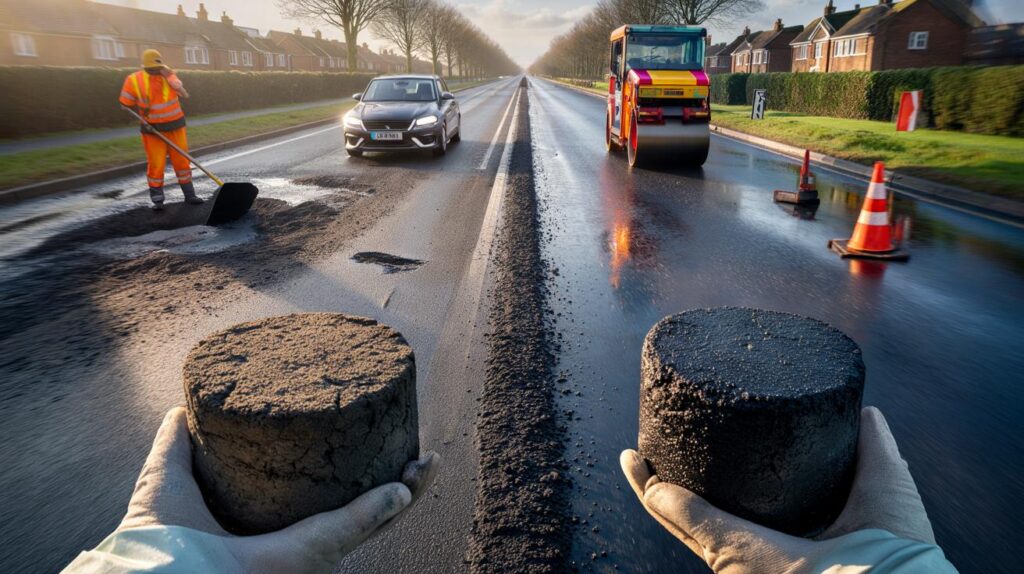
Another cold season looms. Tyres, suspensions and nerves will be tested. Councils weigh a new fix promising tougher tarmac.
A trial in Essex suggests a graphene-reinforced road surface could slow the relentless bloom of potholes. Lab tests and early road performance point to stronger, more water-resistant asphalt. The upfront price is higher. The potential payoff is fewer repairs, smoother journeys and quieter budgets over time.
A stretch of Essex as a live test bed
Essex Highways resurfaced part of the A1016 in Chelmsford in 2022 with two materials laid side by side. One section used standard hot rolled asphalt. The other used the same mix enhanced with a small dose of graphene, a carbon form prized for strength and flexibility.
Engineers took core samples three years later and sent them for independent laboratory assessment. Tests compared stiffness and resistance to water damage — two factors that strongly influence rutting and cracking. Results showed the graphene section held up better.
Lab findings: roughly 10% higher stiffness and about 20% greater resistance to water damage than the control mix.
The additive did not change the look of the surface. It changed how the mix held together. Under stress, failure tended to occur in the stone aggregate rather than the binder or the bond between stone and binder. That detail matters. If the bond is stronger, the surface keeps its integrity for longer under traffic and weather.
The upgraded mix cost an extra £2.50 per square metre to lay on the A1016. That premium is modest at project scale, yet significant for stretched road budgets. The true test is whether the surface lasts long enough to repay the higher upfront spend through fewer interventions.
Upfront premium: £2.50 per m². Potential returns: fewer call-outs, less disruption, longer resurfacing cycles.
What drivers will notice
- Fewer sharp edges and sudden holes forming after freeze–thaw cycles.
- Less rutting where heavy vehicles queue, improving drainage and grip.
- Slightly smoother ride that may trim rolling resistance and fuel use.
- Fewer work crews and lane closures for patching on treated sections.
Why graphene may help
Graphene is a single-atom-thick sheet of carbon. It is light, tough and conductive. In asphalt, it acts as a microscopic reinforcement, distributing stresses and improving the bond with bitumen. That raises stiffness without making the surface brittle. It also limits how water and temperature swings weaken the mix.
Moisture is the silent enemy
Water finds voids in the surface and pries the stones from the binder. Freeze–thaw cycles amplify the damage. Once tiny gaps open, traffic pumps water deeper, accelerating crack growth. A mix that resists moisture damage keeps its shape longer, buys more time between repairs and reduces the risk of potholes opening overnight.
The national picture
Local roads take the hit from rising traffic, intense rain and heat spikes. Councils in England and Wales are estimated to fill a pothole every 18 seconds. The industry puts the cost of restoring local roads to a high standard at roughly £17bn. That sum dwarfs annual budgets.
Essex manages around 5,000 miles of roads. The council reports extra funding of £47.5m since early 2024 to tackle the backlog and resurface critical stretches. Even with injections of cash, choosing the right surface treatment, in the right place, at the right time, matters more than ever.
Every 18 seconds a pothole gets filled, yet the backlog remains: a £17bn headache that hits every driver.
Cost now vs savings later
Graphene-enhanced asphalt is not a silver key for every street. Heavy lorries, junction shear, bus stops and drainage patterns all shape performance. The business case rests on whole-life cost. A surface that lasts longer cuts repeat visits, traffic control costs and waste. It also cuts carbon, because fewer repair runs mean fewer materials, fewer truck miles and less plant time.
| Surface type | Initial cost | Rutting and moisture resistance | Best use cases | Maintenance outlook |
|---|---|---|---|---|
| Standard hot rolled asphalt | Lower | Moderate | General purpose, lighter traffic | More frequent patching on wet or busy routes |
| Graphene-reinforced hot rolled asphalt | +£2.50 per m² (trial) | Higher in lab tests | Heavier traffic, spots prone to water damage | Longer intervals expected, under evaluation |
Beyond Essex: where next?
National Highways is trialling a kilometre of the enhanced surface on the A12 between Hatfield Peverel and Witham. That test stretch will face high-speed traffic and a mix of weather. Data from traffic counters, friction surveys and visual inspections will feed into rollout decisions.
Engineers stress that no single mix will suit every road. Urban side streets need different qualities from dual carriageways. Noise, skid resistance, ease of laying and recycling behaviour also factor into choice. Graphene-modified mixes may join a toolkit that already includes polymer-modified binders, fibre-reinforced mats and warm-mix asphalts.
What still needs proving
- How long the graphene surface lasts before significant cracking under varied climates.
- Whole-life costs vs rival premium mixes over 8–15 years.
- Performance at joints, utility covers and bus stop bays where stresses spike.
- Behaviour after milling and recycling into new mixes.
- Worker handling and consistent dosing at plant scale.
What this could mean for you this winter
Drivers care less about chemistry and more about fewer bills. A tougher surface reduces the chance of a bent rim or a ruined tyre after a night of frost. Fewer emergency patches also reduce surprise lane closures during your commute.
If graphene trials scale, councils could shift from reactive patching to planned resurfacing. That means fewer lumps and joins in the carriageway, more predictable works and better drainage. Results will arrive street by street rather than overnight.
Practical checks for councils weighing adoption
- Target sections with repeated rutting or water ingress, not whole networks at once.
- Measure skid resistance, texture depth and cracking quarterly for two years.
- Compare traffic management costs, not just material prices.
- Track carbon and waste tonnage avoided by fewer interventions.
- Set contract clauses for dose control and batch testing at the asphalt plant.
Wider gains and quiet risks
Longer-lasting surfaces help cut emissions from traffic management, material transport and plant operation. Smoother roads can trim vehicle rolling losses, shaving fuel use and tyre wear. That small saving scales when multiplied across millions of trips.
There are questions to monitor. Additives must not raise noise levels or reduce wet grip. Recyclability matters, because most resurfacing reuses milled material. Early indications suggest graphene doses are low and compatible with recycling, yet real-world milling trials will give the final word.
A note on testing and trust
The Essex cores were tested in an accredited laboratory with procedures in place to secure impartiality. Independent oversight of sampling, chain of custody and reporting builds confidence in results. Replication across more sites and climates will matter just as much as lab numbers.
If you hit a pothole tomorrow
Photograph the damage and the defect if safe to do so. Record the exact location and time. Report it through your council’s portal with evidence. Claims for damage rely on proof and on whether the council had a reasonable inspection and repair regime in place.
Graphene will not erase every hole overnight. It could give road teams a sturdier option where water and wheel loads keep winning. For drivers, a little less judder and a few fewer repair bills would feel like a win already.



10% stiffer and ~20% more moisture resistance sounds good on paper, but what’s the whole‑life cost vs polymer‑modified binders over 8–15 years? £2.50/m² scales fast. Any indepedent data on joints, bus bays and utility cuts where mixes usually fail?