
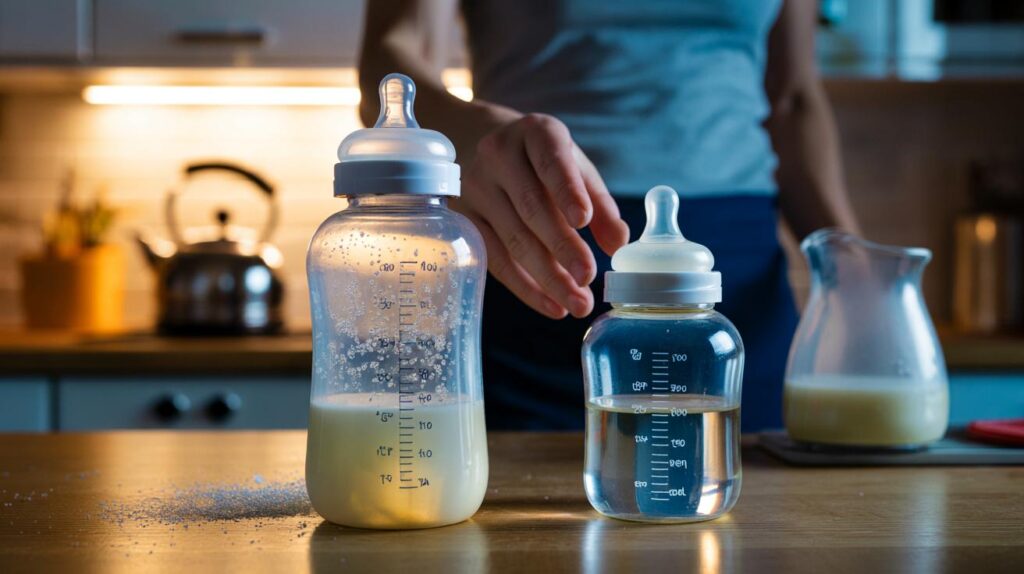
Across the UK, tired parents are reassessing night‑feed routines, as fresh findings unsettle the trust placed in familiar kit.
The mid‑autumn turn has brought a new unease to kitchens and changing bags. Lightweight, unbreakable plastic bottles have long felt convenient. Now laboratory data, expert briefings and parent‑to‑parent testimony are pushing families to ask harder questions about what goes into a warm bottle, and what comes out of it.
Why parents are turning away from plastic bottles
Polypropylene baby bottles dominate the shelves. They are cheap, easy to carry and sold as “BPA‑free”. That label reassured many households for years. Yet “BPA‑free” often means other bisphenols were used instead. Substitutes such as BPS and BPF have raised fresh questions in journals and regulatory consultations. Parents hear a familiar story: one chemical phased out, another one steps in under a friendlier name.
Heat, abrasion and repeated washing change the picture. A bottle that looks fine to the eye can shed microscopic fragments and trace chemicals under real‑world use. The numbers are no longer hypothetical. They are measurable.
Laboratory tests have reported up to 16 million microplastic particles per litre when formula is prepared at 70°C in polypropylene bottles.
What the new figures actually mean for a single feed
Formula guidance recommends water at about 70°C to reduce the risk of harmful bacteria. That temperature, plus shaking and sterilising, increases particle release from some plastics. Researchers have simulated routine feeding and found high counts of both microplastics and nanoplastics. A baby does not drink a full litre at once, yet several small feeds add up over a week. Most particles pass through the gut, according to current evidence, but scientists continue to study if a fraction might interact with developing systems.
Endocrine disruptors and the “BPA‑free” trap
BPA has been restricted in baby products for years. Replacement bisphenols now carry scrutiny. Early studies suggest they may act in similar ways on hormone signalling in cells and animal models. The data on infants remain limited, but the signal is strong enough to prompt caution from paediatricians and toxicologists. Parents do not need a chemistry degree to grasp the direction of travel: simplify materials where heat meets food.
When in doubt, reduce heat and friction on plastics, or switch to materials that tolerate heat without shedding.
Why babies may be more vulnerable
Infants are not small adults. Their organs are still maturing. Barriers in the gut and brain develop over time. Tiny doses that barely register in older children may have different effects in the first months of life. That is why guidance focuses so sharply on the first thousand days.
Practical steps you can take this week
- Use glass or stainless steel bottles for hot liquids. Reserve plastic for cold storage only, if you keep any.
- Do not microwave any bottle. Warm formula in a separate glass jug using a bain‑marie, then pour into the feeding bottle.
- After sterilising, rinse plastic parts with cooled, previously boiled water to reduce loose particles.
- Avoid vigorous shaking in plastic. Swirl gently, or mix in a glass jug before transferring.
- Replace scratched teats and bottles. Wear and tear increases shedding.
- Check teat materials. Medical‑grade silicone withstands heat better than most plastics.
Materials compared at a glance
| Material | Heat tolerance | Main concern | Typical UK price | Care notes |
|---|---|---|---|---|
| Glass | Excellent | Breakage risk | £8–£12 per bottle | Use a sleeve; survives repeated sterilising |
| Stainless steel | Excellent | Can dent; opaque body | £15–£25 per bottle | Good for travel; long‑lasting |
| Silicone (bottle bodies) | Good | Cost; firmness varies | £12–£20 per bottle | Flexible; easy to clean |
| Polypropylene plastic | Moderate | Particle shedding when heated | £4–£8 per bottle | Avoid heat and rough brushes |
The safety balance: heat for hygiene, not in plastic
Formula safety matters. UK guidance asks parents to prepare feeds with water around 70°C to control bacteria such as Cronobacter. That step protects babies. You can keep the hygiene benefit and lower plastic exposure by changing the vessel and the sequence. Mix powder and hot water in a glass jug, let it cool to feeding temperature, then transfer to a glass or steel bottle. If you must use plastic, add a cooled, boiled water rinse after sterilising, then avoid shaking.
Keep the 70°C rule for safety, but move heat away from plastic where you can.
The cost question and what savings look like over a year
A glass starter set costs more up front than plastic. Yet replacements add up. Many families buy two or three sets of plastic bottles each year as scratches appear. A pair of glass bottles with spare teats often lasts the whole year. Stainless steel sits at the top of the price range but can serve several children. Resale groups and baby banks now carry glass and steel options, lowering the barrier further.
What experts are watching next
Scientists are mapping how many particles infants ingest across a typical day. Bottles are one source. So are plastic kettles, food pouches, utensils and even household dust. Regulators in the UK and Europe are reviewing endocrine‑active substances and microplastics in contact materials. Manufacturers are racing to redesign products around simpler chemistries. Parents see momentum building, but the timetable is slow. That makes household choices the quickest lever.
Seven‑day plan to cut exposure without chaos
- Day 1: Audit your feeding kit. Remove scratched items.
- Day 2: Buy two glass bottles and a heatproof jug.
- Day 3: Practise preparing formula hot in the jug, transfer when cooled.
- Day 4: Switch to silicone teats if you use latex and notice wear.
- Day 5: Replace plastic bowls and spoons used with hot food.
- Day 6: Set a no‑microwave rule for baby feeds.
- Day 7: Share the routine with carers and grandparents.
Key figures parents are talking about right now
Up to 16,000,000 microplastic particles per litre at 70°C; billions of nanoplastics measured in some tests.
About 80% of the global infant bottle market by volume uses polypropylene, the plastic linked to higher shedding under heat.
What to ask in the shop before you buy
- What is the bottle body made from? Aim for borosilicate glass or stainless steel.
- What is the teat made from? Medical‑grade silicone is the common heat‑tolerant choice.
- Can I buy spare parts? A replaceable teat extends product life.
- Does the care leaflet advise against high heat? That signals sensitivity.
Beyond the bottle: other hidden heat‑plastic moments
Think about kettles with plastic interiors, pouches warmed in hot water, and plastic bowls that meet steaming purees. Each moment adds a small dose. Switching a kettle to glass or steel is simple. Decant hot food into ceramic or glass. Let heat touch materials that handle it well. Reserve plastic for cold storage and dry snacks.
Extra context for parents who want the full picture
Microplastics are not a single substance. They vary in size, shape and additives. Health effects depend on all three. Current studies suggest most particles pass through the gut. Researchers are testing whether the tiniest fragments interact with cells. Until those studies settle, families can cut the highest exposures—the hot, high‑friction moments—while keeping core hygiene steps that protect against infection.
If you breastfeed or combination feed, the same logic applies to pumps and storage. Choose glass for hot sterilising, silicone for parts that touch milk, and avoid boiling plastic components unless the manual allows it. Small switches, repeated daily, lower exposure across months. That is how routines change without drama and without losing sleep.



Thanks for the practical steps—mixing at 70°C in a glass jug then transferring makes sense. I’d love to see a comparison of particle counts for silicone bottle bodies vs glass/steel. Any sources on nanoplastics passing through the gut in infants? Also, do UK guidlines still insist on 70°C for formula safety?