
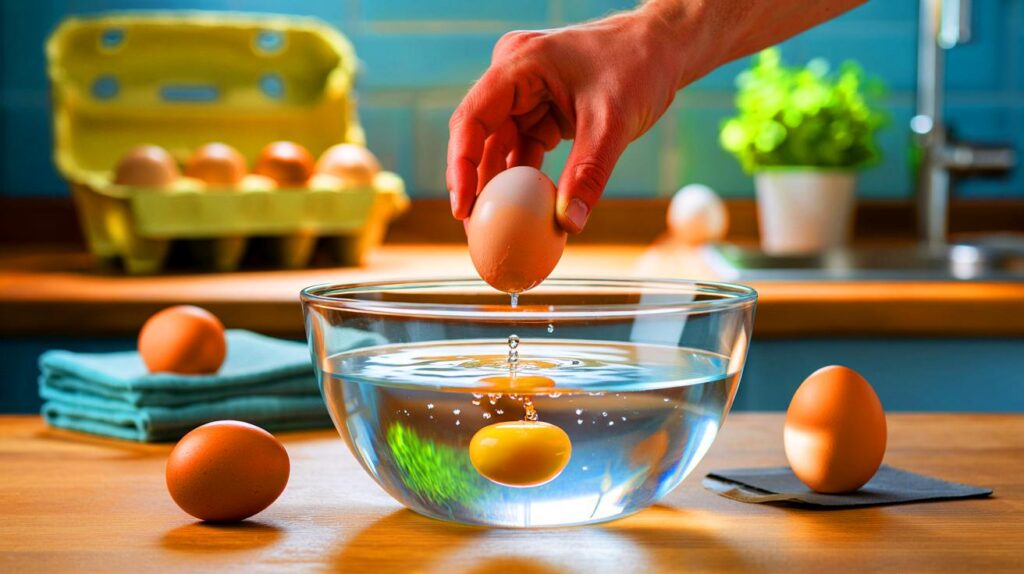
Shoppers face rising prices and confusing dates, yet breakfast still needs to be safe. One small bowl can settle the question.
Households want fewer surprises from the fridge and fewer pounds in the bin. A quick water test, costing roughly 20p in tap water and time, now circulates widely because it works, it’s fast, and it helps families avoid both illness and waste.
Why this tiny test is back in the spotlight
Eggs remain a staple, yet millions get binned every year because labels puzzle people. “Best before” signals quality rather than safety. Many eggs stay safe past that date if you store them correctly and cook them thoroughly. UK guidance points shoppers to chill eggs at 0–5°C and keep them in their box. That slows down quality loss, protects flavour, and reduces risk.
At the same time, food poisoning still spoils weekends. Most cases arise from handling errors at home, not from rare recalls. A simple, repeatable check reduces guesswork. That is where the float test earns its keep.
How to do the 20p water test
You need a bowl, cold water, and 10 seconds per egg. No cracking. No mess.
- Fill a deep bowl with cold water, at least 5 cm above the egg.
- Lower the egg gently. Do not drop it.
- Watch its position and movement. Read the result below.
| What you see | What it means | What to do |
|---|---|---|
| Egg sinks and lies flat on its side | Very fresh; tiny air cell | Use for any recipe. Great for poaching. |
| Egg sinks but stands on its end | Older; larger air cell; still safe | Use soon. Cook through, such as baking or hard-boiling. |
| Egg floats to the top | Likely spoiled; gas build-up | Do not eat. Bin it. |
If it floats, bin it. If it lies flat, it’s fresh. If it stands, cook it through and use soon.
The science: density, gas and pores
Eggshells are porous. Air slowly enters and water slowly leaves. The air cell grows, density falls, and buoyancy increases. A fresh egg is denser than water, so it sinks and settles flat. An older egg has more internal gas. It tilts, then stands as the air cell expands. A spoiled egg contains enough gas to float. This simple physics makes the test reliable at home.
Other quick checks without cracking
- Shell check: avoid eggs with cracks, powdery residue, or slimy patches. These hint at contamination.
- Stamp and date: the British Lion stamp helps traceability. Keep an eye on the best-before date for quality.
- Gentle shake: hold the egg to your ear. A sloshy sound suggests a thinner white and age. Use soon and cook well.
- Torch candling: in a dark room, shine a small torch through the shell. A large air pocket means an older egg.
Use multiple checks when in doubt: shell condition, date, a gentle shake, and the float test together raise confidence.
Storage rules that keep eggs safer for longer
Refrigerate between 0–5°C as soon as you get home. Keep eggs in their original box to shield them from odours and knocks. Avoid the fridge door where temperatures swing. Store pointy end down to keep the air cell at the top. Do not wash eggs at home because water can drive microbes through the shell. Keep them dry and clean. Return unused eggs to the fridge quickly after you take them out.
If you meal plan, place older eggs at the front of the box. Use them first for cooked dishes. This simple rotation saves money and reduces waste.
When you finally crack it: what freshness looks like
Freshness shows itself on a plate. A fresh egg has a tall, tight white and a yolk that stands up, centred. The chalazae, those white cords, hold the yolk in place. An older egg spreads and flattens. The white thins and the yolk sits lower. Age does not always mean unsafe. It means choose the right job: older eggs peel better after boiling; fresher eggs hold together for poaching.
Smell remains your last line of defence. A sour or sulphurous odour signals spoilage. Do not taste to check. Discard immediately and clean utensils well.
Who should take extra care
Pregnant people, very young children, older adults, and those with weakened immunity should aim for eggs that are either very fresh or thoroughly cooked. British Lion eggs with the red stamp are produced to standards that reduce salmonella risk. For dishes that stay runny, choose Lion-stamped eggs. If you prepare a recipe with raw egg, such as homemade mayonnaise or tiramisu, consider pasteurised eggs to add a further layer of safety at home.
Cutting waste without cutting corners
The float test helps you avoid binning good food. Use fresher eggs for quick frying or poaching. Move older, still-safe eggs into bakes, frittata, quiche, and cakes, where full cooking adds a safety margin. Batch-cook and chill leftovers within two hours.
- Freeze beaten eggs: whisk whole eggs with a pinch of salt or sugar, label portions, and freeze for up to 12 months.
- Separate and save: freeze yolks with a little sugar for desserts or salt for savoury dishes; freeze whites plain for meringues.
- Date your box: write the purchase date on the carton to track rotation at a glance.
Common pitfalls that spoil the result
Warm water can mislead the float test because it expands air in the egg rapidly. Use cold water. Salted water changes density and skews the result. Use plain water. Micro-cracks from rough handling allow faster gas exchange and quicker spoilage. Lower eggs carefully. Do not test dirty eggs in the same bowl as clean ones; wipe off visible dirt first to avoid spreading microbes.
A quick decision guide you can trust
Run the float test first. Check the shell and the date. Combine observations. If you still feel unsure, err on the side of caution and discard. A single bad egg can ruin a dish and a day.
One bowl, ten seconds, three outcomes: eat freely, cook thoroughly, or bin. Simple, cheap, repeatable.
Extra context for careful cooks
Heat kills most foodborne pathogens in eggs when both white and yolk set. Aim for firm whites and yolks if you suspect age. For soft-centred eggs served to vulnerable guests, choose Lion-stamped eggs or pasteurised products. If a recipe calls for raw eggs, keep the dish chilled and eat it promptly.
Some readers ask about precision. Commercial labs use Haugh units to measure egg white height and weight, but home kitchens do not need instrumentation. The float test, plus simple observations, offers enough accuracy for daily cooking. It protects health and trims costs, without special gear or guesswork.



Great explainer—thank you! I’ve always been confused by “best before” vs safety, and this cleared it up. Tried the water test just now and two eggs stood on end; used them in a quiche and cooked thouroughly. The guidance about keeping them in the box (not the fridge door) is gold. This will definately cut my waste and save a few quid. Also loved the reminder not to wash eggs at home; I was guilty of that.