
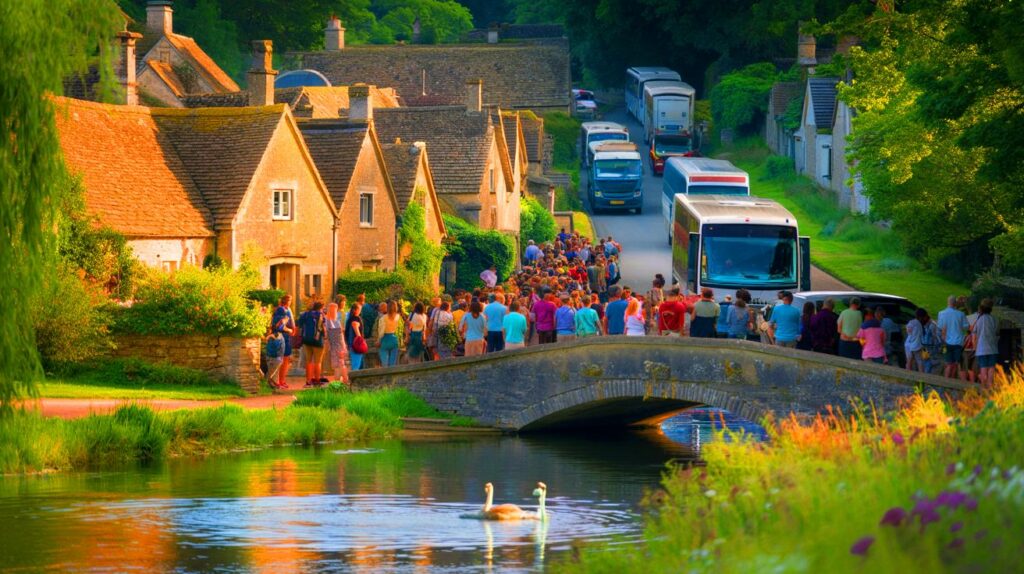
Honey-stone cottages, riverbank willows and a postcard row meet a village straining under its own fame this summer in England.
Britain’s bucolic dream now sits on a knife-edge. After a global ranking placed Bibury at the very top, the draw has intensified, and so have the growing pains that come with celebrity status.
Forbes ranking: why Bibury tops the 2025 list
Forbes, working with Unforgettable Travel Company, has named Bibury the world’s most beautiful village for 2025. The choice nods to the Cotswolds’ hallmark limestone, the painterly bend of the River Coln and the famed Arlington Row, once tied to the area’s weaving trade. The accolade puts a fresh spotlight on a settlement that already featured on countless wish lists and social feeds.
Global No. 1 status has amplified a delicate balance: heritage charm on one side, visitor volume on the other.
Arlington Row’s 14th-century origins, low doorways and moss-soft roofs speak to an older England. The meadows and water meadows, edged by willows, enrich a landscape that photographs handsomely in every season. That aesthetic strength, praised by the ranking, now also sets the stage for the hard questions of capacity, behaviour and stewardship.
Numbers behind the pressure
Locals estimate roughly 600 residents live in Bibury. On busy summer weekends, the headcount shifts dramatically as tens of thousands arrive to walk the lane and stand before the cottages that adorn guidebook covers.
Up to 20,000 visitors can pour in over a single summer weekend, with around 50 coach tours dropping off at peak times.
Those figures are not abstract. They translate into congested lanes, idling vehicles near the river, and long queues that can block shop fronts and cottage gates. The village infrastructure—designed for rural life, not mass tourism—struggles. Residents have pushed for changes to coach routes to relieve the pinch points through the centre.
What people see versus what a place can bear
The view that travellers cherish—golden stone, still water, a row stepped through time—sits on narrow streets. Kerbs are low, pavements are thin, and the margins between privacy and spectacle can vanish once the day’s third convoy arrives. Many visitors move on within minutes. That quick stop delivers minimal spend for the local economy while still producing noise, litter pressure and traffic.
A village worth more than a selfie
Bibury’s appeal is broader than one angle at the end of a lane. The Catherine Wheel pours a proper pint. St Mary’s Church holds centuries of parish life in its walls and churchyard. Bibury Trout Farm offers the sort of hands-on, quietly British experience that rewards unhurried time: fresh fish, simple food, a slow stroll under trees.
Spending an extra hour—and a few pounds—changes the footprint: less queuing, more value left behind, calmer streets.
Short visits compress footfall into one photo stop. Longer stays spread activity, stabilise small businesses and reduce peak bottlenecks. Local voices want visitors to linger, learn and contribute, not just pass through.
How to visit without adding to the strain
There is room for responsible travel that protects the scene people came to see. Small changes multiply when adopted at scale.
- Time your trip: arrive before 9am or after 4pm; pick weekdays over sunny Saturdays.
- Go small: choose minibuses, car shares or public transport instead of large coaches.
- Spend locally: a meal, a church donation, a farm ticket or a shop purchase supports upkeep.
- Keep distance: respect fences, doorways and private gardens; do not perch on walls for photos.
- Tread lightly: stay on paths; riverbanks and meadows are fragile habitats.
- Take breaks elsewhere: spread picnics and rests to neighbouring villages with facilities.
Key facts at a glance
| Metric | Value |
|---|---|
| Resident population | About 600 |
| Peak coaches per day | Around 50 |
| Visitors on a busy summer weekend | Up to 20,000 |
| Distance from central London | About 85 miles |
| Typical journey time by rail and bus | Roughly 2–2.5 hours |
Routes, timing and simple wins
Arrivals by train from London usually route to Kemble, then on by bus or taxi through Cirencester. Journey times vary with connections, and late-morning clusters create pinch points on village approaches. Plan an early train, pause in Cirencester for coffee or lunch, and arrive when day-trippers begin to thin.
Driving can be direct, but parking is limited. Choose smaller vehicles, avoid roadside stopping near river bends, and use marked bays. If a space is not obvious, continue to the next car park rather than circling narrow streets.
Spreading the load across the Cotswolds
Some visitors now pick a base in a less-trodden village and visit Bibury in off-peak hours. Others swap peak weekends for midweek stays in spring or early autumn. These choices ease pressure and produce steadier income for the region’s businesses.
Residents’ calls and what might change
Local campaigns have urged coach operators to avoid the tightest streets, arguing that re-routed drop-offs could thin congestion without strangling trade. Measures under discussion in such settings often include timed access for large vehicles, caps on simultaneous tour groups, and stronger signage on privacy and pathways. None of these ideas removes access; they manage it so that daily life, commerce and heritage can co-exist.
The goal is not fewer visitors forever, but better visits, spaced through the day and season.
Why the title matters—and what it could mean next
Top billing from a global outlet resets expectations. It brings new travellers from beyond Europe, extends the season and focuses attention on a single lane. That can deliver money for conservation and jobs for young residents. It also risks wear on stone, pressure on services and higher housing costs if second-home demand grows. The trade-offs are real, and they will shape policy choices this year.
If you go beyond the photo
Set aside time for St Mary’s Church to appreciate its interior and quiet yard. Book a table, not just a table view, at a pub. If you visit the trout farm, keep food waste contained and follow staff guidance near water. Hold back from drone use unless permitted; wildlife and residents bear the noise more than you do.
Practical add-on: planning a low-impact itinerary
Think in segments. Morning light for the river and Arlington Row. A late breakfast in Cirencester or Northleach. Midday at a museum or a garden in a nearby town with capacity. Return to Bibury after four for a calm hour and a local supper. This simple pattern halves the time you spend in queues and doubles the value you leave in the area.
For group leaders, model a “no-jump-out” rule at the tightest bends, schedule staggered photo stops, and build a minimum 45 minutes of local spend into the plan. A coach of 50 people buying a drink and a pastry each transforms a high-impact stop into support for wages and maintenance.
Wider context: the Cotswolds beyond one lane
The Cotswolds is full of villages with stone as warm and hills as soft as Bibury. Sharing itineraries across several places reduces crowds and keeps coaches moving. It also reveals more of what makes the region tick: small farms, workshops, parish churches and green lanes that cannot be understood in a five-minute dash.
Risk sits in the status quo: quick stops that clog and underfund the places they use. The advantage lies in pacing and distribution. A handful of practical choices—timing, transport type, spending and etiquette—turn a potentially fraught visit into a good day for locals and guests alike.



Timely question. If up to 50 coaches are dropping people within the same window, why not require timed slots and cap simultaneous groups? A small per-passenger levy ringfenced for paths, bins and signage could help, too. The article hints at rerouting coaches—are county councils actually trialling this, and when? Without enforcement (no-stop zones at the tight bends, fines for idling), guidance alone feels toothless. Also: can Bibury encourage longer stays via combined tickets with the trout farm/church to spread footfall?
Arlington Row is gorgeous until it turns into a catwalk for selfie sticks. Maybe issue ‘one photo, one pastry’ rules at the lane?