
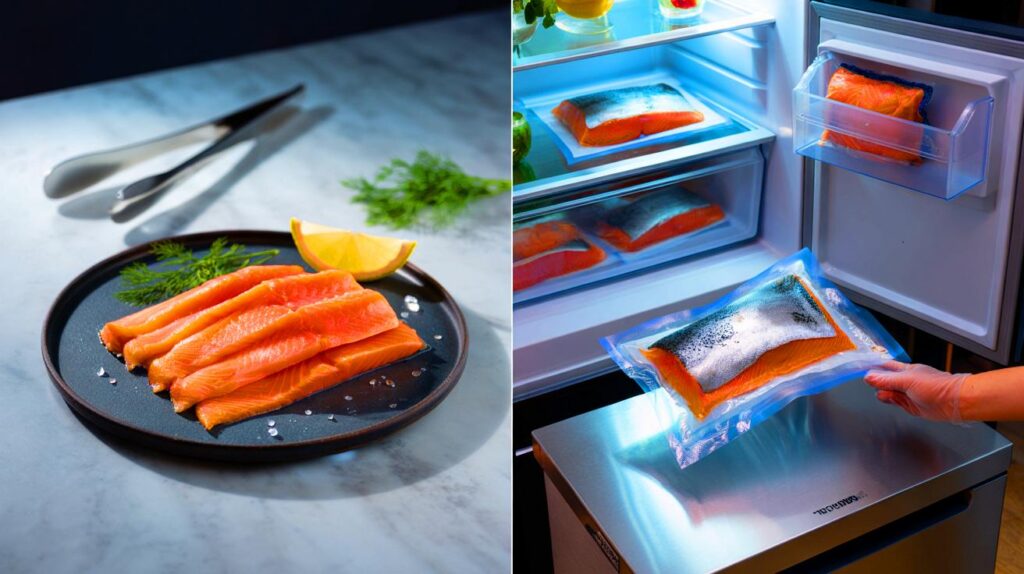
As festive platters and tight budgets collide, one question haunts fridges nationwide: is that glossy pack still safe tonight?
Smoked salmon feels too precious to waste and too risky to gamble. Here’s how to read the label, check the fish, and keep your household out of harm’s way while trimming avoidable waste.
What the date on the pack really means
In the UK, most ready-to-eat smoked salmon carries a use-by date, which relates to safety. Best-before signals quality, not safety. With smoked salmon, assume use-by unless it clearly states best-before. After the use-by, official advice is simple: do not eat it.
Use-by means safety. Past that date, bin it. Smell and colour cannot reliably spot listeria.
Why the hard line? Cold-smoked salmon is not cooked; it is cured and smoked at low temperatures. That process can leave it vulnerable to Listeria monocytogenes, a bacterium that can grow at normal fridge temperatures. You might not detect it with your senses. Keeping your fridge at 0–5 °C slows growth but does not erase the risk.
How long does smoked salmon last in real kitchens
Storage life depends on packaging, temperature, and whether you have opened the pack. The figures below are typical and assume continuous chilling:
| Scenario | Fridge temp | Indicative window | Notes |
|---|---|---|---|
| Unopened, vacuum-packed, factory sealed | 0–4 °C | 2–3 weeks or as dated | Follow the use-by on the label. Do not keep past that date. |
| Opened pack of slices | 0–4 °C | Up to 48 hours | Reseal tightly or use an airtight container. Keep cold between servings. |
| Cut to order at a fishmonger | 0–4 °C | 5–8 days if dated | Ask for a clear use-by. If none, treat conservatively and eat within days. |
| Frozen before the date | −18 °C | 2–3 months optimal | Quality is best within three months. Never refreeze thawed slices. |
Seven quick checks before you take a bite
If the pack is within its use-by but you still feel uneasy, run through these sensory checks. If any fail, do not eat it. If the date has passed, do not use the checks to override the label.
- Smell: sour, sharp, or pungently fishy scents signal spoilage.
- Colour: dull, greyed, or blotchy flesh points to degradation.
- Surface: slimy or sticky film means bacterial action has started.
- Texture: mushy slices that tear and smear rather than separate cleanly are past their best.
- Liquid: milky or cloudy drip in the pack is a warning sign.
- Packaging: a torn seal or a very swollen pouch suggests gas production by microbes.
- Mould: any speckling, fuzz, or unusual growth means discard immediately.
If the date is up, do not taste “just a little”. A tiny bite will not make unsafe fish safer.
What to do if you are still unsure
When doubt lingers, throw it away. Tasting is not a test, and cooking does not neutralise every hazard. For smoked salmon that is on the edge but still within date, use it promptly in a dish that will be heated thoroughly until steaming hot, such as a creamy pasta or a potato bake. Heat reduces some risks, though it is not a licence to ignore the label.
Freezing and thawing without losing flavour
Freezing can save money and reduce waste if done before the use-by date. Pack the salmon in small portions, press out excess air, label the date, and freeze at −18 °C. For serving, thaw overnight in the fridge on a plate lined with kitchen paper, then gently pat dry to restore texture. Do not thaw on the counter. Do not refreeze once thawed.
Freeze before the use-by date, not after. Portioning prevents repeated thaw cycles and protects quality.
Who needs to be extra careful
Some people face greater consequences from listeria and other pathogens. Pregnant women, adults over 65, and those with weakened immunity should avoid ready-to-eat cold-smoked fish unless it is cooked until steaming hot. Hot-smoked salmon, which is fully cooked and flakier, carries a different profile but still demands respect for dates and hygiene.
Cold-smoked versus hot-smoked
Cold-smoked salmon is treated below cooking temperatures, delivering a silky texture and delicate flavour. That same process leaves microbes more capable of surviving and growing in the fridge. Hot-smoked salmon is cooked during smoking, giving a firmer, flaky texture and a more robust taste. Both need chilling at 0–5 °C and careful handling once opened.
Hygiene and handling that actually change the odds
- Keep your fridge at 5 °C or below. Do not trust the dial; use a thermometer.
- Store salmon on the coldest shelf, away from the door, sealed tightly.
- Open, serve, and return to the fridge quickly. Do not leave it out for more than 30 minutes.
- Use clean tongs or a fork; avoid touching slices with warm hands.
- Separate ready-to-eat fish from raw meat or raw fish to stop cross-contamination.
Money, waste, and smarter buying
Plan portions. Choose smaller packs for small households. Do not open a new pack for a garnish if leftovers will linger. If you spot a short-dated bargain, freeze it the day you buy it. For canapés, consider hot-smoked flakes, which tolerate heating and freezing more flexibly than cold-smoked slices.
If you suspect food poisoning
Stop eating the product. Note the brand, batch code, and dates. Keep the pack if you need to report a problem. Many foodborne bugs cause symptoms within hours to two days; listeria can take longer, sometimes a week or more. Seek medical advice promptly if symptoms are severe, you are pregnant, or you belong to a higher-risk group.
A quick decision tree you can trust
- Is the label use-by and the date has passed? Do not eat.
- Is it within date but smells off, looks dull, or feels slimy? Do not eat.
- Is it within date, looks, smells, and feels right, and has been kept at 0–5 °C? Serve promptly.
- Not eating today? Freeze now, before the use-by, in portioned packs.
When safety and appetite collide, the bin is cheaper than a night in A&E. The label is your line in the sand.



This is the clearest guide I’ve read on smoked salmon safety. The use-by vs best-before distinction has me rethinking ‘sniff tests’. Thanks for spelling out the 0–4 °C reality.