
You buy coriander with good intentions. You promise the aubergines a curry night. Then the week happens, and the crisper drawer turns into a quiet graveyard. Wilted, weepy, forgotten. There’s a simple way out that doesn’t ask you to become a different person.
I’m watching a neighbour tip a bag of frozen green beans into a pan on a Tuesday night, the kind of evening where the sky pulls the light away too early. Her kitchen smells like garlic on a low flame and the radio mumbles the traffic. She tells me she froze those beans weeks ago, spread on a tray, “one by one, like coins,” and I realise her freezer is less a storage box and more a time machine. *We’ve all had that moment when a good vegetable slips from bright to tragic.* She plates up in under ten minutes. The beans snap, not slump. The trick takes ten minutes.
Why your veg turns to mush in the freezer
Most vegetables are tiny balloons of water wrapped in thin walls. When they freeze slowly, the ice crystals grow too big and puncture those walls. The thawed result leans soggy, leaching colour and flavour, like a song playing underwater. Water moves. Texture goes missing. That’s why a bag of crudely frozen courgettes tastes like memory foam.
The other villain is clumping. Tip raw chopped veg straight into a bag and the pieces stick together as a single frosty boulder. You end up chiselling out a lump, it half-thaws, then slumps in the pan. A 2023 WRAP snapshot suggested UK households bin millions of portions of fruit and veg every week — much of it bought with appetite and lost to timing. The bin isn’t the enemy. Bad process is.
Here’s the science in plain clothes: rapid freezing creates smaller crystals, which preserves cell structure. That’s what the food industry calls IQF — individually quick frozen. You can mimic it at home with a baking tray and a bit of patience. A quick blanch, a cold shock, a dry-off, and a single layer freeze. **Water is your enemy in the freezer.** Control it and your carrots survive. Ignore it and they come back sad.
The simple freeze hack that saves your veg
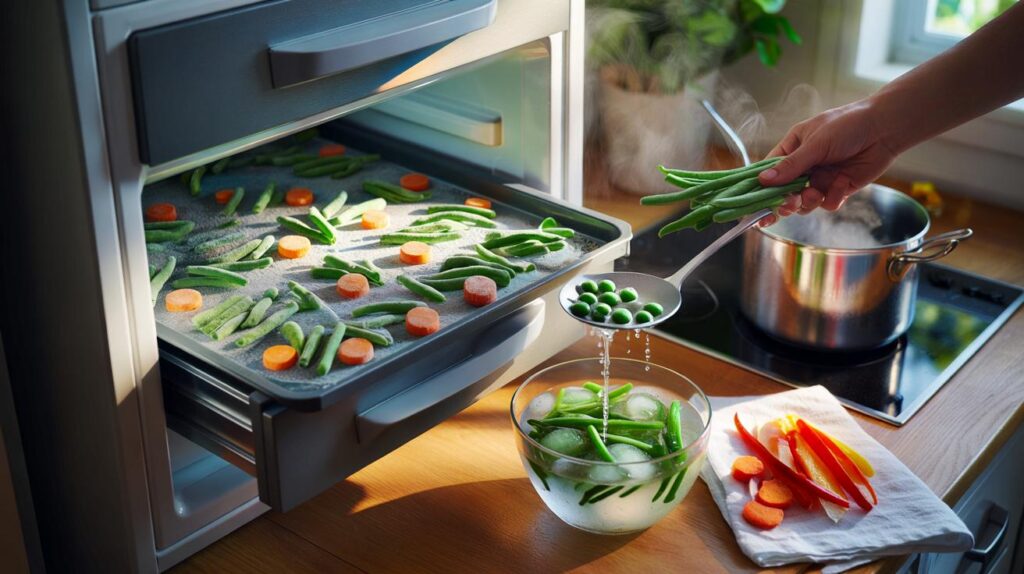
Here’s the move: prep, blanch, chill, dry, tray-freeze, bag. Chop vegetables into even pieces. Drop them into well-salted boiling water for a brief blanch, then straight into ice water to stop the cooking. Drain and dry until they feel barely damp. Spread the pieces on a baking tray in a single layer, no overlaps, and slide it into the coldest shelf for 60–120 minutes, until each piece is a little rock. **Freeze on a tray first.** Tip the now-free pieces into a labelled bag, press the air out, and stash them flat.
Tricks make it easier on busy nights. Use the water-displacement method: submerge a nearly sealed bag in a bowl of water so the water squeezes out the air, then close. If you don’t have ice, rinse veg under very cold water and let them steam off on a clean tea towel. Keep portions modest, like “one stir-fry” or “two handfuls for soup,” stacked flat so they thaw evenly in a pan. Let’s be honest: nobody actually does that every day. Do it once per shop and you’re set for weeks.
Common slips are small, fixable things. People skip the dry-off and lock in surface moisture, which becomes freezer frost and claggy texture. Or they cram too much on a tray, so the cold can’t reach every piece quickly enough. They also label nothing, so bags turn into ambiguous snow.
“Once you tray-freeze, you never go back,” says June, who taught me the trick over a plate of beans and buttered toast.
- Blanch times: broccoli florets 2 minutes; green beans 2 minutes; carrot coins 2–3 minutes; kale 2 minutes; peas no blanch if already frozen.
- Peppers, spring onions, raw onions: skip the blanch, tray-freeze raw.
- Herbs: chop and freeze in olive oil in ice cube trays for instant flavour.
- Courgette: grate, squeeze out water, then freeze in thin slabs.
- Mushrooms: slice, sauté until they give up moisture, cool, then freeze.
Make your freezer a working garden
This is less about perfection and more about rhythm. Batch a tray after your shop, while the kettle’s boiling, as a quiet favour to your stressed future self. Keep a running map of what’s inside — a scrap of paper taped to the door works just fine. **Label, date, and rotate.** The payoff is small but real: weeknights that don’t collapse into beige decisions, and Saturday lunches that start with a handful of bright veg instead of a limp apology.
| Point clé | Détail | Intérêt pour le lecteur |
|---|---|---|
| Tray-freeze after blanching | Blanch, chill, dry, freeze in a single layer before bagging | Keeps texture crisp and pieces separate |
| Flat, labelled portions | Bag in thin layers with dates and intended use | Faster cooking, zero guesswork on busy nights |
| Moisture control | Dry thoroughly, remove air via water displacement | Avoids ice crystals, stops freezer burn |
FAQ :
- Which vegetables freeze best with this method?Firm veg like broccoli, green beans, peas, carrots, sweetcorn, peppers, onions, and kale do brilliantly. Leafy herbs and mushrooms need tweaks, but they work when treated right.
- Do I always need to blanch first?Not always. Blanch high-water, colour-sensitive veg (greens, carrots, broccoli). Skip blanching for peppers, onions, spring onions, chillies, and already-frozen peas.
- How long will frozen veg last?Most tray-frozen veg are at their best within 3–6 months. They remain safe beyond that, but texture and flavour slowly drift.
- Can I freeze potatoes, tomatoes, or salad leaves?Raw potatoes go mealy; parboil chips or roast cubes before freezing. Tomatoes freeze well as roasted halves or sauce. Salad leaves don’t come back for salads — freeze them for soups or smoothies at a push.
- How do I avoid freezer burn?Dry veg completely, remove air from bags, keep portions flat, and don’t leave bags half-open. Cook from frozen in a hot pan so they sear, not steam.



Testé ce soir: carottes blanchies 2 min, bain froid, bien séchées puis congélation sur plaque. Résultat: texture nickel, pas de bloc glacé, cuisson express au wok. L’astuce du déplacement d’eau pour chasser l’air marche d’enfer. Franchement, je pensais que c’était du bla-bla mais non. Merci pour les repères “portions plates” — mon futur moi vous doit un café. Petit bémol: j’ai mis trop sur la plaque la 1ere fois, ça a collé.