
Some ideas don’t arrive with a business plan. They show up in the quiet, where bills and baby bottles share the same table, and the kettle knows the family timetable by heart. This is the story of one such idea — born in a small kitchen, nurtured between naps and night shifts — that found its way to seven figures without asking permission.
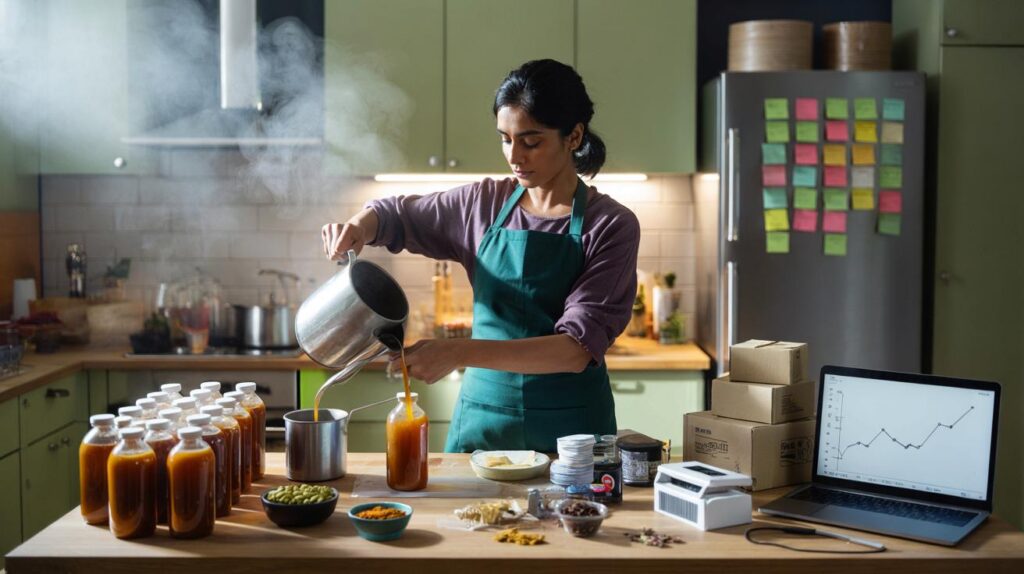
At 5:42 a.m., the kitchen smells like cardamom, ginger, and a promise. Sana Malik lifts a heavy saucepan, watching the chai syrup fall in a slow amber ribbon into warm bottles, each one capped with a click that feels like progress. Outside, the street-sweeper hums, her toddler is still asleep, and her phone pings with two orders she hasn’t promoted yet — a tiny chorus of yes. She checks a scribbled grid on the fridge, a mess of flavours and delivery routes and margin notes, a life mapped in pen. The kettle starts again, unasked, like muscle memory. The kettle changed everything.
The Kitchen Table That Became a Boardroom
It began with missing a taste she couldn’t buy. Sana’s mother brewed chai that felt like a hug and a nudge, strong enough to hold a day together, and nothing on the shelves came close. She wondered if she could bottle that ritual without losing its soul, so she tested sugar ratios at midnight and lined up spoons like a tiny orchestra on the table. **A kitchen table can be a factory line.**
The first real test wasn’t a launch, it was a folding table at the Moseley farmers’ market. She took 36 bottles, a hand-lettered sign, and a borrowed card reader that glitched if you breathed near it. By noon, the bottles were gone and a queue had formed for samples, with two café owners quietly asking if she did wholesale. Later, an Instagram Reel — just steam, a pour, and a caption that read “proper chai, less faff” — hit 180,000 views in three days. Pre-orders pushed the fridge door shut.
Why did it cut through? The product solved a fiddly daily moment without flattening it into something bland, a ritual in a bottle rather than a shortcut. The price landed in that sweet spot where a treat still feels sensible, and the litres-per-batch quietly made the unit economics work. She didn’t shout; she showed. People could see themselves in the steam, and that mattered more than clever copy or a thousand hashtags.
How She Built Momentum
Sana used what she calls the 5–5–5. Five variations, five trusted testers, five days to decide what stays. Each round got a tiny spreadsheet — tasting notes, costs per litre, shipping weight, all the unglam bits that decide whether a nice idea becomes a real thing. She repeated the cycle with labels, packaging tape, even the length of her stirring spoon. Margins moved a few pence at a time, and it added up.
Prices were the hardest part. New founders almost always underprice, and Sana did too, worried that ambition might look like arrogance. We’ve all had that moment when pressing “publish” on a higher price feels like a dare. Let’s be honest: nobody really does that every day. She climbed one pound at a time, adding value rather than excuses — better bottle seals, faster shipping windows, clear guides for baristas — until the business could breathe between orders.
“I stopped trying to look big and started looking true,” she told me, wiping a drip of syrup from the counter with the side of her sleeve, unconcerned. **Margins are not a mood; they are maths.** Below is the simple toolkit she keeps within reach — literal Post-its on a cupboard door — that helped her scale without losing the plot.
“If they can picture themselves using it tomorrow morning, they’ll buy it tonight.” — Sana Malik, founder of Spill the Chai
- Pre-orders as proof: small batches sold before brewing to test demand without waste.
- Story-led photos: hands, steam, mugs; not sterile product shots on white.
- Margin check: cost per bottle, shipping, returns cushion; reviewed every Friday.
- Founder video once a week: imperfect, honest, answer three real customer questions.
- Partnerships over ads: cafés, yoga studios, and co-working spaces with tasting swaps.
The Bigger Picture of Female-Led Growth
This isn’t just a nice tale about tea; it’s a pattern you can copy-paste. A kitchen table forces focus because chaos is expensive, so you prioritise moves that compound: repeatable batches, a loyal first hundred customers, and distribution that doesn’t eat your margin while you sleep. **The gap between idea and income is smaller than it looks.** A million pounds arrived for Sana not as a single fireworks moment but as a hundred tidy, boring, brilliant decisions — pricing that didn’t flinch, suppliers who answered the phone, and a brand voice that sounded like a person you’d actually text back. The business still runs from a modest unit ten minutes from that same kitchen, kettle intact, proof that scale can be human-sized and still massive.
Some ideas don’t need permission, only pattern and pace. You might not brew chai, but maybe you bake gluten-free sourdough that actually toasts well, or you fix tangled inboxes for busy freelancers, or you design baby rompers that survive the tumble dryer without drama. What Sana’s story whispers is simple: find the daily pinch point, create the little relief, tell the truth about it, and repeat until the curve bends. The rest looks like luck from far away, but close up it’s timing, trust and tenacity poured again and again.
| Point clé | Détail | Intérêt pour le lecteur |
|---|---|---|
| Start with micro-tests | Use 5–5–5 cycles to validate flavour, pricing, and packaging fast | Reduces risk and gives clear next steps without overthinking |
| Build demand before supply | Run pre-orders and partnerships instead of big ad spends | Generates cash flow and proof without burning budget |
| Protect margin early | Track cost per unit, shipping, and returns weekly | Keeps the business healthy as orders grow |
FAQ :
- How do I know if my kitchen-table idea is worth pursuing?Test if strangers will pay, not just friends who love you. Sell ten units, gather feedback, and repeat once; momentum beats compliments.
- What funding did she use to hit seven figures?Mostly revenue. Small pre-orders, reinvested profits, and a micro-loan for equipment once demand proved steady.
- How did she balance childcare and growth?Time blocks anchored to naps and nursery hours, plus batching tasks at dawn. One delivery day, one admin day, one production day.
- When should I raise prices?When costs rise or the product improves. Communicate the why, add clear value, and update recurring customers with grace.
- What’s the biggest early mistake to avoid?Underestimating shipping and packaging. Model real weights, test breakage, and choose materials that protect and still look like your brand.



Amazing story, but how did you handle shelf life and food safety certificaitons at scale? Did you switch to a co-packer or keep brewing in-house once orders spiked, and what did that do to margins? Can the “kettle” magic survive a 1,000-bottle run?