
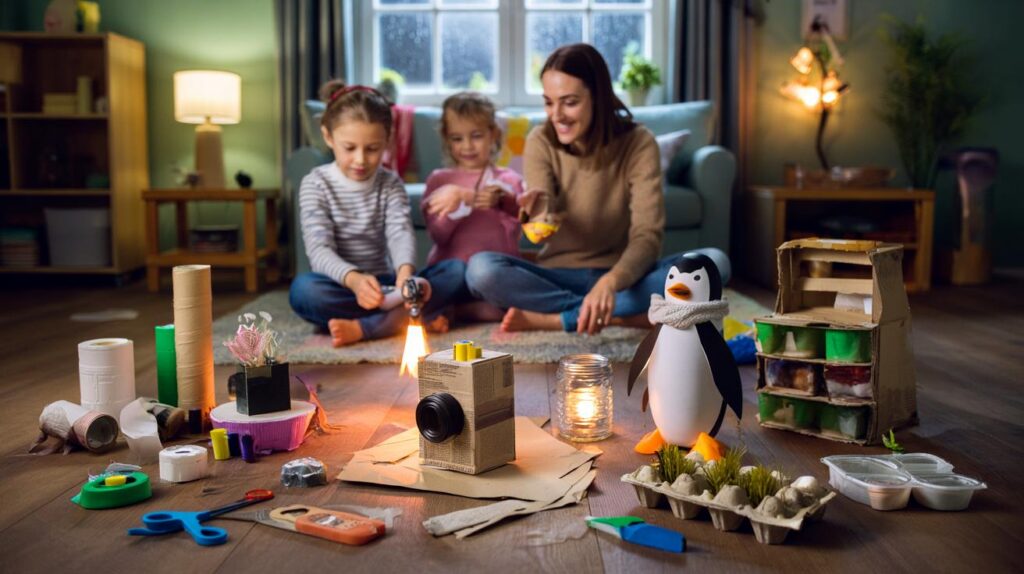
It’s raining outside, the bin’s full of packaging, and the kids are orbiting the sofa like bored satellites. You’ve got a living room, two restless pairs of hands, and more cardboard than a small shop. What if that was the point?
There’s a moment, right after you scatter the cereal boxes and loo-roll tubes across the rug, when the room exhales. The telly is off. A kettle hums in the kitchen, and a glue stick rolls towards a mischievous sock. You can almost hear the ideas scrabble in the air like tiny paws. A crisp tube becomes a rocket. A milk jug looks suspiciously like a penguin. Your child’s face shifts from “I’m bored” to “I’ve got this.”
You sit cross-legged, still in your slippers, and realise the living room has turned into a studio by accident. The tick of the clock seems to slow, replaced by the papery rasp of cardboard and the squeak of markers. It’s not about perfection. It’s about the physics of tape and the joy of making something from nothing. What happens next is the good bit.
A small mystery appears on the coffee table.
Why recycled crafts turn your living room into a creativity engine
Kids don’t need fancy kits to make astonishing things. They need limits that feel like a dare. Hand them a box of “rubbish” and the room becomes a **living-room lab** where texture, shape, and sound invite experiments. The cardboard pings, the bottle cap clicks, the tissue paper rustles like autumn. You see ideas grow sideways, not in straight lines.
One Saturday in Leeds, a family turned delivery boxes into a mini city, complete with a bus route and a park made from egg cartons. Visitors had to show a ticket drawn on scrap paper. It took two hours and zero new plastic. Only about 9% of plastic produced globally is recycled, and UK household recycling hovers at roughly half. When kids upcycle at home, they learn to pause before buying yet another “craft kit” wrapped in plastic. That pause is gold.
There’s a brain reason it feels so good. Constraints nudge divergent thinking, which is the fancy term for “many answers at once.” A cereal box can be a greenhouse, a guitar, or a postbox depending on the tape and the child holding it. The lesson hides in plain sight: materials are just decisions waiting to be made. Sorting the recycling becomes a slow conversation about where things go, what they’re made of, and why a jam jar can live again as a lantern. That is sustainable living, with glue on your fingers.
How to set up a zero-stress recycled craft session in your lounge
Start with a 10‑minute hunt. Tell the kids you’re running a **recycled treasure hunt** and set a timer. Grab cardboard, loo‑roll tubes, clean jars, yoghurt pots, string, paper scraps, bottle caps, fabric offcuts. Create three zones on the rug: “Build,” “Colour,” “Fasteners.” Put child‑safe scissors, tape, glue stick, and markers in a shallow tray. Add a damp cloth for sticky hands. A tea towel under the work area looks humble but saves your sofa. Music helps; something bouncy keeps the energy kind.
Keep your role light. Ask, “What could this be?” instead of “Here’s what we’re making.” The fastest way to kill joy is perfection. Don’t over‑engineer; the wobble is the charm. Hot glue guns are brilliant for older kids with supervision, yet tape and string do plenty. Mind staples and sharp lids. Glitter travels like gossip, so use confetti from hole‑punch scraps. We’ve all had that moment when the floor looks like a confetti factory exploded. Let’s be honest: nobody really does that every day.
Give the session a story spine. “We’re building a tiny cinema,” or “It’s a bug rescue hospital.” Then step back and narrate lightly while they lead.
“Start with what you have, give it a name, and let the mess earn its place,” says Georgia, a primary teacher who runs after‑school eco‑clubs.
- Cardboard camera: two boxes, a bottle cap shutter, a strap from string. Snap and pretend. It’s pure theatre.
- Penguin jug: milk jug body, paper beak, sock scarf. Paint the “tuxedo.” Wobbly is adorable.
- Rocket tube: crisp tube, cone nose, tissue tail. Countdown included. Park it on a mug-stand.
- Mini greenhouse: clear punnet lid, egg‑box pods, herb seeds. Water with a spoon. Watch the lift.
- City in a shoebox: cereal boxes for buildings, paper roads, a bus from a tea box. Add felt‑tip street names.
From quick makes to lasting habits
This isn’t a one‑off craft afternoon; it’s a way to reset the week. Pick a regular window, kettle on, phones away, a basket of “good rubbish” tucked by the bookcase. Rotate what you collect: bottle tops in a jam jar, interesting cardboard, fabric from worn‑through school trousers. Share a swap box with neighbours; it’s wildly social for something that starts in your lounge. Set gentle challenges—“Build something that moves,” “Make a gift from waste,” “Invent a game using only circles.” Name your favourites and display them on the mantel for a week, then take a photo and salvage the parts. *This is where the magic sneaks in.* You start to spot materials in the wild differently, the kids do too, and little by little the house learns to use what it has before it buys what it wants.
| Point clé | Détail | Intérêt pour le lecteur |
|---|---|---|
| Turn rubbish into prompts | Design small challenges like “Build a bridge from two boxes and a string.” | Easy ideas reduce decision fatigue and spark faster play. |
| Make a simple kit | Tray with tape, child scissors, glue stick, markers, and a hole‑punch. | Everything to hand means more making, less searching. |
| Close the loop | Display, photograph, then harvest parts back into the basket. | Keeps clutter down and teaches circular habits at home. |
FAQ :
- What recycled materials are safest for little hands?Choose clean, dry packaging without sharp edges: cereal boxes, loo‑roll tubes, bottle caps, paper trays, yarn, and fabric scraps. Skip anything that once held chemicals, broken glass, or tins with jagged rims.
- How do I prep materials without turning it into a chore?Rinse containers when you empty them and air‑dry in a dish rack. Flatten boxes with a quick run of the hand. Keep a basket in the kitchen; when it’s full, craft day is on.
- My child loses interest after ten minutes. What then?Scale it down. Offer a single prompt—“Make a hat for a toy.” Set a tiny timer and celebrate a two‑minute win. Curiosity grows when the bar is low and the praise is specific.
- How do I weave in sustainable living without a lecture?Talk while you work: “This pot used to hold yoghurt—what could it hold next?” Sort leftovers together and guess which council bin they belong in. The chat is the curriculum.
- We’re short on space. Where do finished makes go?Designate a “gallery shelf” for the week. Snap photos on Friday, then gently reclaim tape, caps, and boxes into the craft basket. A labelled folder of photos becomes your family’s making archive.



Loved this! On a grim rainy day we turned cereal boxes into a mini cinema; the “pause before buying” tip is gold. My kids actually sorted the recycling after—weirdly proud. We’ll definitley keep a basket of “good rubbish” by the bookcase.
Looks fun, but how do you keep the chaos under control? Glitter migrates like gossip—I swear I’m still finding sparkles from 2019. Any real tips for cleanup that don’t kill the vibe?