
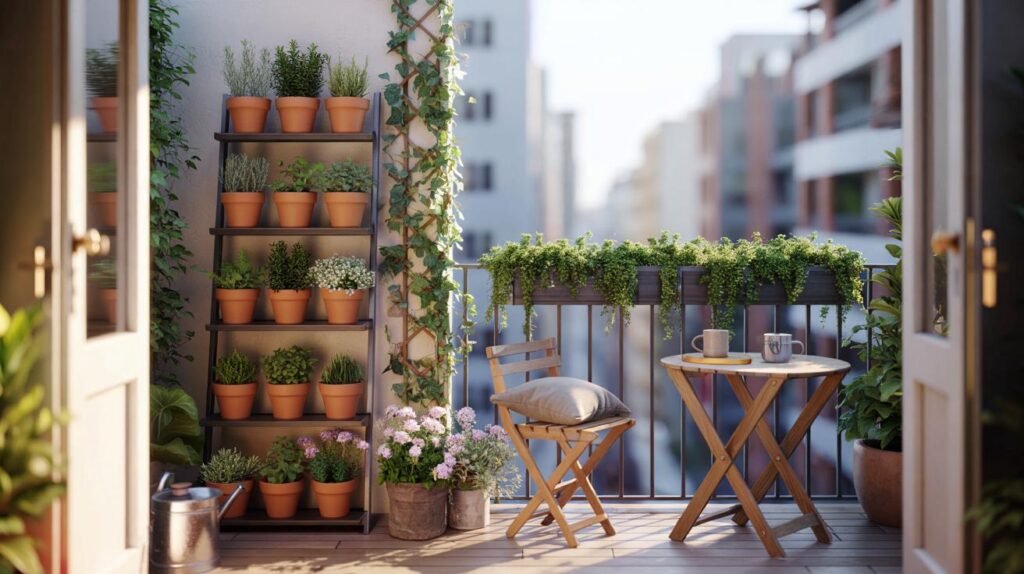
Your home stops at the back door, but your life doesn’t. A tiny balcony can feel like a forgotten corridor of air and traffic noise, a space leased to pigeons and laundry. Yet a few right moves can turn it into a daily reset button, a place where plants breathe and you can too.
The morning I finally noticed my own balcony, a bus sighed below and a neighbour watered a pot with a chipped mug. Sun striped the railings. There were three mismatched chairs, two dead geraniums and the quiet suspicion that I’d been wasting good sky. We’ve all had that moment when a small space feels stubborn and unsortable, yet your fingers itch to try. I dragged the chairs inside, swept the grit, and stood in the echo of a blank stage. What if a balcony could change your day?
Think Vertical, Think Vivid
Small spaces answer best to height, rhythm and light. When you stack, hang and train, a flat rectangle becomes a pocket woodland or a sunlit meadow. Think ladder shelves against the wall, slender climbers up a taut line, a rail planter that ties the view together. The trick is simple: lift the eye, layer the foliage, leave the floor breathing.
A friend in a fourth-floor walk-up proved it in one weekend. She fixed two timber battens to the wall, added three narrow shelves, and clipped in herb pots like notes on a music stand. A single jasmine wound up jute twine and found the wind. She kept one square clear for a foldable stool and a book. By Sunday night the space felt twice the size, even though nothing had moved but the gaze.
There’s a reason it works. Height creates depth, and depth creates calm. Low plants at the front, waist-high leaves behind, tall climbers to frame the sky — your brain reads it like a landscape, not a ledge. Light plays better too when foliage sits at different levels, so a shy patch can still catch a soft bounce. And the floor stays open, which means your shoulders drop the second you step out.
Design Moves That Work in Tight Spaces
Start with light. Stand outside for five minutes at breakfast, lunch and late afternoon, and note where sun actually lands. Then pick a palette that thrives in those conditions, not on a glossy mood board. Shade lovers like ferns, heuchera and ivy bring velvet greens; sun chasers like thyme, rosemary and dwarf lavender add scent and gentle drama. Use three pot sizes, repeat them, and slip a narrow trellis where your eye wants height.
Let’s be honest: nobody actually does that every day. That’s why systems beat willpower on a balcony. Group thirsty plants together so one deep soak handles the lot, slide saucers under pots to contain runoff, and place a small watering can where your hand naturally reaches. If wind whips your railings, choose heavy, low containers and tuck the tallest plants into corners for shelter. One simple rule helps: if you can’t reach it easily, you won’t tend it.
Think in zones, not clutter. One corner for sitting, one wall for growing, one ledge for herbs. Keep the walkway clear with hooks and hangers instead of floor pots. Start vertical with a ladder shelf or stacked crates, then layer textures — glossy leaves, feathery grasses, matte terracotta. A single accent colour, repeated twice, stitches it all.
“On a balcony, you’re designing a feeling as much as a garden,” says an urban grower I met on a Hackney roof. “Give your eye a place to rest, and the space feels bigger immediately.”
- Measure your light in hours, not vibes.
- Repeat pot sizes and colours for calm.
- Keep one square metre free for breathing room.
- Water deeply, less often, in the morning.
- Choose slow growers to reduce pruning.
Planting, Pots and the Quiet Art of Care
Soil is the engine. Use a peat-free mix with added grit for drainage, then line the bottom of pots with a thin layer of clay pebbles. Slip herbs into 15–20 cm pots, climbers into 25–30 cm, and leave a finger’s width below the rim for watering. Train a climber with two or three ties from the start, not after it sulks, and rotate your pots a quarter turn every few weeks to keep growth even.
Mistakes happen when speed takes the wheel. Overcrowding smothers airflow and invites mildew; too-big pots stay wet and drown roots. If your balcony is shaded by a tree, pick leaf shape over flowers and enjoy the textures: lungwort, foxglove, lamium. If it bakes in afternoon sun, go silver and scented: santolina, oregano, dianthus. When you travel, move containers close together in a shady spot to slow evaporation, and leave a saucer of water nearby for visiting birds.
Your balcony will talk if you let it. Leaves turn pale when hungry, curl when thirsty, droop when roots are trapped. Respond with small, steady tweaks rather than weekend drama. Choose slow-growing varieties that hold form without constant trimming, and set a ten-minute weekly ritual that fits your life.
“I treat my balcony like a room with living furniture,” a neighbour told me, grinning through tomato leaves. “Once it’s arranged, I only nudge it.”
- Feed lightly in spring and mid-summer.
- Top up mulch to keep moisture in.
- Swap one plant per season to refresh the scene.
- Wipe railings and leaves to cut dust and glare.
- Keep a pair of secateurs by the door for quick snips.
Stand back and let the space surprise you. The city hum you thought you hated becomes a backdrop to birdsong, to the clink of a cup, to new leaves that weren’t there yesterday. Think in seasons and stories rather than instant reveals: bulbs that rise in March, herbs that peak in July, a fern that stays green in November. The balcony will never be finished, and that’s the quiet joy worth sharing with anyone who needs a pocket of green on a grey day.
| Point clé | Détail | Intérêt pour le lecteur |
|---|---|---|
| Vertical layers | Use shelves, trellises and rail planters to lift plants | Makes the space feel larger and calmer |
| Right pot + soil | Peat-free mix with grit, matched to plant size | Healthier roots, fewer problems, better growth |
| Simple care routine | Group watering, weekly 10-minute check, seasonal swaps | Low effort, high payoff, less stress |
FAQ :
- What plants actually cope with wind on a balcony?Look for flexible stems and small leaves: grasses, rosemary, thyme, euonymus, ivy. Tuck taller plants into corners and use heavier pots for stability.
- Can I grow vegetables in such a tiny space?Yes, if you go compact: cherry tomatoes, cut-and-come-again lettuce, dwarf beans, chillies. One deep 30 cm pot per crop keeps things simple.
- How do I stop water dripping onto neighbours?Add saucers, water slowly until you see the surface glisten, and use a lightweight mulch to reduce splash. Morning watering gives soil time to absorb before heat builds.
- What if my balcony is mostly shade?Play with texture and glow: ferns, heuchera, hosta, lamium, hellebore. Lighter pots and a mirror panel brighten the mood without fussy care.
- I rent — am I allowed to fix things to the wall?Check your lease first. Freestanding ladder shelves, over-rail planters and tension poles create height without drilling.



This finally demystified tiny balconies for me—’lift the eye, layer the foliage’ is gold. I swapped floor pots for a ladder shelf and it already feels bigger. Any tips for keeping jasmine from drying out on windy days without drowning it? I’m using saucers but not sure about deep vs. shallow watering. Also, love the three-pot-size rule; sounds simple but I’ve always overcomplicated it. Thanks!