
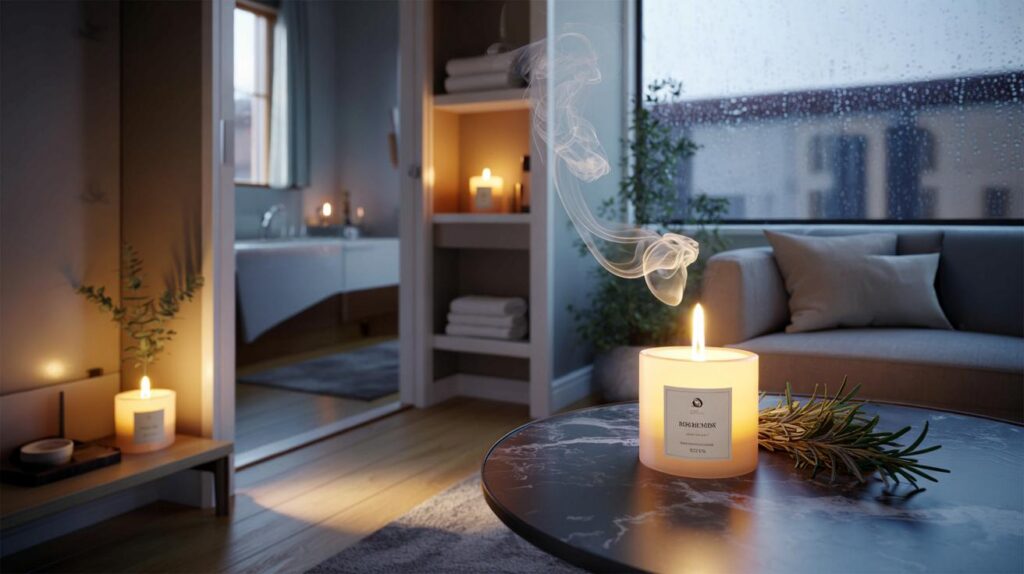
Tuesday evening, rain freckling the windows, the flat carrying a faint memory of last night’s garlic and the dog’s damp paws. You strike a match, set a fancy candle on the coffee table, and wait for the room to turn into a plush hotel spa. It glows beautifully, yet the scent hangs in a stubborn bubble, as if the air refuses to play along. You wander the corridor, sniffing like a truffle pig, wondering why a £45 candle smells powerful only when you’re practically nose-to-wax. It’s not that the candle is weak — it’s that the room is winning. The secret interior designers use isn’t just the brand or the fragrance notes. It’s where the flame sits in the choreography of your home. The candle is the instrument. The air is the stage. The trick is placement, not price. The triangle rule.
The Spa Triangle Rule designers swear by
Here’s the insider move: create a three-point “scent triangle” across your flat, placing candles at different heights along the natural route your air already takes. One low, one mid, one high — each from the same fragrance family, whispering the same story at three volumes. By separating the sources, you turn pockets of perfume into a gentle, confident veil that travels with you, not after you. **Scent is architecture for the nose.** When designers talk about a room feeling expensive, they often mean this: the smell greets you, lingers near you, and fades before it shouts.
I first saw it in a small Marylebone one-bed staged for sale. The stylist tucked a eucalyptus candle low on a hallway console, a softer fig blend at coffee-table height in the lounge, and a tiny cedar votive on a high bathroom shelf. Nothing felt perfumey up close. Yet step from the lift and you caught a clean breath; sit on the sofa and it warmed; crack the bathroom door and it finished crisp and woody. Viewers kept asking which brand made the flat smell “like a boutique spa”. The candles were mid-range. The placement was pure theatre. Buyers noticed the feeling, not the props.
Why it works comes down to the way scent molecules hitch a ride on convection and drafts. Warm air rises, cool air falls, doorways pump invisible tides every time you move, and radiators create soft currents that tug fragrance around corners. A single candle fights that dance in one spot, often too close to seating or too far from circulation. Three points — low near a corridor, mid where you linger, high where steam or warmth lifts — create a gradient. Your nose reads the blend as layered, never flat. It’s the difference between a solo and a chorus that floats.
How to set the triangle in your own flat
Start by mapping your airflow like a detective. Where does air enter or move — the front door, the kitchen extractor, the warm corridor after a shower? Pick one low candle (around 40–50 cm from the floor) near that movement, a mid-height candle (70–90 cm) in the living zone, and a high candle (150–170 cm) on a shelf or ledge near a warm, steamy space. Keep them in the same scent family: think eucalyptus, rosemary and cedar for spa-fresh, or neroli, bergamot and vetiver for serene. Light the low one first for 10 minutes, then the mid, then the high, so the scent climbs with you. **Placement does the heavy lifting.**
A few guardrails save both noses and curtains. Trim wicks to about 5 mm each burn to prevent smoky tops and sooty jars, and give new candles a full first melt to set their memory. Don’t park candles in window drafts or right under cabinets — the scent will sprint or the heat will mark the wood. We’ve all had that moment when the room smells like a duty-free sample card. Choose one family and vary intensity, not theme, and snuff before it gets heady. Let’s be honest: no one actually does that every day. But when you do, the pay-off is instant hospitality.
“Three candles, three heights, one story — low to invite, mid to comfort, high to cleanse. Put them where the air already travels and your flat does the rest.”
Use this as your pocket checklist when you’re tempted to plonk a candle on the nearest surface and call it done. The triangle brings discipline in the friendliest way, and it’s forgiving — you can tweak distance and strength without breaking the spell. Try these quick notes while you test your layout:
- Heights: roughly 45 cm (low), 80 cm (mid), 160 cm (high).
- Distances: keep 2–4 metres between points so scents meet, not collide.
- Timing: stagger light-up by 10 minutes; snuff the high candle first when guests arrive.
- Safety: clear 30 cm from fabrics; use a snuffer to avoid smoke bursts.
- Family: pick one palette (eucalyptus/rosemary/cedar or neroli/bergamot/vetiver).
Leave space for your nose
A spa never feels crowded by scent, and that restraint is the soul of this rule. Light the triangle for the prelude — an hour before guests, a Sunday bath, the first evening after a work trip — then dim it back to one flame so the air can breathe. Let a reed diffuser or a linen spray carry the baton between burns, keeping the overall profile steady and quiet. **Good homes whisper, they don’t shout.** If you like experimenting, swap the mid-height candle seasonally: warmer woods in winter, greener herbs in spring. Your flat will start to smell like itself, only kinder. The triangle is less a trick than a habit of paying attention to air, and once you notice the currents, you’ll never unsee them. A touch of scent at the right height can change how you sit, how you exhale, even how you sleep.
| Point clé | Détail | Intérêt pour le lecteur |
|---|---|---|
| Le “Spa Triangle” | Trois bougies, trois hauteurs (45/80/160 cm) alignées sur le flux d’air | Structure simple, résultats pro sans équipement ni budget luxe |
| Une famille olfactive | Notes cohérentes (eucalyptus–romarin–cèdre ou néroli–bergamote–vétiver) | Évite l’odeur “parfum mêlé”, donne une signature apaisante |
| Allumage en escalier | Bas 10 min, puis milieu, puis haut; extinction en sens inverse | Diffusion progressive, pas d’effet trop lourd près des invités |
FAQ :
- How many candles should I light at once?Two is the sweet spot for most flats; light the third only to prep the air before people arrive.
- Can I mix different brands and wax types?Yes, keep the scent family consistent and trim wicks; soy, rapeseed or coconut blends play nicely together.
- Where exactly should the low candle go?Near a hallway or entry flow, about ankle-to-knee height, and away from swinging fabrics or shoes.
- What if my flat is open-plan?Create your triangle within the living zone and use the kitchen edge or a bookshelf as the high point.
- Do I need the same fragrance in all three?Not identical — think cousins, not twins; one herbal, one citrus-herbal, one woody from the same palette.



Tried the triangle tonight—low eucalyptus by the hallway, fig at coffee-table height, tiny cedar up on the bathroom shelf—and my flat finally smells intentional rather than “one loud corner”. Genuis tip. The staggered light-up (low, then mid, then high) made a surprisingly big difference.