
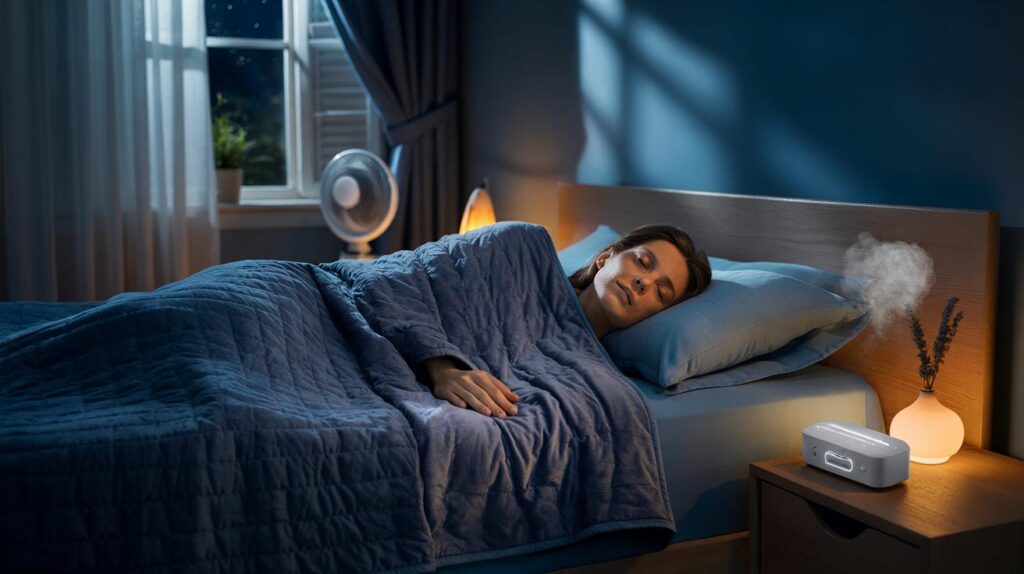
Restless nights rarely come with a single cause. A racing mind, a room that runs warm, blue-lit screens, a duvet that never sits right — all of it stacks up. Faced with that bundle of tiny frictions, many of us are turning to tangible sleep aids, from weighted blankets to cooling pads and the hush of white noise. Not a miracle cure. A nudge toward calm that you can actually feel.
The night I understood it, the only light in my flat was the flashing red dot of the broadband router. The city hummed through the double glazing; someone on a late call drifted past my window, laughing. I lay there waiting for sleep to turn up like an unreliable friend, and then I dragged a weighted blanket over my shoulders and chest. It was like a firm hand on the back, a gentle ‘stay’. The buzz in my head lost its colour. The minutes stopped shouting. A strange thought landed, quiet and obvious. What if the body just wants to feel held?
The quiet logic of pressure and calm
Watch a toddler settle when a parent’s palm rests on their spine and you’ll see the principle in soft focus. Pressure signals safety. Muscles slacken, breath deepens, and the nervous system dials down its alarms. Weighted blankets borrow that logic for grown‑ups who’ve forgotten how to be still. The fabric doesn’t knock you out. It tells your body it can stop scanning the room.
We’ve all had that moment when sleep feels close and then slips away because the mind keeps rummaging in old drawers. In a Swedish randomised study, adults who used weighted blankets saw bigger drops in insomnia scores across four weeks than those under regular duvets, with more people reporting better continuity of sleep. One participant described it as ‘a hug without the awkwardness’. That rings true at 2am, when language and logic feel a long way off.
There’s a simple physiology at play. Gentle, evenly spread pressure can nudge the parasympathetic system — the part that handles rest and digestion — to take the wheel. Heart rate steadies, the breath goes low and slow, and arousal cues ease. Pair that with the age‑old recipe of darkness, regular bedtimes, and a cooler room, and you shift the odds. **Deep pressure** is not a sedative; it’s a signal. Your body reads it like a green light.
What to try tonight, without turning your bedroom into a lab
Start with fit and weight. The usual guide for a weighted blanket is roughly 8–12% of your body mass, nudging towards the lighter end if you’re unsure. Let it cover your shoulders to ankles, and keep it off your head and neck. Lay it on top of your duvet for a few nights so you can peel it back if you warm up. Two or three calm breaths, hands resting on the blanket, notice the pressure across your collarbones. That’s the cue.
Temperature is the saboteur no one invites. Keep the room at 16–19°C, swap to a breathable cotton cover, and consider a cooling pillow if you run hot. Dull the room with blackout curtains or a wraparound eye mask, then hum a quiet noise floor — a bedside fan or a compact white noise unit can smooth out the unpredictable clanks that jolt you awake. Let’s be honest: nobody actually does that every day. Miss a step, and try again tomorrow.
Habits whisper louder than hacks. Pick a simple wind‑down ritual that appeals to your senses: dim the lights, stretch for three minutes by the bed, and read a few pages of something mild. Small rhythms teach the brain what comes next. You’re not building a shrine to sleep; you’re nudging the dial a notch, night after night.
‘The magic isn’t in the gadget. It’s in how your body interprets the signal: safe, predictable, held.’
- Choose weight: 8–12% of body mass, lighter if you’re unsure.
- Keep it breathable: cotton cover, no layers tucked tight at the neck.
- Cool the room: 16–19°C, crack a window if the air feels stale.
- Sound matters: low, steady noise masks the random spikes.
- Stack signals: dim light, warm feet, quiet breath, same time nightly.
A kinder route through restless nights
There’s a reason sleep aids with a tactile edge feel so human. They make calm something you can touch. A weighted blanket doesn’t negotiate with your thoughts; it talks to your nerves in a language older than words. Pair that with small wins — a caffeine cut‑off after lunch, a lamp that shifts amber after sundown, even a lavender spritz for the placebo you’re happy to take — and your night gets less jagged. **Sleep window** matters as well: get into bed when you’re actually sleepy, not just ‘done with the day’. You’ll slip more cleanly into the night, then wake with that rare, quiet certainty that you didn’t wrestle the dark. That you were simply carried.
| Point clé | Détail | Intérêt pour le lecteur |
|---|---|---|
| Weighted blanket fit | Pick around 8–12% of body mass; aim for shoulder‑to‑ankle coverage | Comfort without feeling pinned; better chance of staying asleep |
| Cool, dark, and steady | 16–19°C room, blackout or eye mask, gentle white noise | Fewer wake‑ups from heat and sudden sounds or light |
| Rituals that stick | Short wind‑down, steady lights, light reading, same time nightly | Builds a predictable cue set the brain recognises |
FAQ :
- How heavy should my weighted blanket be?Most adults do well with 8–12% of body mass. If you’re between sizes, start lighter and see how it feels over a week.
- Will a weighted blanket make me too warm?It can if the cover traps heat. Go for breathable cotton, keep the room cool, and lay it over your existing duvet at first so you can remove it mid‑night.
- Does it help anxiety as well as sleep?Many people report feeling calmer and drifting off faster. Trials suggest improved insomnia scores and fewer wake‑ups, likely via reduced arousal.
- What if I’m a side sleeper?It still works. Aim the weight across shoulders, hips and thighs, and leave space at the neck so you don’t feel compressed.
- Are there alternatives if I don’t like the weight?Try a body pillow for pressure along the front, a cooling topper, a wraparound eye mask, or a CBT‑I app to train more restful patterns. **Caffeine cut‑off** and gentler evening light help too.



I tried a 10% weighted blanket plus a cheap fan for steady noise, and my 2 a.m. doomscrolls dropped off. Not a miracle, but the “deep pressure = signal, not sedative” line resonated. Thanks for the clear, no-gadgety advice!
Can you link the Swedish randomised study you cite? I’d love details on sample size, effect sizes, and whether they controlled for temperature and pre‑sleep routines. Otherwise it feels a bit cherry‑picked.