
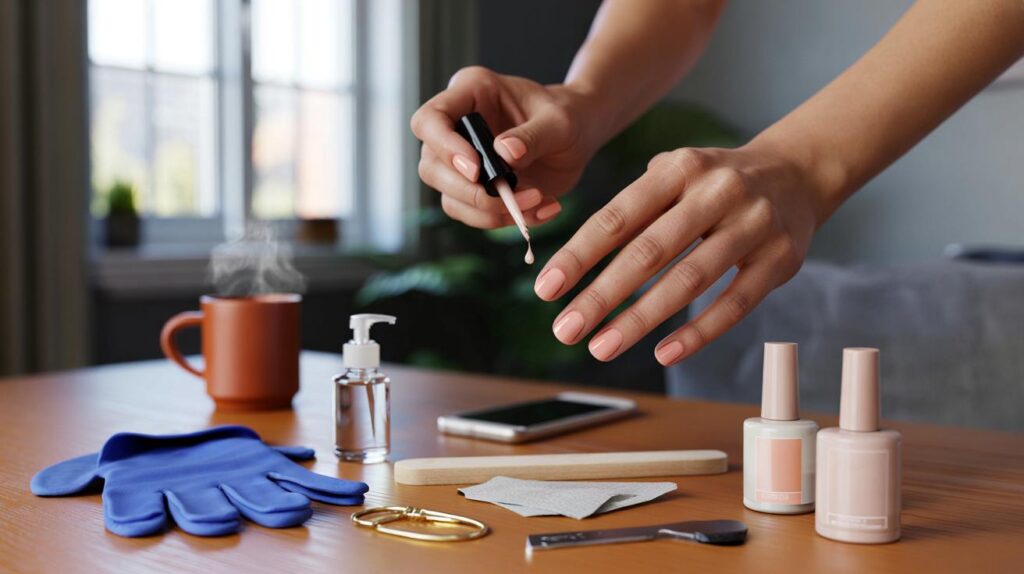
You want glossy, chip-free nails without booking out your Saturday or dropping salon money every other week. Your days are a blur of typing, taps, bags, keys, prams, pans, and a never-ending stream of tiny tasks that quietly wreck a fresh coat. The dream is simple: a neat at-home manicure that actually survives Monday to Friday — school run to late train, deadline to drinks — and still looks like you meant it. It’s not magic. It’s method meets habit, done in a way real people can keep up with.
On a grey Tuesday, I watched a woman on the Jubilee line cradle a coffee like it held her last ounce of calm. Her nails were a blush beige, quietly immaculate, the kind you notice without quite knowing why. She whipped out a tote, fished for a pass, tapped her phone, and the polish didn’t flinch. I thought about all the times mine had chipped before Wednesday and the petty rage of it. We’ve all had that moment where a tiny nick feels like the week winning. What she had wasn’t luck or a secret salon. It was a sequence. It starts before the first swipe.
The real reason your at-home mani chips by Wednesday
Polish doesn’t just fall off. It lifts because nails are oily, bendy, and constantly soaking up water. Then they dry, shrink, expand again. That tiny movement pries paint from the edges and the cuticle line. Rushed prep leaves invisible film — hand cream, SPF, kitchen grease, life — trapped under the base coat. By Wednesday, the bond loosens and the first chip lands. The fix isn’t more layers. It’s better contact between nail and polish, and a shape that resists your daily knocks.
Tell me if this sounds familiar: Monday morning, fresh coat, picture perfect. By lunch you’ve opened three parcels, typed 4,000 words, and done the washing up you promised you’d leave. Tiny nick on the index. On Wednesday, a full flake. I followed a London producer called Maya for a week. She kept nails short, rounded the corners, skipped lotions right before painting, and wore washing-up gloves without fail. The manicure lasted seven days. Same polish. Different prep and tiny protective habits. That was it.
Nails are not glass; they’re layered keratin with natural oils on top. Paint sticks when the plate is clean and slightly matte, and when each coat shrinks evenly as it dries. Thick, fast coats dry on the surface and stay soft beneath, which makes dents and early chips almost guaranteed. Shorter lengths reduce leverage, meaning less impact on the free edge. Short nails last longer than long talons when life gets hectic. **Dry prep beats any fancy polish.** Get the surface right and even budget colour behaves like a pro formula.
Prep, paint, protect: the week-proof method
Start with water-free prep. File first, shaping into a soft square or rounded tip so your edges don’t catch on zips and pockets. Push back cuticles gently with a wooden stick; don’t cut live skin. Lightly buff to remove surface shine, then swipe each nail with isopropyl alcohol or a non-oily acetone wipe to dehydrate. If your nails run oily, use a pH-bond/primer. Apply a gripping base coat in the thinnest veil possible, capping the free edge. Two thin colour coats, 2–3 minutes between each, then a glossy, durable top coat — again capping the edge. Let the final layer set in cool air, not heat.
Common slip-ups are tiny but loud. Painting straight after a shower traps water in the nail; wait at least an hour. Flooding the cuticle creates a peelable ledge; leave a hairline gap all around. Old, thick polish chips fast; if it strings when you lift the brush, it’s time to bin it or add a few drops of thinner. Shaking bottles makes bubbles; roll them between your palms. Rushing dry time is the classic trap. Let’s be honest: no one actually does this every day. **Thin layers win every time.** They dry harder, wear longer, and look cleaner.
There’s a quiet art to sealing the deal across the week. Keep nails away from long, hot water sessions for a few hours after painting so the bond settles. Wear gloves for dishes and cleaning. On day three, lightly buff the very tip and add a fresh layer of top coat to lock it all back down.
“Longevity is 80% prep and 20% restraint,” says London nail tech Jo Lambert. “Resist thick coats, protect your edges, and your polish will outlive your schedule.”
- Week-proof checklist: clean, dry nail plate (alcohol swipe)
- Shape short, with softened corners, and cap the edge each coat
- Two thin colour coats, 2–3 minutes apart
- No hot water for 2–3 hours after painting; gloves for chores
- Top-coat refresh on day three; a glass file in your bag for emergencies
Make it a ritual, not a rush
The manicure that lasts isn’t a sprint; it’s twenty calm minutes you give yourself. Put on a playlist, paint at a table not the sofa, and treat each coat like a breath. Leave a whisper-thin gap at the sides for a crisp, grown-up edge. Paint the thumbs last. If you wear gel at home, be gentle on removal — think pure acetone, cotton, and aluminium foil — because thin, healthy nails hold polish longer. The aftercare is tiny and human: a drop of oil at night massaged into skin, not right up to the polish edge, and gloves when the sink stares you down. Share your best shade with a friend. Pass on the trick that made yours last.
| Point clé | Détail | Intérêt pour le lecteur |
|---|---|---|
| Prep on dry nails | File, gently push cuticles, buff lightly, dehydrate with alcohol | Cleaner bond means fewer chips by midweek |
| Paint in thin layers | Base coat + two thin colour coats + long-wear top coat, all edges capped | Salon-level finish with stronger wear at home |
| Protect all week | Gloves for chores, avoid hot water early, re-topcoat on day three | Stretch a Sunday manicure to a Friday night |
FAQ :
- How long should a home manicure last?With dry prep, thin coats, and midweek top-up, classic polish typically gives 5–7 days. Gel can stretch to 10–14, depending on your routine.
- Should I buff my nails?Yes, lightly. A soft buff removes surface shine for better grip. Over-buffing thins the nail and invites peeling over time.
- What’s the best top coat for longevity?Look for a thin, self-levelling formula that cures hard without shrinking. Fast-dry is handy, but long-wear formulas often resist chips better.
- Can I shower right after painting?Better to wait a couple of hours. Heat and steam swell nails, which can lift fresh polish at the edges.
- How do I fix a chip midweek?Gently smooth the chip with a glass file, tap on a thin dab of colour only where it’s missing, let it set, then top-coat the entire nail.



Tried the “thin layers win” tip tonight and it defnitely made a difference—day 4 and no chips. Capping the edge was the game-changer. Thanks!
Is it necessary to use isopropyl alchohol every single time? My nails feel super dry after—any gentler alternative that still gets rid of oils?