
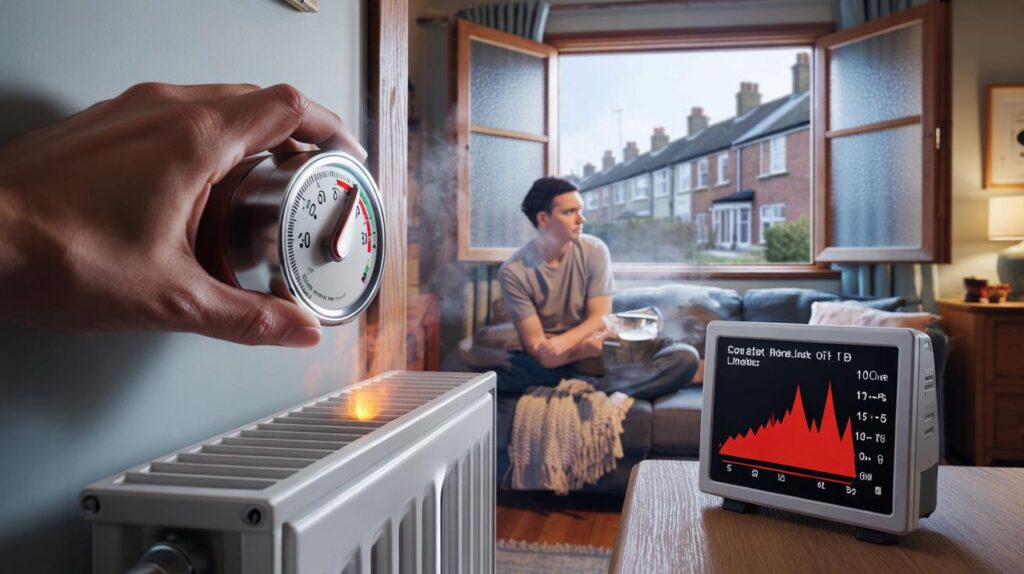
Heating engineers say the most expensive habit this winter isn’t a broken boiler — it’s a tiny twist on your thermostat that quietly burns money all evening.
The morning light in Sheffield doesn’t so much arrive as admit defeat. You pad into the kitchen in thick socks, kettle on, and the radiators are still sulking. A breath hangs in the air. Without thinking, you jab the thermostat and spin it right up to 25°C, the domestic equivalent of shouting at the weather. The boiler thunders awake, you grab your mug, and tell yourself you’ll nudge it back down later. You won’t. Somewhere, a smart meter starts whispering bad news. The trap is invisible.
The £100 mistake hiding in plain sight
Across the UK, millions of us treat the thermostat like a throttle: crank it up to heat the house faster, then forget. It doesn’t work like that. A thermostat is an on/off target — set higher and your system just runs longer, pushing past comfort and into waste. Later, you’re in a T‑shirt on the sofa with the window cracked open. This winter, every degree really does cost.
Here’s the quiet bill-buster: that “quick blast” to 24–26°C. In Leeds, Tom told me he did it after a late shift, just to “take the edge off.” He fell asleep on the couch; at 2am the spare room was tropical. His smart meter showed a sharp spike and roughly 18% more gas used that day. Energy Saving Trust has said turning down just 1°C can shave up to around 10% off heating bills. One night like Tom’s cancels weeks of good intentions.
Why the waste? The heat-up pace is set by your boiler and radiators, not the number on the dial. A higher setpoint doesn’t add horsepower; it’s a longer runway. The system keeps firing until the target is reached, then often overshoots. If your boiler runs hot flow temperatures, that marathon run can also reduce condensing efficiency. The result is the double hit: overheated rooms and a boiler burning harder than it needs to for far longer than you planned.
What to do instead — small tweaks, big savings
Pick a steady setpoint — for most homes, 19–20°C hits comfort without carnage. Use a schedule so warmth arrives when you need it: a gentle preheat before you wake or return, then back down when you’re out or asleep. If you’re freezing on arrival, use a 30–60 minute “boost” and let the thermostat settle. Set it and let it.
Target rooms, not the postcode. Turn down hallway TRVs so the hallway doesn’t boss the boiler. Keep bedrooms cooler than living spaces. Close doors, block draughts, and lower the boiler flow temperature to around 55–60°C if you’ve got a modern condensing boiler, so it sips rather than gulps. We’ve all had that moment when you come home, see your breath, and want instant summer. Don’t crank it — you’ll pay for the comfort twice.
Let’s be honest: no one really does that every day. Habits wobble, days get messy, and the thermostat becomes a mood ring. Build easy defaults that forgive human nature. A simple, repeatable routine beats heroic micromanagement.
“A thermostat isn’t a speed dial,” says Chris Hall, a Gas Safe engineer with 20 winters under his belt. “It’s a promise. Choose the temperature you want to live at, then let the system deliver it. One degree down can feel small. On your bill, it’s huge.”
- One degree down = big savings. Try 19–20°C for living spaces; 16–18°C for bedrooms if that suits you.
- Use timed schedules: preheat 30–45 minutes before wake-up/evening; reduce overnight and when you’re out.
- Trim boiler flow temp to 55–60°C on condensing boilers for better efficiency; radiators will feel cooler but work smarter.
- Bleed and balance radiators; a balanced system warms rooms evenly without overfiring.
- Aim TRVs lower in hallways and unused rooms; keep doors shut to hold heat where you are.
A winter of small wins
This isn’t about living in a jumper cave. It’s about putting the thermostat back in its lane. The old habit — twist it up, forget, pay later — is a hand-me-down from colder houses and cheaper gas. A steadier setpoint, a modest boost, and better room control give you a calmer home and a calmer bill. Share the trick with your neighbour. Ask your landlord about TRVs. Talk to your family about comfort temperatures that work for everyone, not just the coldest hands or the loudest voice.
There’s a bigger kindness in it, too. Lower peaks mean fewer panicked boiler runs and fewer nights where someone is peeling off layers at 10pm with the window open. If you can, nudge the boiler flow temperature down and let radiators settle into a warm, long exhale rather than a panting sprint. The house feels gentler like that. The dog sleeps better. You stop chasing heat and start shaping it.
In a year where every line on the statement matters, this is one of the few wins that arrives by Tuesday. Try it for a week. Watch the graph on your smart meter smooth out. Notice how the evening feels less on-off, less feast-famine. You might still nudge that dial on a bleak night — humans do — but it won’t be your reflex anymore. That’s when winter starts to feel negotiable again.
| Key points | Details | Interest for reader |
|---|---|---|
| The costly thermostat mistake | Cranking to 24–26°C to “heat faster” only makes the boiler run longer and overshoot | Simple behaviour shift that can cut wasted energy and stress |
| Better daily control | Hold 19–20°C, use timed schedules and TRVs, close doors, tackle draughts | Comfortable rooms without paying for unused spaces |
| Optimise your boiler | Lower flow temp to 55–60°C on condensing boilers for higher efficiency | Potential 5–10% savings with a two-minute tweak |
FAQ :
- Does turning the thermostat up heat the house faster?No. It only raises the target temperature. Your system warms at the same rate, then runs longer, often wasting energy.
- What temperature should I set?Most homes feel fine at 19–20°C. Keep bedrooms cooler if you like. Older people or those with health conditions may prefer 21°C.
- Is it cheaper to leave the heating on low all day?Usually no. Heat leaks out constantly. Scheduled heating that matches your routine is typically cheaper and just as cosy.
- Do smart thermostats fix this?They help with schedules, geofencing and gradual preheat. The rule still stands: pick a sensible setpoint and avoid big cranks.
- How much can I save by dropping 1°C?Guidance suggests up to around 10% off heating use, depending on your home. For many households, that’s tens of pounds over a cold month.



Thanks—clear, practical. I’ve been doing the ‘quick blast’ to 24–25°C and wondered why bills jump. I’ll set 19–20°C, lower flow temp to ~58°C, and use schedules. Definately trying the TRV tweak and door-closed habit this week.