
Your sofa smells a bit lived-in. The spray under the sink promises “Alpine Breeze”, yet it hangs like perfume in a lift and doesn’t fix the funk. There’s a simpler route hiding in the fruit bowl. Lemon juice won’t turn your lounge into a lab, and it can lift odours without a trail of chemicals. If you’re ready to freshen fabric and breathe easier, start with a small squeeze of common sense.
The late light falls across the cushions, and you spot the shadow of last night’s curry and your dog’s honest life choices. You hover with a can of something “fresh linen” and industrial. Then your eye lands on a lemon by the chopping board, the same one you grate over pasta. You slice it, and the smell is clean, awake, almost cheeky. You catch your reflection in the TV and remember what your gran did with stains long before trigger sprays and micro-mists. Maybe the answer is less complicated than it looks. Maybe it’s right here.
The quiet power of lemon on fabric
Citric acid is gentle on noses and, used properly, kinder to fabrics than a lot of mystery concoctions. It helps break down light soils and the compounds we recognise as “sofa smell”. That’s body oils, cooking vapours, pet dander, even the faint haze of last weekend’s wine. Lemon’s brightness doesn’t mask those odours; it shifts the balance so the air feels honest again. We’ve all been there with a room that’s “clean” but somehow not. This little fruit tips it back.
Picture a Sunday in a rented flat in Leeds. Jade, who fosters cats, decided to test a lemon-and-water spritz on the arm of her W-code sofa after one furry misadventure. She dabbed, not scrubbed, waited for it to dry with a fan, and the room smelled like… room, not a spray catalogue. The cat still looked guilty, but the cushion didn’t. She kept the bottle by the radiator, and the habit stuck. The lemon didn’t perfume her life. It reset it.
Here’s why it works. Odours often cling to slightly alkaline residues—skin oils, the trace of detergents, even tap water minerals. Lemon juice is mildly acidic, so it neutralises that cling and loosens dirt’s grip on fibres. The aroma you notice is brief, then it’s gone. No thick fog, no sticky film. That said, acidity can nudge dyes and delicate fibres if you go in heavy. Fabric care tags matter: W means water-based cleaning is fine, S prefers solvent, WS is flexible, X means vacuum only. For silk, wool, rayon/viscose, suede, or uncoated leather, step away from the lemon and call a pro.
Step-by-step: a lemon-based refresh that actually works
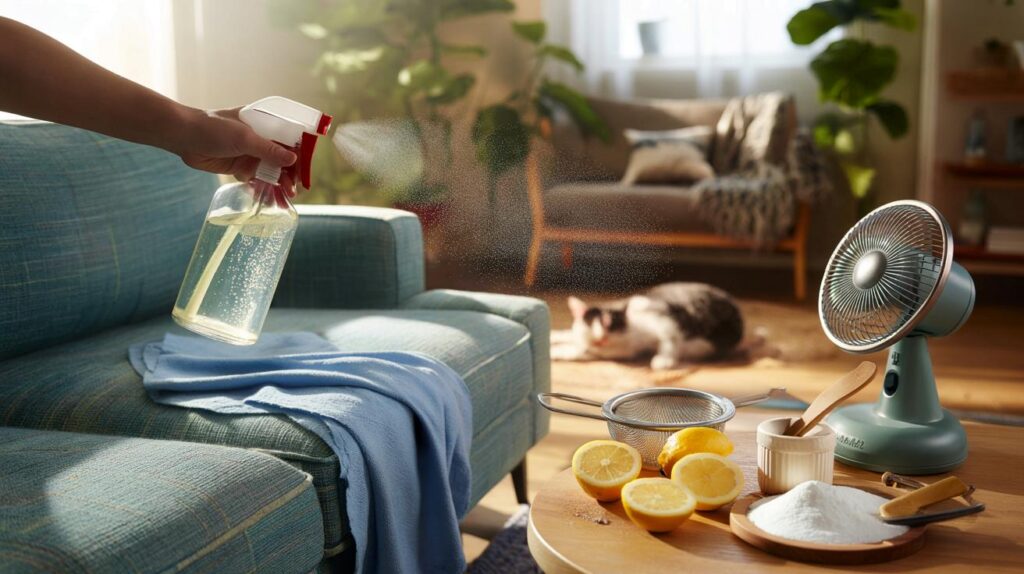
Start dry. Sprinkle bicarbonate of soda lightly over cushions and arms, leave 30–60 minutes, then vacuum with the upholstery tool. Next, mix your spritz: strain fresh lemon juice and combine 1 part juice with 3 parts cool water in a clean spray bottle. For light soiling, add a single drop of mild washing-up liquid. Mist a microfibre cloth, not the sofa, and work in small sections, blotting and lifting rather than rubbing. Follow with a second damp cloth (plain water) to remove any residue. Blot dry with a towel, prop cushions up, and run a fan. This is where a lemon beats the bottle.
Keep it gentle. Over-wetting invites watermark halos and warps cushions. Rubbing can fuzz fibres and push dirt deeper. Patch test the mix inside a zip seam or under the back cushion and let it dry before you commit. Skip direct sun while it dries, as acid plus bright light can nudge colour. If your care label shows S or X, use only dry methods like bicarb and vacuuming, or book a technician. And never, ever pair acids with bleach or ammonia—different jobs, dangerous reaction. Let’s be honest: no one does that every day, which is why a simple ritual you’ll actually keep beats complicated hacks you’ll forget.
Think of lemon as a reset, not a miracle. For greasy marks, pre-blot with a barely soapy cloth before your lemon mix. For lingering pet odours, leave a dish of bicarb with dried lemon peel under the sofa overnight and refresh weekly. **Always patch-test on a hidden seam.** **Never mix lemon or any acid with bleach or ammonia.**
“A light hand wins,” an upholsterer in Bristol told me. “Treat the fabric like skin: clean, rinse, dry. If it squeaks when you rub, you’ve gone too hard.”
- Care codes cheat sheet: W (water OK), WS (water or solvent), S (solvent only), X (vacuum only)
- Bad smells love soft foam: dry fast with a fan to stop them settling back
- Use distilled water if your tap water is hard to avoid mineral rings
- Lemon peel sachets in cushion covers keep things quietly fresh
Living with a fresher sofa—minus the clouds of perfume
The best part of this ritual is how ordinary it feels. You cook, you clean, you sit. Your fabric holds a life that’s busy and imperfect, and the cure is as simple as a squeeze and a cloth. On quiet evenings, the room smells like itself—no pine forests, no “Tropical Burst”—just fabric that’s had a reset and air that’s easy to breathe. You might find you talk more, nap more, read more, because the space isn’t arguing with you anymore. Maybe you’ll keep a small bottle of lemon spritz next to the remote and a bowl of peels under the coffee table. Maybe you’ll tell a friend and swap notes about what works on velvet versus cotton. A sofa that smells clean without smelling of anything at all tends to become the centre of a home. That’s a small domestic win worth sharing.
| Key points | Details | Interest for reader |
|---|---|---|
| Lemon resets odours | Mild acid neutralises alkaline residues and loosens grime without heavy fragrance | Fresher room scent without chemical cloud or sticky build-up |
| Method is low-fuss | Dry clean with bicarb, then spritz cloth with 1:3 lemon-water, blot, rinse, dry fast | Quick routine you’ll actually keep, safe on W/WS fabrics |
| Know the limits | Avoid silk, wool, rayon/viscose, leather, S or X codes; don’t mix with bleach or ammonia | Prevents damage and keeps you safe while cleaning smarter |
FAQ :
- Can lemon juice lighten my upholstery?It can nudge dyes if too strong or dried in bright sun. Keep to a 1:3 dilution, patch-test, and dry in shade with a fan.
- Will my sofa smell of lemon afterwards?Only briefly. The scent flashes off as it dries. What lingers is neutral air, not citrus perfume.
- Is it safe for leather or suede?No. Skip acids on leather, suede, nubuck, or any uncoated hide. Use a leather-specific cleaner or a professional.
- What about pet accidents?Blot first, sprinkle bicarb, vacuum, then use the lemon mix on W/WS fabrics. For deep padding issues, consider an enzyme cleaner formulated for upholstery.
- Can I mix lemon juice with baking soda in the spray?You can, but they neutralise each other and reduce cleaning power. Use bicarb dry first, then your lemon-water mix separately.



Patch-test warning = gold. Saved my velvet ottoman; thx!