
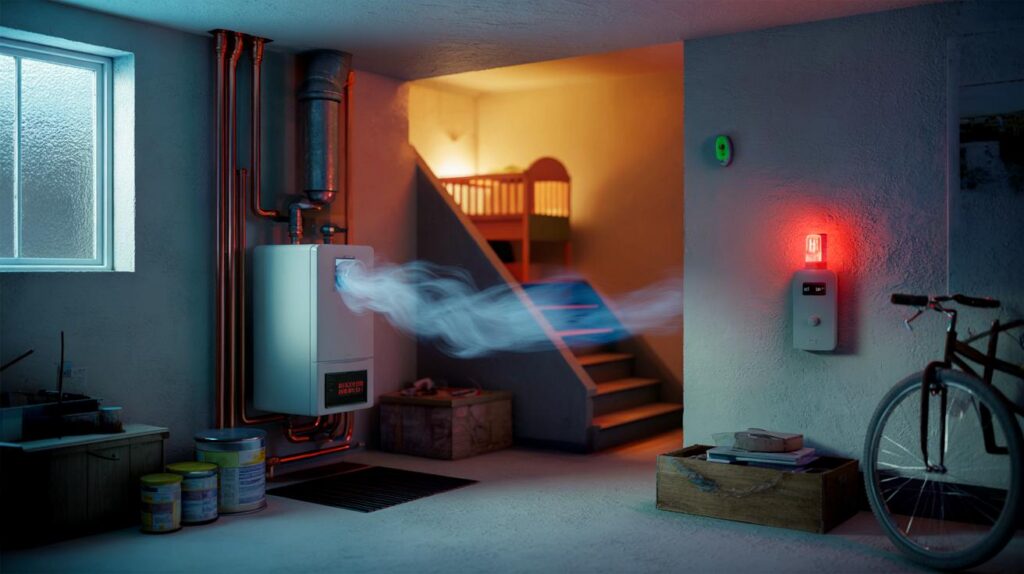
The boiler that keeps your home warm can produce a gas you’ll never see or smell. In a quiet basement or cupboard, that gas can collect, drift, and make a family drowsy before anyone knows what’s happening. A carbon monoxide alarm is small, blunt, and often ignored — until the moment it saves a life.
It’s late, and the house is sleepy, that soft winter hush where radiators tick and the dog has taken your spot on the sofa. You go down to the basement for a jumper, brushing past old paint tins and bikes with flat tyres, and the boiler hums like a tired fridge. *You never smell it coming.* Upstairs the baby monitor glows, the TV murmurs, and a tired brain tallies to-do lists for tomorrow. A tiny chirp cuts the air. You stop, listen, and try to place the sound you’ve never really listened for. Then the silence changes.
The invisible threat below the stairs
We think of basements and utility rooms as storage, not danger, which is why carbon monoxide slips into so many ordinary evenings. **Boilers that burn gas, oil, coal, or wood can all produce carbon monoxide.** The gas forms when fuel doesn’t burn completely — a misadjusted burner, a blocked flue, poor ventilation. It drifts from warm appliance to cooler corners, and it doesn’t stab like smoke; it soothes like sleep. That’s what makes it so treacherous.
One Friday in Leeds, a paramedic told me they’d found a family dozing at 6pm with headaches and a window cracked “for some air.” The boiler was new, the flue partly iced, and the neighbour’s CO alarm was the hero that forced a knock on the door. Gas Safe engineers still find a worrying number of problem appliances each year, and surveys have shown that a surprising share of homes have at least one unsafe gas device. The pattern repeats: mild symptoms, normal evenings, near misses.
Carbon monoxide binds to haemoglobin in your blood around 200 times more readily than oxygen. That means oxygen struggles to reach the brain and heart, so you feel like you’re coming down with a bug — dizziness, nausea, a dull headache that paracetamol ignores. In higher concentrations, minutes matter; in lower ones, the drip-drip exposure can harm over days. **Silence is not safety; CO leaks often make no noise at all.** Without a detector, the body is the alarm, and it tends to ring too late.
Where to put a CO alarm and how to live with it
Place a CO alarm on each level with a combustion appliance and near bedrooms so it can wake you. Keep it 1–3 metres from your boiler, at breathing height if the room is used daily, and never tuck it behind curtains, on top of the boiler, or right next to vents. Look for the EN 50291 mark, press the test button monthly, and note the expiry date stamped on the back — most units serve for 7 to 10 years. **A £20 alarm can do what your nose never will: it buys you time.**
People often install one alarm by the boiler and forget the landing. That’s not clever at 3am. Others wall-mount it too close to a bathroom, then grumble at steam or dust beeps, which only leads to switching it off. We’ve all had that moment when we moved a “noisy” gadget into a drawer to keep the peace. Let’s be honest: nobody actually does that every day. Put alarms where you’ll hear them, teach kids what the sound means, and keep the manual in the kitchen drawer you actually open.
Here’s what professionals repeat on every job. Read it, then screenshot it.
“CO doesn’t care how new your boiler is. If fuel burns, you need an alarm and a clear way out.” — Station Manager, West Yorkshire Fire & Rescue
- If an alarm sounds: open doors and windows, switch off the appliance if safe, and get everyone outside.
- Call the National Gas Emergency number on 0800 111 999 (or your fuel supplier if off-grid) and follow their guidance.
- Seek medical advice, mentioning carbon monoxide exposure. Don’t go back in until a qualified engineer says it’s safe.
- Book an annual service with a Gas Safe registered engineer and keep flues and vents clear.
The small device that changes how a home feels
Once a CO alarm is on the wall, something subtle happens: the house exhales. You stop second-guessing a headache. You stop sniffing the air at night like you can outwit chemistry. The device becomes part of the soundtrack of home, like the boiler tick and the kettle’s soft rumble, and your focus returns to ordinary life — Sunday roasts, damp gloves on radiators, the dog claiming your cushion. A neighbour will borrow your spare alarm and, days later, text a relieved “Got it up — cheers.” That’s how safety spreads street by street: not through lectures, but through people who nudge, share, and say, “This saved us once.” The hidden danger doesn’t vanish, but now it has to make a noise first.
| Key points | Details | Interest for reader |
|---|---|---|
| CO is invisible and fast-acting | Binds to blood ~200x more readily than oxygen; early symptoms mimic a cold | Explains why you can feel unwell without realising the true cause |
| Placement matters more than price | EN 50291 alarm near bedrooms and 1–3 metres from boilers; avoid dead spots | Clear steps to make a cheap device genuinely life-saving |
| Have a plan for the beep | Ventilate, evacuate, call 0800 111 999, and get a qualified engineer | Simple actions to remember when seconds count |
FAQ :
- Where should I put a CO alarm in a home with a boiler?Near bedrooms so it can wake you, and in the room with the boiler 1–3 metres from the appliance, away from corners, vents, and behind curtains.
- Do I still need an alarm with a modern condensing boiler?Yes. Any fuel-burning appliance can produce CO if something goes wrong with combustion or flues, including modern units.
- How often should I test and replace a CO alarm?Press the test button monthly and replace the unit at the end of its stated life, usually 7–10 years; batteries vary by model.
- What levels make a CO alarm trigger?EN 50291 alarms trigger based on both level and time, from lower levels over longer periods to higher levels quickly.
- Is a CO alarm the same as a smoke alarm?No. CO alarms detect an odourless gas; smoke alarms sense particles from fire. Homes need both, ideally interconnected.



This hit close to home—our neighbor’s CO alarm went off last winter and it literaly saved their toddler. I’d been procrastinating but I’m ordering two alarms today. Didn’t know about the 1–3 metre rule or EN 50291, so thanks for spelling it out.
Genuine question: if I’ve got a brand‑new condensing boiler that was serviced 3 months ago, what are the realistic chances of CO issues? Are false alarms common with steam from showers or dust? My partner worries we’ll disable it after a few beeps—any tips to avoid that?