
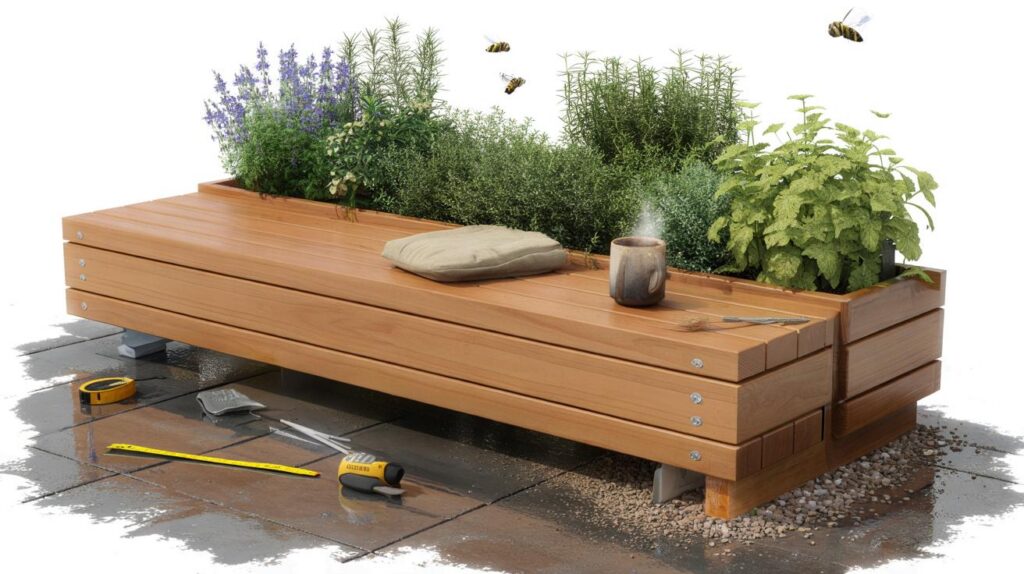
Garden seating eats space, planters need care, and the budget rarely stretches to both. You want a spot to perch with a book and a place to grow thyme, lavender, maybe a tomato vine. Shops sell the dream, yet it never quite fits your corner. So you build the thing that does.
On a grey Saturday, the patio was still beading with last night’s rain. A tape measure snagged on a terracotta pot; the cat prowled the fence top like it owned the lot. I traced a line with my toe where a bench might live, then nudged a planter into the imaginary end to see if the whole picture would click. It did, oddly fast. I could already hear bees thrum and the scrape of a mug on timber. What if the seat could grow?
Why a bench–planter combo just makes sense
Fold a seat and a planter into one shape and your garden starts to behave differently. It offers a place to land and a burst of green at the exact height where you breathe it in. The planter softens the bench edge, screens a footpath, and wraps the sitting moment with scent. We’ve all had that moment when you sit down outside and feel the whole day slow by a notch.
On a narrow terrace in Bristol, I watched a couple build a 1.8 m bench with a 40 cm-square planter on the right. They tucked it against a boundary wall and planted rosemary and trailing lobelia, just brushing the seat. Two evenings later, neighbours leaned over to ask where they bought it. They smiled and said, “We didn’t.” It cost them less than a decent bistro set and took a weekend with tea breaks.
The logic is neat. A seat height around 45 cm keeps knees happy; a seat depth of 40–45 cm supports the back. The planter wants 30–35 cm of soil depth for herbs and annuals, or 45 cm if you fancy a dwarf shrub. Tie the two with a continuous top line so the eye reads it as one calm piece. Build the skeleton from 45 × 95 mm timber (2×4) for strength, then skin with slats that echo your fence. **Integrated planter** means you save space and gain atmosphere in the same meterage.
How to build it: from sketch to final screw
Sketch your footprint first: 1,800 mm bench length, 450 mm seat height, 400 mm seat depth, planter box 400 × 400 mm internal. Cut list in quick strokes: two bench frames from 45 × 95 mm timber, rails every 300 mm, a boxed frame for the planter with a false base set 100 mm above the patio for drainage. Use exterior-grade screws, galvanised brackets at stress points, and a spirit level so the tea doesn’t slide.
Common snags come from small things. People forget drainage holes and a gravel layer, then wonder why basil sulks in July. Others skip a breathable liner, and wet soil sits against timber all winter. Let’s be honest: nobody oils their garden bench every month. Choose pressure-treated timber, leave 3–4 mm expansion gaps between slats, and pre-drill to stop splits near ends. Level on slabs or pavers, not bare soil, so you don’t end up with a wobbly throne in March.
Drill 6–8 holes in the planter base, staple a pond-friendly liner with slack at the corners, and add a 30 mm layer of pea gravel before compost.
“Build the frame as if you’re not the one who’ll sit there,” a joiner told me. “Future you will thank past you for every hidden bracket.”
- Timber: 45 × 95 mm framing, 19–22 mm slats, pressure-treated
- Fixings: exterior screws, galvanised brackets, exterior wood glue
- Tools: saw, drill-driver, countersink, square, clamps, sander, spirit level
- Liner: pond liner or heavy-duty membrane, staples, scissors
- Finish: exterior oil or microporous stain; stainless steel caps optional
- Drainage: pea gravel, drill bits 8–10 mm
Make it yours and let it grow
Planting changes the bench from furniture to company. Herbs close to the seat are small miracles: thyme and rosemary by the knees, mint isolated in a pot sunk into the soil, trailing lobelia or bacopa to spill over the edge. If your spot is shady, swap for ferns, heuchera, or fragrant woodland strawberries. *You can smell the thyme every time you sit.*
Finishes steer the mood. A pale, oiled larch looks Scandinavian and light; stained softwood blends with fences and disappears behind cushions. Two thin coats beat one gloopy one. **Low-maintenance finishes** are your friend on busy weeks, and a removable seat slat panel makes future upkeep less of a faff. Add felt pads or rubber feet if the bench sits on a balcony to spread weight and keep peace with downstairs.
Think about seasons. In summer, the planter hums with bees and low sun catches the slats like a ribbed shadow. As nights draw in, swap annuals for winter pansies, cyclamen, or a dwarf conifer dressed with a tiny light string. **Drainage matters** in winter; lift the pot-in-pot trick or tilt the base a hair so water doesn’t sulk in corners. It’s a bench that keeps you outside ten minutes longer than you planned.
| Key points | Details | Interest for reader |
|---|---|---|
| Right-size the frame | Seat 450 mm high, 400–450 mm deep; planter 300–450 mm soil depth | Comfortable seating and healthy roots without guesswork |
| Build for weather | Pressure-treated timber, breathable liner, pea gravel drainage, microporous finish | Longer life, fewer repairs, plants that thrive after rain |
| Design for care | Removable slats, expansion gaps, accessible screws, level base | Easier maintenance and a bench that stays sturdy |
FAQ :
- What wood should I use?Pressure-treated softwood is affordable and sturdy; larch or cedar costs more but weathers beautifully. If you go untreated, finish it well and refresh yearly.
- Do I need to line the planter?Yes, a breathable liner separates wet compost from timber. Add drainage holes and a gravel layer so roots don’t sit in a swamp.
- Will it be too heavy for my decking or balcony?Keep the planter modest, use lightweight compost, and spread load with rubber feet or bearers. Check balcony limits; soil gets heavy after rain.
- How do I protect it in winter?Refresh finish in autumn, raise the bench on pads, and pick hardy plants or move tender ones to pots indoors. Brush off leaves that trap moisture.
- What plants work best?Sunny spots: thyme, rosemary, trailing lobelia, dwarf lavender. Shade: ferns, heuchera, ivy, alpine strawberries. Mix textures and something scented near the seat.



Brilliant idea! The integrated planter next to the seat makes so much sense—herbs at nose height is chef’s kiss. Your cut list and the reminder about a breathable liner are gold. Feeling insipred to spend my next grey Saturday with a drill.
Question on ergonimics: is a 45 cm seat height comfy for shorter folks? I’m 5’2″ and sometimes my knees dangle. Would dropping to 42 cm mess with the planter alignment? Any recs?