
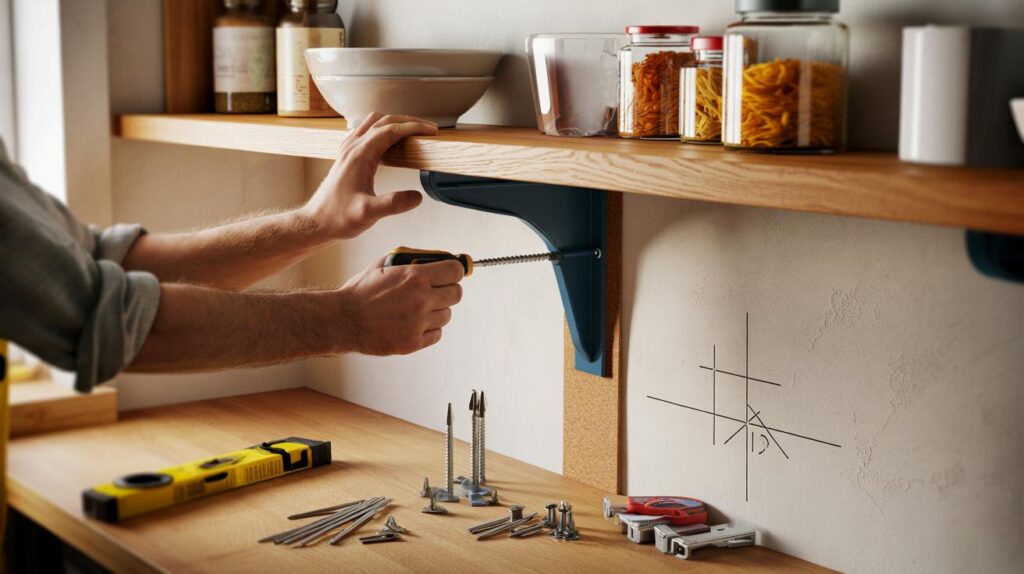
When a shelf shudders, it’s never just the shelf. It’s the clink of jars, the edge of a frame catching light, the tiny fear that today might be the day it gives. A DIY expert walked me through why that wobble happens and how to end it — so your storage holds steady and your space feels calm again.
Last Tuesday, in a kitchen washed with mid-morning glare, I watched a shelf tremble as someone nudged a pasta jar back into place. The wall was old plaster, the brackets narrow and tired, the fixings the wrong kind for the job. A DIY expert named Meg, sleeves rolled to the elbow, ran a finger along the bracket and cocked her head, the way a mechanic listens to an engine that’s about to speak. She didn’t start with tools. She started with questions.
What’s on this shelf most days? Where’s the nearest stud? Single-skin plasterboard, or brick lurking behind? She tapped, pressed, and measured. Then she smiled, that small grin people wear when they’ve spotted the simple thing everyone else had missed. The wobble wasn’t a mystery. It was a message.
Why the “wobble” happens long before things fall
Most shaky shelves aren’t about clumsy hands. They begin with the unseen: fixings too small, the wrong plugs for a crumbly wall, brackets spaced like an afterthought. The board sags as humidity cycles through the seasons, tiny shifts that add up. You don’t notice the first millimetre. You notice the squeak of a cup when the slope finally reveals itself.
Meg talks about “the triangle that saves you” — the physics in plain sight. Brackets make a triangle with the wall and the shelf; a shallow triangle flexes, a deeper one fights back. She showed me a renter’s hallway in Manchester where a single floating shelf bowed like a cat’s back just six months in. It was the silence after the wobble that felt loud.
There’s also the lever you create when you store heavy things up front. Weight at the lip multiplies the force at the fixings. That’s why flimsy plastic plugs tear out of plasterboard like paper: the wall fails before the board does. Solid walls behave differently from stud walls; brick will hold a sleeve anchor comfortably, while plasterboard needs toggles or a proud hit into a timber stud. Your wall is not an abstract concept. It’s the whole story.
The fix that makes shelves feel planted, not precarious
Start with diagnosis. Tap the wall and map what’s behind: a magnet or a stud finder for the timber, or a pilot hole in an inconspicuous spot if you’re confident. If you hit a stud, great — use two 50–60 mm wood screws per bracket. If not, choose proper plasterboard anchors: metal self-drillers for light loads, toggle or cavity anchors for heavier. Space brackets no more than 600 mm apart, and tighten until firm, not crushed. Consider a slim timber batten along the wall edge to create that deeper triangle and to share the load across more fixings.
Don’t rush the rehang. Level the shelf dry, mark exact holes, then take it down to drill. Keep dust out of anchors so they bite. If the shelf itself has a bow, flip it so the curve stands up; weight will settle it flatter over time. Redistribute the heavies closer to the wall, and move fragile items to the ends where the brackets are strongest. On painted walls, a thin cork pad under the back edge can kill micro-movements that start the wobble. Let the shelf sit under load for a minute, then retighten softly.
Many “fails” are small habits stacking up. People grab whatever plug comes in the kit and put it into anything, as if walls were all the same. They drill holes too big and then wonder why anchors spin. They set brackets too low under the shelf, which shortens the triangle and invites flex. Let’s be honest: nobody does that every day. But a quiet check takes minutes and saves the long sigh nobody wants to hear at 10 p.m.
“Shelves don’t fail without sending signals,” Meg told me. “A tiny sway, a faint squeak, the bracket that loosens every fortnight — that’s the whisper. Fix the whisper and you never meet the shout.”
- Quick safety upgrades: add a hidden wall batten, move brackets closer to heavy zones, switch to cavity toggles on plasterboard, and shorten the overhang beyond the last bracket.
- Use 18–25 mm thick boards for books or cookware; thin boards sag faster than your patience.
- Where kids can reach, fit discreet anti-tip straps or a secondary pin through the bracket hole.
- Your wall matters more than your wood. Pick fixings for the substrate first, the shelf second.
- Keep one driver bit in perfect condition; worn bits strip heads and tempt under-tightening.
Safer storage that doesn’t look like a workshop
There’s a version of this where everything turns ugly. It doesn’t have to. Rebate a small lip under the front edge to stiffen a thin shelf without changing the face. Paint the batten to match the wall so it disappears. Swap dainty brackets for ones with a graceful return, or colour them to echo your cooker knobs or the plant pot you love. Small touches keep the romance while adding the maths. A shelf that feels planted changes how you use a room; you stop babying it and start trusting it again.
We’ve all had that moment when a glass rattles and your shoulders tighten. That’s the body telling you what the eye pretends not to see. The shelf is asking for a better anchor, a cleaner joint, a wider stance. Nudge the storage hierarchy too — heavy things back, light things front, breakable favourites near the bracket. It’s not a rule so much as a rhythm. Once you feel it, the wobble reads like a weather forecast, not a drama.
One more thought from Meg sticks: rigidity is a partnership. The wall lends its bones, the bracket supplies geometry, and the shelf spreads the stress. Change any one, and the others adapt. That’s why a simple batten can be a revelation; two screws into a stud can change your week; a 10 mm shift in bracket height can transform the triangle. Studs beat guesswork. Share this with the friend who swears by sticky pads and hope. Or keep it and quietly fix the thing that’s been nagging at you every time you make tea.
| Key points | Details | Interest for reader |
|---|---|---|
| Match fixings to the wall | Studs take wood screws; plasterboard needs toggles; brick likes sleeves | Fewer failures, stronger shelves without overspending |
| Build a better triangle | Use deeper brackets or add a painted wall batten to stiffen the span | Cleaner look, less wobble, more weight capacity |
| Load smarter | Heavy items close to the wall and near brackets; keep fronts light | Safety boost with zero new tools |
FAQ :
- How do I know if I’ve hit a stud?You’ll feel consistent resistance on the drill, see fine wood shavings, and a screw will bite firmly. A magnet can find the stud’s nails at skirting or plasterboard seams.
- What anchors work best for plasterboard?For light loads, metal self-drilling anchors are quick. For books or kitchenware, use toggle or cavity anchors that expand behind the board.
- How much weight can a floating shelf hold?It depends on the bracket system, wall, and span. On stud walls, into timber, 20–30 kg across 60–80 cm is common; on plain plasterboard, cut that significantly unless you use toggles and a batten.
- My holes are stripped. Can I save them?Yes. For brick, use a larger plug and re-drill cleanly. For plasterboard, shift the bracket 30–40 mm, or fit a batten to move fixings into fresh material.
- When should I call a professional?If you’re dealing with very old plaster, tiled walls you can’t damage, electrics likely behind, or shelves over cots and beds. A pro brings detectors and liability along with skill.



Loved the ‘triangle that saves you’ idea—never thought bracket depth mattered that much. I’ve been spacing mine way too far apart, defintely explains the squeak I hear at night. Going to try a painted batten this weekend. Thanks for the clear, calm advice.