
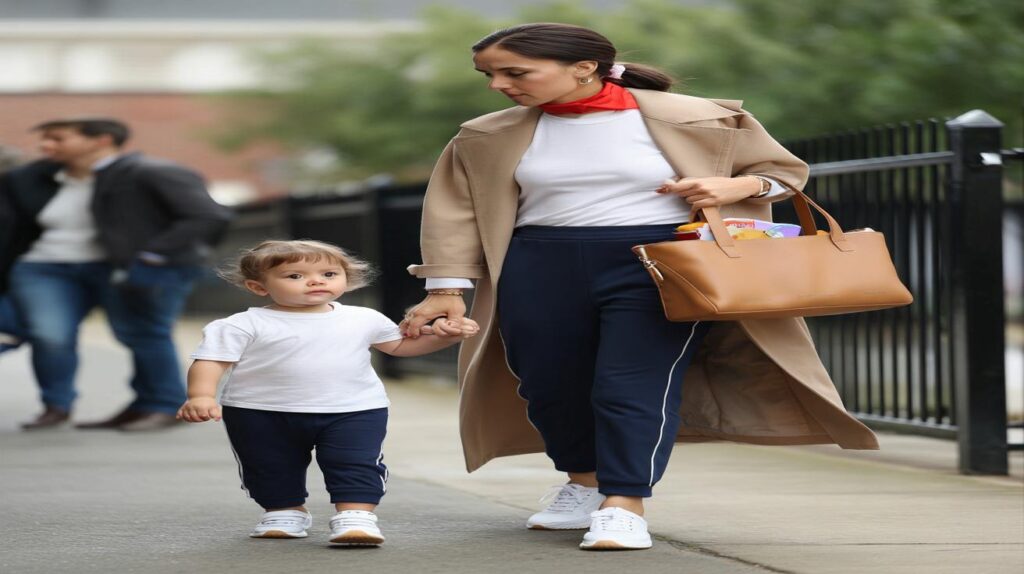
You shouldn’t have to choose between getting the kids out the door and feeling like yourself. Style that survives the school run, the commute and the midday spill is possible — without defaulting to the “mum look”.
The pram wheel clips the curb, a juice pouch erupts, and somewhere between a lost sock and a Teams ping, your white tee waves the white flag. At the gates, you scan the sea of leggings and bobble-flecked jumpers, clocks ticking louder than the bell. On the train, a blazer brigade glides past, and you feel stranded between two wardrobes that don’t speak to each other.
Then, a small miracle: the right trousers, a crisp knit, a jacket that makes you stand taller. The lunchbox leak meets a wipe-clean bag; you dab and keep moving. A colleague says you look “very together”, and you almost laugh — you’re anything but. What if the fix is simpler than you think?
Reframing the “mum look” into a life-proof uniform
The “mum look” isn’t motherhood. It’s what happens when decision fatigue meets clothes that don’t fit your day. Tired basics, stretched waistbands and shoes that apologise for your to-do list.
It’s also a story the high street keeps selling: comfort without shape, neutral without nuance, function without flair. Swap that script. Think streamlined joggers in ponte, a longline trench, a breathable knit and trainers that mean business. Suddenly the school run, lift ride and 4 p.m. stand-up feel like the same life, not costume changes.
On a Tuesday, Claire, 36, a project manager with two under seven, tried a five-piece rotation for a week. Tailored joggers, merino tee, trench, leather trainers, structured tote. By Friday she’d repeated outfits and no one noticed — except the headteacher who asked where her coat was from. In a quick poll of her team, half admitted they spend longer finding a charger than choosing clothes. The point lands: less choice, better choices.
Strip the logic back and three rules emerge. Set a palette you love so pieces talk — navy, camel, white, black, with one energy colour. Upgrade fabrics to ones that hold shape and wipe well: ponte, merino, technical cotton, coated denim. Anchor every outfit with a “third piece” that does the heavy lifting: trench, blazer, cardigan-vest or a utility jacket.
Those anchors explain why your old leggings-and-hoodie felt invisible; the silhouette had no structure. Add a jacket with a clean shoulder, a knit with weight, or a waist seam, and your base looks intentional. Hemlines matter: cropped trousers above the ankle bone with a chunky trainer; midi skirts that clear the mid-calf with a block heel or sleek loafer. Your life hasn’t changed. Your lines have.
Clothes that work hard reduce mental load. Machine-washable knits mean fewer “Can I wear this?” moments. A water-resistant tote keeps your laptop safe next to snacks. Style isn’t the opposite of practicality; it’s how practicality looks when it’s considered. You get back minutes, which add up to a calmer face in the school mirror and the lift’s reflection.
Small systems that change everything
Start with a Sunday ten. Ten minutes, hanger in hand, pull five outfits that work across your week. Lay them left to right on the rail in order of likely chaos: Monday big meeting, Tuesday nursery drop, Wednesday WFH. Slip socks into shoes, tuck tights into skirts, loop a scarf through the trench. Future you will thank you at 7:41 a.m.
Build a three-part formula: Base, Third Piece, Anchor. Base is your tee and trousers or a dress. Third Piece is structure — blazer, trench, cardigan-vest. Anchor is shoes-and-bag doing the practical work: leather trainers and a structured tote, or loafers and a crossbody. Rotate fabrics with the forecast. Choose one “elevate” detail per day — a gold hoop, a silk scrunchie, a sharp parting — and keep everything else quiet.
Common traps come disguised as kindness. Buying another pair of black leggings because the last ones “did fine”. Stacking beige knits that don’t match tones, so they don’t layer. Falling for dry-clean-only trousers when the toddler favours ketchup. Let’s be honest: nobody does that every single day.
If trends tug, ask one question: will this play nicely with three things I already own? If yes, welcome to the rotation. If not, leave it for someone else’s Pinterest board. We’ve all had that moment when a mirror returns a person who looks tired of compromise; that’s your cue to swap compromise for clarity.
When I spoke to Leanne, a headteacher and mum of two, she put it neatly.
“I stopped dressing for who I thought a good mum looks like, or what a competent head looks like. I dress for how I need to move, with one thing that makes me smile.”
- Swap leggings for ponte kick-flares: same comfort, sharper line.
- Trade ballet flats for leather trainers: rain-friendly, posture-friendly.
- Use a structured tote with a zip pouch: spills contained, laptop calm.
- Choose a ribbed cardigan-vest over a hoodie: drape, not bulk.
- Keep a stain stick in your bag and a spare tee in your desk.
Putting style on autopilot without losing you
Think of your wardrobe like a tiny team that knows its jobs. The navy blazer leads meetings and school concerts. The striped tee handles coffee runs and car seats. The coated jean does swings and smart-casual. You’re not asking clothes to be miracles. You’re asking them to show up the way you do.
Two edits supercharge everything. First, tailor waist and hem once — trousers that skim, sleeves that don’t drown you. Second, pick one signature so people see you, not just your outfit. Maybe it’s a bright-red lip on Fridays, maybe it’s a tortoiseshell clip or a slim silver watch. **Micro-signatures** make repetition feel like intention, not a laundry backlog.
There’s a secret to feeling “finished” in five. It lives in texture and contrast. A soft tee under a sharp lapel. A matte trainer against a glossy tote. A wool coat over a silky midi. **The human eye reads contrast as care**, even when your morning was chaos. Soyons honnêtes : personne ne fait vraiment ça tous les jours. Some days, clean hair and decent socks win. On others, you’ll catch a lift reflection and grin because you look like you on purpose. **That’s the point.**
| Key points | Details | Interest for reader |
|---|---|---|
| Build a three-part uniform | Base + Third Piece + Anchor; pre-plan five outfits in a Sunday ten | Cuts decision fatigue and keeps you sharp from school gate to Zoom |
| Prioritise fit and fabric | Ponte, merino, technical cotton; tailor hems and waists once | Comfort without sag, machine-washable pieces that still look smart |
| Use colour and contrast | Tight palette with one energy colour; texture shifts for polish | Outfits look intentional, repeatable and photogenic with zero effort |
FAQ :
- What’s the fastest way to look polished on the school run?Throw on your Third Piece and Anchor. A trench over a tee and ponte trousers with leather trainers reads “put together” in under a minute.
- Which shoes survive rain, playgrounds and meetings?Leather trainers with a clean profile, or lug-sole loafers. Both grip in drizzle, wipe clean and still look smart with a blazer.
- Can I wear denim to work without feeling sloppy?Yes: dark, straight or barrel-leg coated denim with a blazer. Add a belt and simple jewellery to sharpen the line.
- How do I deal with stains and spills mid-commute?Carry a mini stain stick and a microfibre cloth; keep a spare tee in your tote. Choose fabrics with a bit of coating or tight weave.
- What affordable swaps make the biggest difference?Upgrade leggings to ponte flares, cotton hoodies to ribbed cardis, canvas totes to structured zip bags. One better base and everything else lifts.



Loved this—finally a take that doesn’t shame comfort. The ‘Sunday ten’ is genius; I tried laying out outfits and my morning brain actually chilled out. One note: any budget-friendly brands for merino or technical cotton that can handle toddler ketchup and office aircon? Also, thank you for reframing the ‘mum look’ into structure not sacrifice. Tiny micro-signatures idea is chef’s kiss. Consider me converted.
Not convinced. Streamlined joggers still read like loungewear at my firm; partners would raise an eyebrow. Any evidence this flies outside creative teams?