
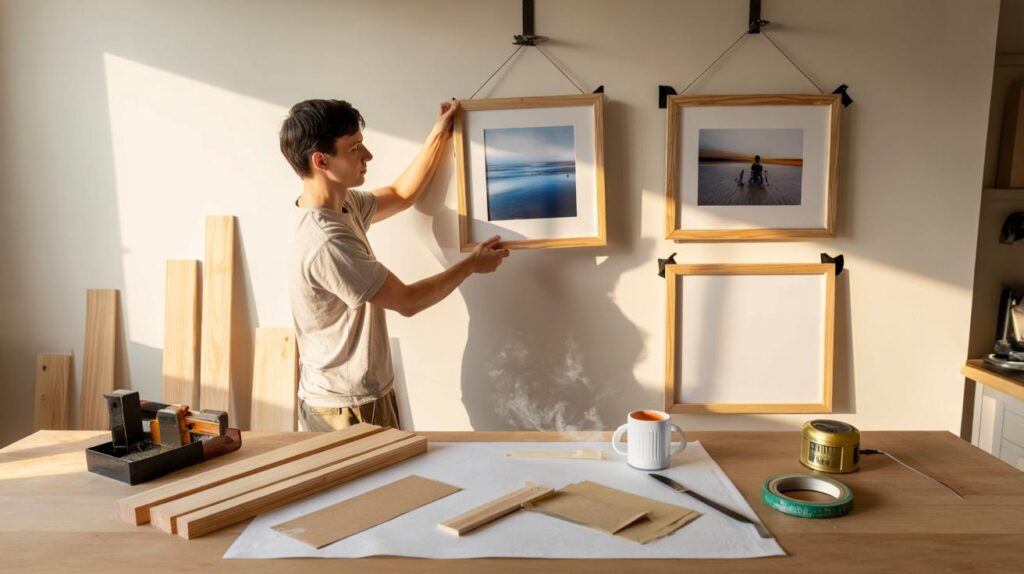
Blank walls can feel like a shrug. A rented room, a tight budget, a life in motion — and suddenly the place you sleep in looks like it belongs to someone else. A young man decided to fix that with timber offcuts, a hand saw, and a stubborn belief that frames could turn four white rectangles into a story.
The first Saturday I met him, sunlight ran across a kitchen table that had seen too many mugs and not enough sanding. He was 27, sleeves rolled, the radio low, measuring out lengths of pine that cost less than a takeaway. There was a smell of coffee and sawdust, and he kept talking about edges: clean edges, soft edges, the way a room changes once you give it borders. He’d been collecting photos and prints for years, kept in shoeboxes, waiting for “a someday” that never came. Then he made a mistake on purpose.
He built one frame, and the room breathed
The first frame wasn’t perfect. The mitres met like new friends — slightly unsure, a little gap-toothed, yet suddenly loyal. He set it upright against the wall, slid in a postcard of waves he took on a cold day in Whitby, and it was as if the room had found its voice. The light caught the bevel, the grain flashed, and he grinned like he’d pulled off a quiet magic. The living room didn’t change size, but it felt bigger, like a window had opened somewhere you couldn’t see.
He keeps receipts because the numbers tell the story. Pine strip: £7.98 for two metres. Mitre box and pull saw: £14 on sale. PVA glue, sandpaper, and a tin of wax: another £9. A frame for under a tenner once you break it all down, and no one can tell when it’s on the wall. He made three more by evening and leaned them like dominos along the skirting. It smelled like a small forest after rain. When he finally hung the first one, the blank wall flinched and then softened.
There’s a reason frames shift a room. They draw a boundary around a moment and invite your eye to rest, then wander again with purpose. Paint alone can feel flat; timber throws a tiny shadow, and that shadow gives depth, a heartbeat. **He didn’t buy art — he turned the frame itself into a piece of it.** The wall became a rhythm instead of a void, a line of small stories instead of a single, pale slab of silence.
The simple method that works in a small flat
He buys pine strip, 44mm by 12mm, the kind you find in a quiet aisle in B&Q. He marks four lengths with a 45-degree angle at each end, using a mitre box that clamps to the table, then cuts with a pull saw so the blade does the work and the fibres don’t tear. Two long pieces, two short, measured around the print with 2mm of play. He glues the corners, tapes them tight like a parcel, and leaves them to cure while he makes tea. Sand, stain, wax; he presses a piece of acrylic behind the print, backs it with card, and tapes it closed. Command strips take it to the wall without tears from a landlord.
Some lessons arrived with splinters. Measure the print, not your memory of it. Cut slow, because speed makes dust and regret. Don’t flood the timber with stain; rub it like you’re saying hello. He used coffee once, then knocked back the yellow with a thin wipe of watered-down black, which gave the grain an old-book warmth. We’ve all had that moment when you hang something, step back, and realise it needs to move two centimetres to the left. Let’s be honest: nobody really does that every day.
He keeps the set-up small: one saw, one box, one square, one brush, and a rag that never truly looks clean. **The key is not a workshop — it’s a repeatable habit that fits between dinner and the washing up.**
“I thought I wanted perfect frames,” he told me, “but what I wanted was frames that let the room be mine.”
- Use 120-grit, then 240-grit sandpaper for edges that feel kind to your fingers.
- Pre-drill if you add brads; timber splits when you rush.
- Acrylic is lighter than glass, kinder to rental walls, and safer near knees and elbows.
- Masking-tape corners while glue cures; it’s a cheap clamp that works.
- Lay prints on a clean microfibre cloth, not a newspaper that bleeds ink.
When frames become a map of a life
By the end of a month, his hallway looked like a quiet gallery curated by someone who knows your name. A ticket stub from a gig in Sheffield. A black-and-white of his grandfather’s hands. A crayon drawing his niece made of a cat that could also be the sun. None of it rare, all of it rare. He left space between frames like pages in a book, so the wall could breathe and the stories wouldn’t shout at each other. Friends come over and point without thinking, and there’s always a story behind the pointing. The house grew warmer without turning up the thermostat, and it didn’t cost him more than a couple of pints each week to keep going.
| Key points | Details | Interest for reader |
|---|---|---|
| Affordable method | Pine strip, mitre box, pull saw, glue, sandpaper, wax; frames under £10 each | Turns a tight budget into visible change on the wall |
| Rental-friendly hanging | Acrylic glazing and Command strips; lightweight, no drilling | Protects deposits and keeps options open |
| Design rhythm | Consistent timber width, varied print sizes, spacing like a poem | Makes walls feel intentional, not cluttered |
FAQ :
- What timber should I choose for a first frame?Pine or poplar is cheap, soft, and forgiving. Hardwoods look lovely, but they punish mistakes.
- How do I get clean 45-degree corners at home?Use a mitre box and a sharp pull saw, cut slowly on the waste side of the line, then sand the faces flat before gluing.
- Glass or acrylic — which is better?Acrylic is lighter, safer, and easier to cut; glass resists scratches and looks classic. For rentals, acrylic wins on weight.
- What’s the real cost per frame?After buying basic tools once, materials often land under £10 per frame, sometimes less if you use offcuts.
- How do I plan a gallery wall without making a mess?Lay frames on the floor, photograph a layout you like, then use painter’s tape on the wall to mark the outline before hanging.



Under £10 per frame? That’s wild. Great work.