
Five moves in three years will do strange things to your sense of home. It taught me that walls don’t just hold stuff; they hold habits, moods and tiny negotiations with yourself. Here’s what the churn revealed about living spaces — and the moves I’m done making.
The last time I carried a plant up four flights, the pot cracked and so did my patience. Cardboard grazed my shins. The keys felt too clean, like they belonged to someone more organised, someone with matching glasses and a label maker. I put the kettle on the floor, sat on a cold tile, and watched the light slide across an empty room that was already judging me.
By midnight, the mattress was on the floor and the Wi‑Fi wasn’t. The neighbour’s door clicked like a metronome. It smelled faintly of old toast, which is a weird kind of comfort. I stared at the ceiling and realised the room was deciding who I’d be here. Then the fuse blew.
What constant moving taught me about space
I learned that rooms train you. If the first thing you see is a sofa, you’ll sit; if it’s a table, you’ll write, or at least pretend to. A window that faces a tree makes an early riser of you. Two steps to the fridge makes a snacker of everyone. Space is not neutral — it’s a quiet coach, nudging you until you forget you’re being nudged.
One flat sat above a bar that came alive on Tuesdays for reasons I still don’t understand. Another had sunshine for two glorious hours, then gloom you could butter. A third grew mould behind the wardrobe like a secret. A Shelter survey last year found roughly a quarter of renters reported damp or mould, and I can tell you it doesn’t just stain walls; it stains routines. You start drying socks on chairs, you stop inviting people round, you Google dehumidifiers at 2am like you’re planning a heist.
The real lesson was this: your life bends towards the path of least resistance. Put your running shoes by the door and you’ll run more. Hide your TV remote and you’ll talk more. We fixate on decor, but the friction points matter more — where your bag lands, where the washing lingers, where cables trip your temper. I thought I was chasing freedom, but I was actually chasing ease. When ease fits the person you want to be, your space starts doing the heavy lifting for once.
Practical lessons: what I now do and what I refuse to do
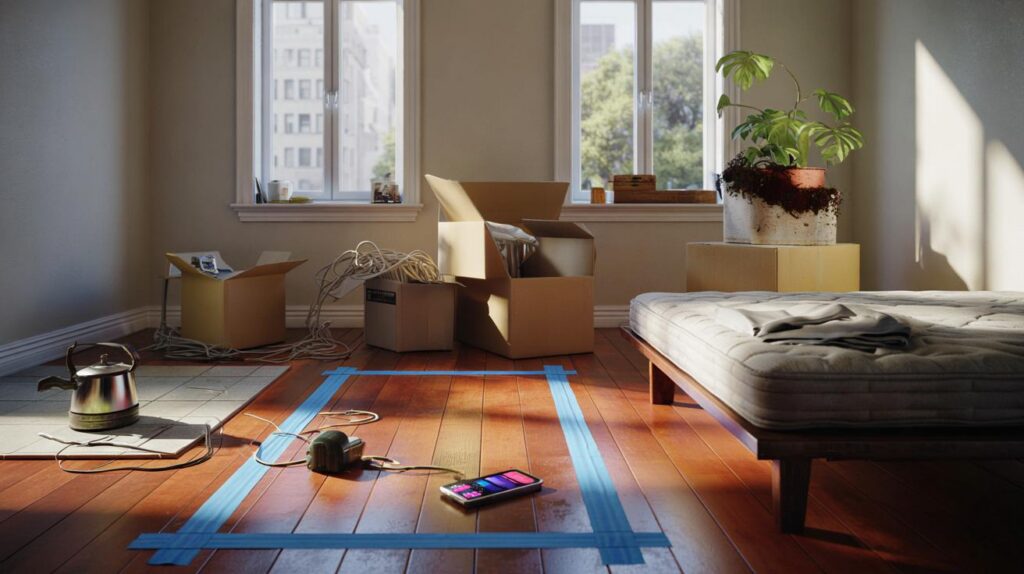
Before I sign, I do a 48‑hour “fit test”. Day one: visit in daylight and at night, stand in silence for five minutes in every room, map power sockets, and check phone signal in your usual work spot. Day two: measure the biggest three items you own and tape their footprint on the floor with painter’s tape. Take a 30‑second video at the window to catch street noise. If I can’t make my life fit on tape, it won’t fit in real life.
My biggest mistake used to be falling for vibes and fighting physics. I’d ignore the fact there was nowhere to put a table because the tiles were pretty. Or I’d assume “I’ll declutter once I’m in.” We’ve all had that moment when a smiling agent distracts you with a scented candle while the storage is screaming. Now I do the maths: metres of hanging space versus number of hangers; surfaces versus stuff that lands on surfaces. Let’s be honest: nobody actually does that every day. Do it once and you’ll save a year of sighing.
I stopped outsourcing judgement to hope and started asking questions out loud. A letting agent in East London told me the only tenants who don’t regret their flats are the ones who come back twice and listen for the building. He meant this:
“A home tells you what kind of life will be easy here. If the life you want sounds impossible in the silence, it probably is.”
- Never again will I take a bedroom on a ground floor facing a bus route.
- Never again will I rent without a spot for a real table, even a tiny one.
- Never again will I pretend lamps can replace daylight.
- Never again will I ignore the neighbours’ weekend soundtrack “just this once”.
- Never again will I store anything in “temporary” boxes for more than a week.
A home is a story you edit slowly
Five moves later, I don’t romanticise blank space. I treat it like a draft. You write the first week with where you drop your keys. You rewrite with where the laundry basket actually makes sense. You cut scenes that never worked — the chair nobody sits in, the shelf that only collects dust and guilt. It’s not a sprint for perfection; it’s a series of trims until the good parts shine by default.
I’ve learned to buy slower and move lighter. To invest in doors that close and curtains that keep mornings kind. To leave a wall empty on purpose. The best sign a home fits isn’t a photo; it’s forgetting where your phone is because you’re busy living. If any of this nudges you to walk through your place tonight like a detective — listening, taping, measuring, asking — then maybe your next move won’t require a van.
| Key points | Details | Interest for reader |
|---|---|---|
| Spaces shape behaviour | Light, layout and friction points quietly coach daily habits | Actionable lens for tweaking routines without willpower |
| Test fit before you sign | 48‑hour visits, tape footprints, noise and signal checks | Reduces regret and costly mistakes |
| Never‑again rules | No ground‑floor bedrooms on busy roads, real table required, daylight over lamps | Clear guardrails to copy and adapt |
FAQ :
- How do I choose fast when the market is brutal?Decide your top three non‑negotiables before viewing and carry a tape measure. Do two visits at different times if you can, and film 30 seconds out of every window. If it fails one non‑negotiable, walk.
- What’s the most overlooked red flag?Hidden noise. Listen for hums, bass bleed, and door slams. Check the bedroom with windows shut and open, and ask to stand in the hallway for a minute; stairwell echoes don’t lie.
- Any cheap fixes for a bad layout?Use tape and rugs to zone, hang hooks behind doors, add wheels to a shelf to create a movable wall. Swap bulky floor lamps for wall lights to free space and push furniture off the walls to create pathways.
- How much should I declutter before moving?One trunk’s worth per room is a good rule. Fill three boxes: keep, donate, undecided. Seal the undecided box for 60 days; if you don’t open it, it goes.
- How do I make a place feel like home fast?Unpack bedding, kettle, and one ritual corner first — a lamp, a chair, a plant. Hang two things on the wall within 24 hours. Small anchors settle your brain while the rest catches up.



Loved the 48-hour “fit test” idea—standing in silence in every room is genius. I’m stealing that for my next viewing. I’ve definately fallen for pretty tiles and regretted it when the table didn’t fit. Mapping sockets and filming 30 seconds out the window is so practical; it’s like future-you leaving a voicemail for present-you. Thanks for the reminder that space is a coach, not just decor.
‘Gloom you could butter’ made me snort. But seriosuly, why do Tuesday nights go feral under random bars? Is that a thing or are you cursed?