
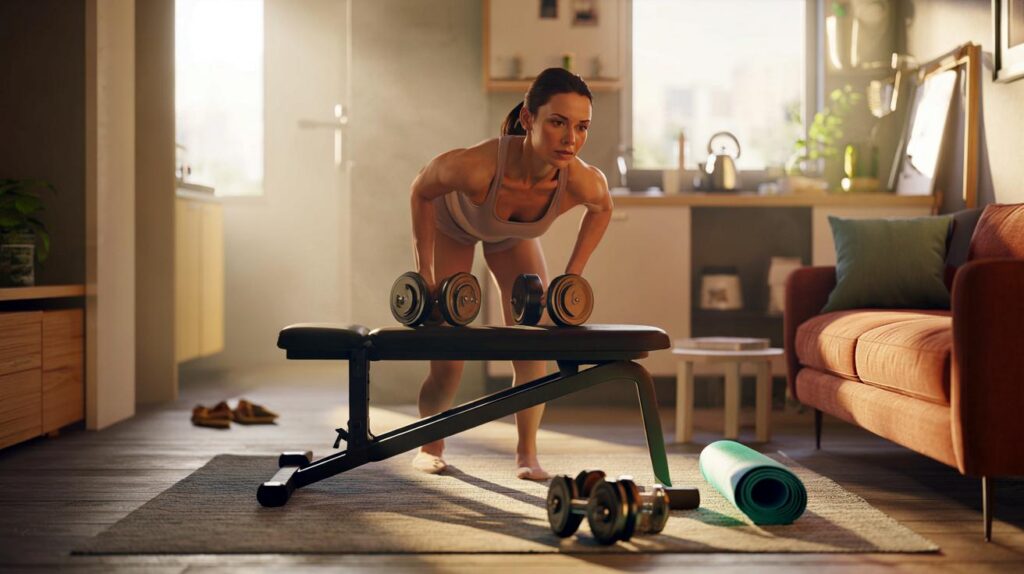
Space is tight, motivation comes in waves, and yet the urge to get stronger won’t leave you alone. A simple workout bench can turn the gap between your sofa and coffee table into a training spot that actually works. No racks, no cables, no drama—just angles, leverage, and a plan that fits under the bed when you’re done.
The bench lives behind the sofa, barely wider than the cushions, hidden like a secret. On a grey Tuesday, you pull it out, set it flat, and let the kettle steam while your playlist flickers on. The hallway is narrow, shoes in a tangle, but the space right here is enough. Two dumbbells on the rug, feet finding their mark, back settling into the pad. You exhale and feel the quiet snap into focus. One set starts, then another. Time ripples. You don’t need a gym. The bench does the rest.
Why a bench unlocks big strength in a small home
A bench turns your floor into a training platform where angles do the hard work. Flat means push, pull, hinge. A click to incline and your chest, shoulders, and lats switch on from a new direction. The bench isn’t just somewhere to sit; it’s leverage. It gives you stability to lift heavier, confidence to explore range, and a repeatable setup that makes strength feel doable on a weekday night.
Think of it like this: with a bench and two adjustable dumbbells, you can cover your whole body. Presses, rows, hip thrusts, step-ups, split squats, pullovers, even core variations that actually hit. Many UK adults live in small flats, and the NHS still recommends muscle-strengthening at least twice a week. The bench makes that guideline feel less abstract. It slides under a bed, leans behind a door, and appears when you want an honest 25–35 minutes that count.
The logic is simple. Strength loves stability and range. The bench gives you both. Instead of fighting balance on the floor, you lock your back onto a firm surface and direct the effort where you want it. Range of motion expands because your elbows can travel deeper on presses and flyes while your hips find a solid fulcrum for thrusts. Change the bench angle and you change the line of pull, which lets you stack easy progress: more reps, a tougher angle, a slower tempo, or **progressive overload** in small, steady jumps.
How to use your bench: moves, setup, and a weekly flow
Start with three bench positions you can hit without thinking: flat, a gentle incline around 30°, and the bench edge for hip work. On flat, drive your feet into the floor and pull your shoulder blades into the pad as if you’re tucking them into your back pockets. For an incline press, sit tall, then lie back with dumbbells resting on your thighs before you roll them into position. For hip thrusts, set your shoulder blades on the bench edge, feet hip-width, shins vertical at the top. Brace, breathe, move with intent.
Common hiccups show up fast. Elbows flaring high on presses can bug your shoulders; tuck them closer to a 45° path. Wobbly wrists drain strength; stack knuckles over the dumbbell handle like you’re punching the ceiling. If the bench rocks on a soft rug, slide a yoga mat under the legs. Keep your ribcage down on rows so you pull with lats, not lower back. Be kind to yourself when energy dips. Let’s be honest: nobody does this every day. Two or three sessions a week still change everything.
Here’s a simple rhythm that works in tiny rooms and busy lives.
“Set the bench, set your body, then set the pace. Small space, big results—one honest set at a time.”
- Day A (push): Incline dumbbell press 3×8–12, flat flyes 2×12–15, seated overhead press 3×6–10.
- Day B (pull): One-arm bench-supported row 3×8–12 each side, pullovers 2×10–14, rear delt raises on incline 2×15.
- Day C (legs/core): Hip thrust 4×6–10, Bulgarian split squat 3×8–12 each, bench leg raises or dead bug 3×10–14.
- Progress with one more rep, a slower 3-second lowering, or a small weight bump each week.
- Finish in 30–35 minutes. Rest 60–90 seconds. Keep it tidy, keep it moving.
Small space, big results is a mindset as much as a method
We’ve all had that moment when the living room looks more like a gym storage cupboard than a home. The trick is to make the bench part of the room’s rhythm, not an invasion. Roll it out, set a timer, hit three crisp movements, and pack it away—done before the kettle cools. *Strength in a small place feels different: closer, sharper, strangely personal.* You notice the angle of your wrist, the way your feet bite the floor, the quiet surge when a set moves smoothly. One routine becomes a habit. One habit becomes your baseline. You don’t need perfection. You just need honest reps and a bench that keeps showing up when you do. And sometimes, that’s exactly enough.
| Key points | Details | Interest for reader |
|---|---|---|
| Bench = leverage | Stability, range of motion, and adjustable angles multiply every dumbbell you own | Lift safely and harder without bulky machines |
| Six cornerstone moves | Incline/flat press, bench row, hip thrust, Bulgarian split squat, pullover | Full-body strength from one compact tool |
| Efficient weekly flow | Three 30–35 minute sessions using a **push–pull–legs** split | Fits busy schedules and small flats with real, trackable progress |
FAQ :
- Do I need an adjustable bench?A flat bench works, but adjustability widens your options and comfort. A 30–45° incline unlocks upper chest, shoulders, and rear delts while sparing your neck.
- What weight should I start with?Pick a load you can press for 8 reps with 2 reps still “in the tank.” Rows and lower-body moves can usually go heavier. Aim to add 1 rep or a small plate weekly.
- Can I train my whole body with just a bench?Yes. Combine presses, rows, hip thrusts, split squats, step-ups, pullovers, and core variations. Add a backpack or bands if your dumbbells top out.
- How do I progress if my weights are limited?Use tempo (3–1–1), pauses at the bottom, extra sets, or angle changes. Mechanical drop sets work well—move from incline to flat without changing weight.
- My shoulders feel cranky on presses. What should I change?Tuck elbows to about 45°, pull shoulder blades back and down, and keep wrists stacked. Swap some flat presses for a slight incline, and include light flyes to open range.



Loved the “small space, big results” mindset. I’ve got a tiny flat and a bench that hides behind the sofa, so this felt oddly personal. The push–pull–legs split in 30–35 minutes is very do-able, and the cue about stacking knuckles helped my wrist. Any tips for tracking progress when weights are adjustable but fiddly to change mid set?