
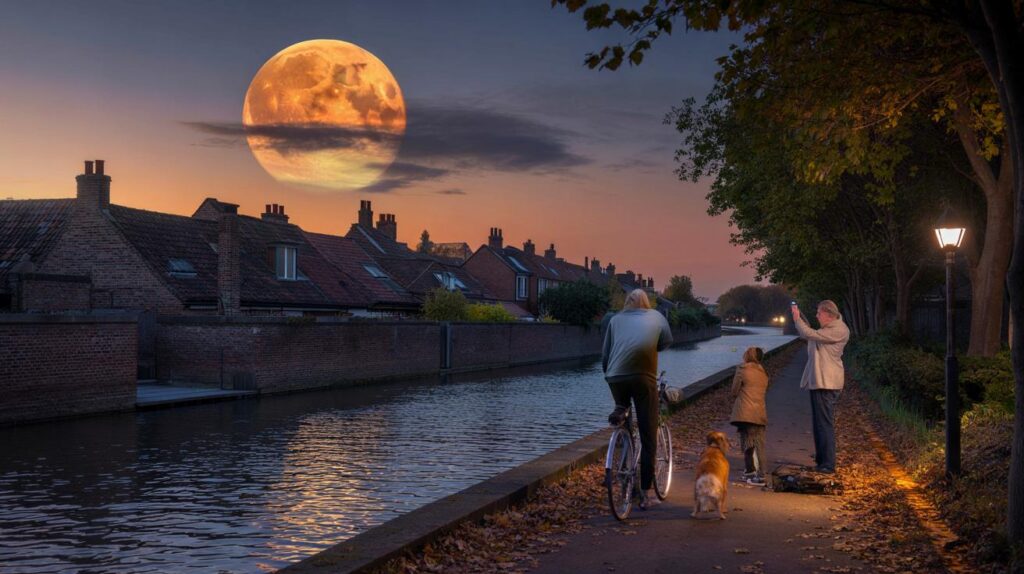
A rare quirk of calendars and orbits is about to gift October a double badge: the Harvest Moon and the first supermoon of 2025 landing together. It means a brighter, slightly larger full Moon close to the horizon at dusk, right when most of us are walking home, cooking dinner, or glancing out of the window. No telescope needed. Just a clear break in the clouds and a reason to pause.
The first time I noticed it, I was standing outside a corner shop in a draughty queue, biting the end of a receipt. The Moon hauled itself up over the terrace roofs like a paper lantern, orange at first, then creamier, and for a minute the street felt choreographed. A cyclist slowed, a dog stopped sniffing, someone on the phone said, “hang on, look at that.”
It will look like that again, only a touch bigger and brighter. This one is closer.
Why this Harvest Moon is different
Most years, the **Harvest Moon** shows up in September, nearest the autumnal equinox. In 2025, the full Moon that sits closest to that date falls in early October, tipping the title across a month boundary and turning a familiar name into something rarer. Factor in that the Moon is also near its closest point to Earth and you’ve got 2025’s first supermoon stealing the show.
The calendar bit is simple to feel, even if the maths is fiddly. Expect the full phase to peak on 7 October 2025 (UTC), with the Moon’s closest approach arriving within about a day of that, which is what nudges it into “supermoon” territory. To your eyes that means a disc up to 14% larger than at its smallest and around 30% brighter than an average full Moon, a difference that matters when it’s hanging low over rooftops or the sea.
Why does it land this way? The equinox is fixed in the calendar, but the Moon’s cycle runs a touch shorter than our months, sliding forward each year. Some years the September full Moon lies a shade too far from the equinox; the October one squeezes closer and claims the Harvest Moon badge. Then there’s perigee, the point where the Moon’s orbit brings it closest to Earth, which drifts through the year in a rhythm of its own. When those two patterns overlap, you get this kind of headline-night.
When and how to see it
Circle the evenings of 6–8 October on your phone and plan for the main event on Tuesday 7 October (your local date may vary slightly by time zone). The rule is wonderfully low-tech: on the night of the full Moon, it rises roughly around sunset and sets around sunrise. Look east as the sky softens, catch that first orange lift above chimneys or trees, then track it as it lightens to pearl and climbs.
City or countryside, it’s the horizon that sells the show. Find a spot with a clean eastern view — a canal towpath, a hill, a seafront, a playing field after the last whistle. We’ve all had that moment when a clear patch opens between clouds and everything lines up. Let’s be honest: no one really does that every day. On this night it’s worth the small logistics — a coat, five extra minutes, and a slower walk home.
Think of the Moon as a patient performer that rewards a little stagecraft. If the forecast is fussy, give yourself a 48-hour window around full; the nights before and after can look nearly identical to the eye.
“You don’t need special gear — you need somewhere you won’t be hurried,” said a Northumberland stargazer who’s been logging Moonrises for two decades.
- Best time to look: around local sunset for the biggest, warmest tint near the horizon.
- Where to face: east at moonrise, west at moonset; check a compass app if you’re turned around.
- Simple kit: a warm layer, a torch with red mode, and patience for passing clouds.
- Photography nudge: use buildings, trees or water to anchor scale; drop exposure a stop to keep the disc from blowing out.
What makes it “super”, and why that matters to your eyes
“Supermoon” isn’t an official scientific term, but it’s handy. In practical terms it means the full Moon lands close to perigee — the point where the Moon is nearer Earth on its slightly squashed orbit. That proximity adds a quiet punch of brightness and size that your brain registers best when the Moon has context: near a pier, a cathedral, a train line, a skyline you know by heart.
There’s also the famous Moon illusion at low altitudes, making it look enormous near the horizon. Your mind compares it with familiar objects and exaggerates the scale in a way a ruler wouldn’t. The trick, if you’re chasing that theatre, is to catch it low: first 30 minutes after moonrise or the last 30 before moonset. The numbers matter less than the choreography of place and moment.
Light pollution blunts the Milky Way, not the Moon. You can watch this from your back garden or a busy pavement and the result will still feel startlingly intimate. If you do head out to darker edges, the payoff is the landscape — the way the light floods a field or coastal path, how shadows stretch and the ground glows. *It won’t demand a telescope; it will ask for your attention.*
Your mini plan for the night
Start with a map and a horizon. Pin a spot with an open eastern view for moonrise — a bridge over the river, the brow of a hill, an estate car park that faces into the sky rather than a wall. Note local sunset time for your town, then arrive 10–15 minutes ahead so you can settle and let your eyes adjust. If you’re in the UK, that’ll be early evening in October, jacket weather and crisp breath.
Phones can help, but don’t overthink it. A simple moon-phase app or a quick search for “moonrise time + your town” will do. If you’re taking photos, go wide, include people or buildings for scale, and try burst mode as it clears the horizon. If the clouds play games, give them room; holes drift and reopen. And if you miss the exact rise, the climb is long and generous.
For families, it’s a kind night out: no late-night marathon, no trekking to the countryside, just a short walk and a reason to look up together. For commuters, it’s a pause on a bridge, a minute before the bus, a glance over the station canopy. For early risers, there’s a mirror act before dawn, the Moon dropping to the west with a cooler, paler tone as the day takes over.
A small, bright ritual for a busy year
You don’t need a label to enjoy it, but names help us make space. Harvest Moon hints at the old, practical glow that stretched evenings for gathering in the fields, and the October twist this year threads that story into our own schedules. The first supermoon of 2025 adds a bit of theatre, a nudge to pay attention to a thing that arrives on time whether we do or not.
There’s a quiet democracy to it. People on night shifts see it. Kids in pyjamas at the window see it. Runners on a towpath, smokers on a doorstep, grandparents on a bench, delivery drivers at red lights. Share a photo if you want, or don’t. The real bit is that hush when it clears the rooftops and the whole street seems to breathe in, then exhale together.
| Key points | Details | Interest for reader |
|---|---|---|
| Rare October Harvest Moon | Full Moon nearest the equinox falls in early October 2025 | Explains why the Harvest Moon isn’t in September this year |
| 2025’s first supermoon | Full Moon aligns near perigee, appearing larger and brighter | Sets expectations for a noticeably striking Moon |
| Best viewing window | 6–8 October evenings, with 7 October at centre; look east at sunset | Gives a clear, simple plan that works anywhere |
FAQ :
- When exactly is the 2025 Harvest Moon?The full phase lands on 7 October 2025 in UTC, with the spectacle essentially the same on the evenings of 6–8 October depending on your time zone.
- Why is it called a Harvest Moon?It’s the full Moon closest to the autumnal equinox, long linked with extra twilight for bringing in crops, thanks to later moonrises that reduce fully dark gaps after sunset.
- What makes it a “supermoon” this time?The Moon reaches full near its closest point to Earth, known as perigee, so it appears up to 14% larger than at its smallest and noticeably brighter.
- What’s the best time and direction to look?Face east around local sunset for moonrise; if you’re up before dawn, face west for moonset. The low-altitude view delivers the most drama.
- Do I need equipment or a dark-sky site?No. You can enjoy it from a balcony or a bus stop. Binoculars add texture if you have them; a dark horizon helps with scenery, not with the Moon’s brightness itself.



Great explainer—love the east-at-sunset rule and the 48‑hour wiggle room. Definitly marking Oct 7 in my calendar.