
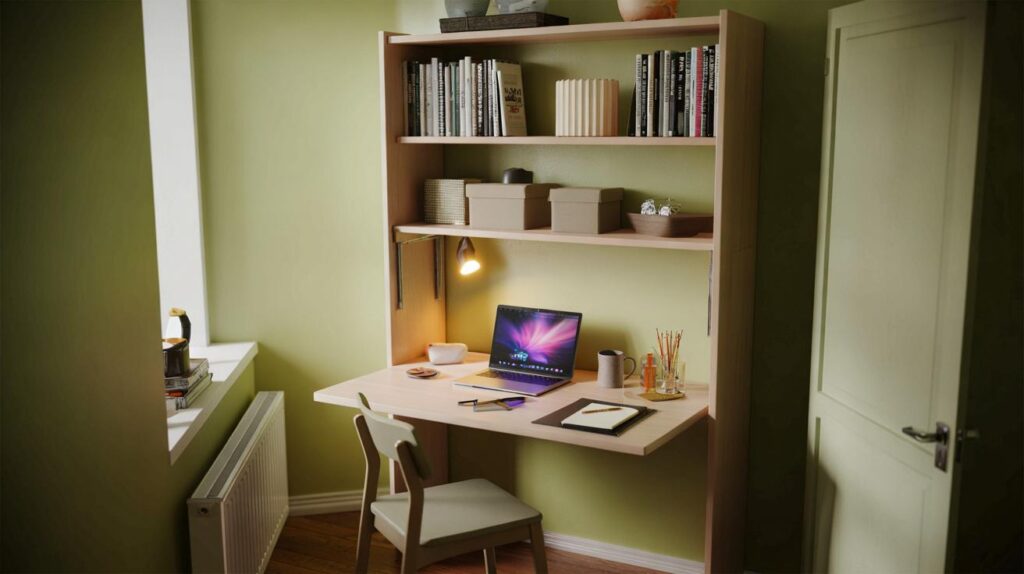
Spare rooms have vanished, dining tables do double duty, and families are hunting for square centimetres they don’t have anymore.
IKEA thinks it has an answer, folding a proper work surface into the nation’s best-loved Billy bookcase without surrendering floor space. The new design takes a familiar shape and builds in a desk you can slide out when you need it and tuck away when you do not.
A bookcase that becomes a desk
The idea is simple. Keep shelves for books, toys and baskets, then add a pull-out, lockable work surface in the lower section. When you push it back, you get a normal bookcase with a slim profile. When you pull it forward, you gain a workstation big enough for homework, craft sessions or laptop duty.
The figures matter. The unit is 80 cm wide and 106 cm high. Depth sits at a modest 33 cm when closed, then stretches to a full 112 cm with the table extended. That shift turns a wall into a practical hub without demanding a dedicated office.
Closed depth 33 cm; extended depth 112 cm. That recovers about 0.63 m² of floor area when stowed compared with in-use.
How the mechanism works
The lower shelf rolls out on guides and locks to create a steady surface. IKEA has tuned the action so children can manage it, yet it still feels sturdy for daily use. You pull, it clicks, and the panel sits firm. When you are done, release and slide it in. No fiddly legs. No wobble.
Storage does not suffer. Shelves above hold up to 18 kg each, enough for hardbacks, board games or storage boxes. The vertical layout means you stack belongings close to the wall and keep the centre of the room free.
Each upper shelf is rated to 18 kg. Keep heavier kit on fixed shelves and leave the moving section clear before sliding.
Why this solves a real household problem
Most flats and family homes now juggle study, play and work in the same rooms. A permanent desk eats space and invites clutter. A fold-down wall table needs a free wall and usually blocks shelving. This hybrid avoids both traps. It assigns a crisp spot for tasks, then gives the room back once the job is done.
Children get a clear routine. Pull the table out after school, lay out books and pencils, then slide everything away before dinner. Adults do the same for emails or bills. No negotiation over the kitchen table. No bulky desk gathering dust.
Key specifications at a glance
| Width | 80 cm |
|---|---|
| Height | 106 cm |
| Depth (closed) | 33 cm |
| Depth (extended) | 112 cm |
| Shelf load limit | 18 kg per shelf |
Set-up, safety and daily use
Assembly follows IKEA’s usual pattern with labelled parts and clear diagrams. Two people make light work of the heavier stages and help align the sliding section. Once built, anchor the unit to the wall so small hands cannot tip it. That step matters in any tall bookcase and is even more relevant when you add a pull-out surface.
Think about the chair. A slim dining chair or a compact task chair slides under neatly when the table retracts. Leave cables simple and removable. Use a short extension block on the wall and loop a cable tie around it so you can lift it off the desk at closing time.
- Measure skirting depth and position of sockets before purchase.
- Leave at least 120 cm clearance in front when using the table.
- Fit felt pads on the chair to protect flooring as you slide in and out.
- Store heavy items on the lower fixed shelf to keep the centre of gravity low.
What it actually fits
The work surface handles a 14–16 inch laptop, a notepad, and a mug with room to spare. Kids can spread out an A3 project or build a model without pieces spilling into walkways. For craft, keep scissors, glue and pens in a caddy on the top shelf and bring it down only when the desk is open.
Where it shines and where it does not
Small bedrooms gain a study spot without swallowing floor space. Living rooms keep an uncluttered look, because the surface hides when guests arrive. In a hallway, the bookcase handles post, keys and chargers, then tucks away before school runs.
- After-school study station that resets in 30 seconds.
- Craft bench for fabric cutting and papercraft.
- Laptop corner for hybrid work days.
- Games shelf above with a family puzzle pad below.
If you run twin large monitors, a wide drawing tablet or a desktop tower, you may want a bigger fixed desk. Try the working height in store if you are very tall, as comfort depends on your chair and posture. The 18 kg per shelf limit suits books and boxes, but it is not a bench for heavy tools.
Smart ways to maximise the design
Zone the shelves. Keep daily items within shoulder height and archive items higher up. Use matching boxes to keep the look calm and reduce visual noise in shared spaces. A warm table lamp on the top shelf can bounce light off the wall and soften the room in the evening.
Cable discipline helps. Stick a small adhesive hook under the shelf to park your laptop charger head. Use a short USB hub rather than snaking long cables through the unit. A roll of painter’s tape nearby lets children label project folders without sticky residue.
Space maths that helps you decide
Think in square metres. Compared with a permanent 120 × 60 cm desk, this design surrenders depth only at the moment you need it. When closed, it takes 0.26 m² of floor area (0.80 × 0.33). Open, it uses 0.90 m². That means you reclaim roughly 0.64 m² the rest of the day, close to the size of a small hallway rug.
Use the open depth only for the task window you plan — everything else in the room stays accessible the rest of the time.
Buying checklist and practical add-ons
- Wall width available: 80 cm plus 5 cm breathing room either side.
- Front clearance: at least 120 cm so knees and chair fit comfortably.
- Anchoring kit and suitable wall plugs for your wall type.
- Two storage boxes that fit the upper shelves for fast tidy-ups.
- A clip-on task light or a slim desk lamp for evening sessions.
Extra guidance to get more from it
Ergonomics matters. Aim for forearms level with the desk surface and feet flat on the floor. A cushion can raise a child to the right height; a footrest helps shorter adults. Keep screens an arm’s length away and lift a laptop on a simple stand if your neck feels strained.
Plan a weekly reset. Sunday night, slide the desk out, clear orphan cables, recycle scrap paper and refresh supplies. Ten minutes keeps the whole unit functional and stops clutter creeping onto living surfaces. Families can share a calendar and reserve time slots, which reduces clashes and makes expectations clear.
If you rent, the ability to move the entire station when you change rooms or flats is a quiet advantage. You carry one piece, not a desk and a bookcase. For parents, the sliding ritual signals “work time” and “play time” without a lecture. Small, repeatable cues like that help children focus and then switch off afterwards.



Finally a desk that disappears into a Billy—my studio just leveled up! 🙂 Does the pull-out lock feel sturdy enough for daily typing?
112 cm when open is alot—where am I putting my legs and chair in a 2m-wide room? The 120 cm clearance note sounds optimisitic with skirting and radiators.