
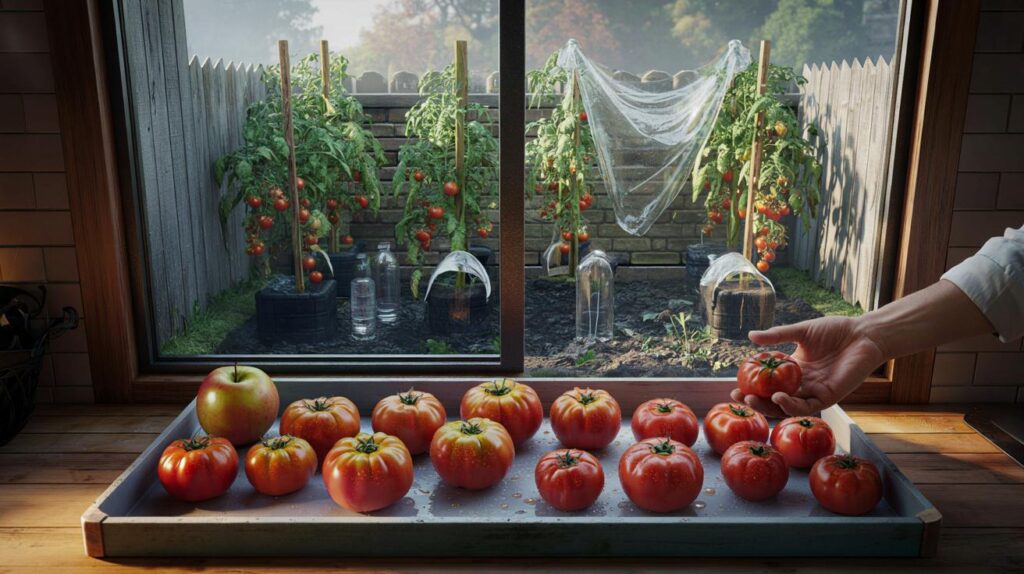
Mist lifts, daylight shrinks, and the garden looks spent. Yet red fruit still tempts on the vines, almost within reach.
Across Britain and France, growers push late-season plants for one more flush of colour. They nudge the thermometer up, pick with precision, and finish the job indoors. You can copy the routine in an allotment, a back yard, or on a balcony without fancy kit.
Why autumn stalls your tomatoes
Short days and cool nights slow the plant’s engine. Below about 13°C, the pathway that turns fruit from green to red falters. Lycopene, the red pigment, forms poorly in the cold. Sugars rise more slowly. Overnight dew lingers, inviting disease. Leave fruit to chance, and you get pale spheres that stick at half-blush.
Below 13°C, colour formation stalls. Keep fruit near 16–20°C and you’ll see red within 7–12 days.
The grower’s rule of 13°c
Market gardeners treat 13°C as a line in the sand. They aim to keep the microclimate above it at night, then chase a gentle 18–21°C by day. That range suits ethylene action, the ripening hormone that drives colour and aroma. When forecasts threaten single digits, they switch from coaxing on-plant colour to controlled indoor finish.
Quick protections that add degrees, not drama
Fleece, cloches and a south-facing wall
You don’t need a tunnel house to gain a few vital degrees.
- Horticultural fleece (around 17 g/m²) adds 2–3°C. Drape at dusk, peg loosely, lift in the morning for airflow.
- Clear cloches or cut-bottle covers trap sun by day and slow heat loss by night. Vent the tops to stop condensation.
- Shift pots to a south-facing brick wall. Masonry soaks up afternoon sun and radiates back after dark.
Airflow matters. Stale, wet air feeds blight. Leave gaps at ground level and avoid heavy watering late in the day.
Warmth without damp guides fruit from blush to full red and keeps disease at bay.
Make the ground work for you
Lay black mulch or a bin liner at the base of each plant. Dark surfaces absorb sun and re‑emit it at night. Slide a couple of dark bricks or water-filled bottles beside the stems as thermal mass. These small tweaks often lift the microclimate by 1–2°C, enough to keep the ripening clock ticking.
Pick at the breaker stage, then finish indoors
Spot the right moment
Wait for the “breaker” stage: the first visible shift from solid green to a pale green or a faint orange blush near the stem. Fruit at this stage will finish off‑vine without losing texture or flavour if you treat it well.
- Look for a lighter green shoulder or a coin-sized blush at the peduncle.
- Feel for slight give under the skin, not softness.
- Check that seeds are gelled, not glassy; cut one fruit to confirm.
- Pick before a cold snap. Frosted fruit rarely colours properly.
Turn your kitchen into a ripening room
- Lay fruit in a single layer in shallow crates or on trays. Keep space between tomatoes.
- Add a ripe apple or banana at one end. Both release ethylene that nudges colour along.
- Hold 18–21°C in a dry, shaded place. Avoid direct sun that hardens skins.
- Check daily, rotate fruit, and remove any with spots. One bad tomato can trigger a cascade.
- Keep tomatoes away from leafy greens that yellow in ethylene-rich air.
Expect full red in roughly a week for fruit already blushing, and up to two weeks for pale green breakers. Lower room temperatures stretch the timeline; warmer rooms shorten it but risk mealy texture if you exceed the low twenties.
What works and what it costs
| Method | Typical cost | Heat gain | Time saved | Main risk |
|---|---|---|---|---|
| Fleece cover | £6–£10 for 10 m | +2–3°C at night | 2–3 days faster | Condensation if not vented |
| Clear cloche | £8–£15 each | +3–4°C | 3–4 days faster | Overheating on sunny noon |
| Black ground cover | £4–£7 for sheet | +1–2°C | 1–2 days faster | Slugs under cover |
| Indoor finish with apple | £0–£1 | Stable 18–21°C | 5–10 days to red | Rot if stacked |
Tricks growers share when frost is near
Save the crop in one evening
- Strip new flowers and tiny fruit. The plant stops wasting energy and directs sugars to the keepers.
- Top each plant above the highest truss with sizeable fruit. Growth slows; ripening continues.
- Remove a few shading leaves around each cluster to let light in while keeping at least two leaves per truss.
- Harvest whole trusses at breaker stage and hang them indoors on string. Fruit ripens on the vine, away from frost.
- Lift entire plants with roots and hang them upside down in a cool shed, provided foliage is healthy.
If a batch stays stubbornly green, turn it into chutney or fry firm slices. You still bank the work of a long season and avoid waste.
After picking: keep flavour alive
Store for taste, not just colour
Skip the fridge. Cold strips aroma and toughens texture. Rest fruit at room temperature, ideally 18–20°C. Place them stem-down on a soft cloth so the shoulders don’t bruise. Keep a finger’s width between tomatoes for airflow. Rotate daily. Move the ripest to a cooler spot to slow them while laggards catch up.
Room temperature keeps perfume intact; the fridge silences it and slows the final turn to red.
Science that helps you time your moves
Ethylene, lycopene and the sweet spot
Tomatoes ripen in response to ethylene, a gas the fruit produces as it matures. Ethylene triggers enzymes that soften walls, free up aromas and turn chlorophyll into lycopene. The sweet spot for those reactions sits in the high teens. Dip much below 13°C and the enzymes lose steam. Sit above the low twenties for long spells and texture suffers. That is why growers chase gentle warmth, not heat.
A balcony test you can try this week
One crate, one apple, and a fortnight
Pick 12 breaker-stage tomatoes on the same afternoon. Split them into two groups of six. Put one group on a kitchen shelf at 18–20°C with a ripe apple nearby. Leave the second group in a cool porch at 12–14°C without an apple. Check colour each morning and log the change. Most kitchens will deliver full red by day 8–10. The porch set often lags at day 12–14 with paler shoulders. That gap shows why seasoned growers move quickly when forecasts dip.
Risks, payoffs and next steps
Balance speed with quality
Rapid ripening brings a quicker plate of red fruit, but it can flatten flavour if you overshoot temperature or crowd crates. Slow ripening in the low teens preserves acid balance, yet it raises disease risk. Aim for steady warmth, space fruit out, and give each tomato a daily check. If you manage that rhythm, you can rescue 70–90% of a late crop and still slice into juicy scarlet fruit long after the first frosts brush the lawn.
For bigger gains next year, choose cultivars with reliable late colour, such as medium salad types that turn red at cooler thresholds. Pair them with early fleece habits and a simple cloche, and you’ll start October with a head start rather than a scramble.



At 12°C nights, if I pick at true breaker stage, will the lycopene pathway still complete indoors without texture loss, or do I risk mealiness if my kitchen drifts to 22–23°C? Also, does 17 g/m² fleece really net +2–3°C in breezy plots?