
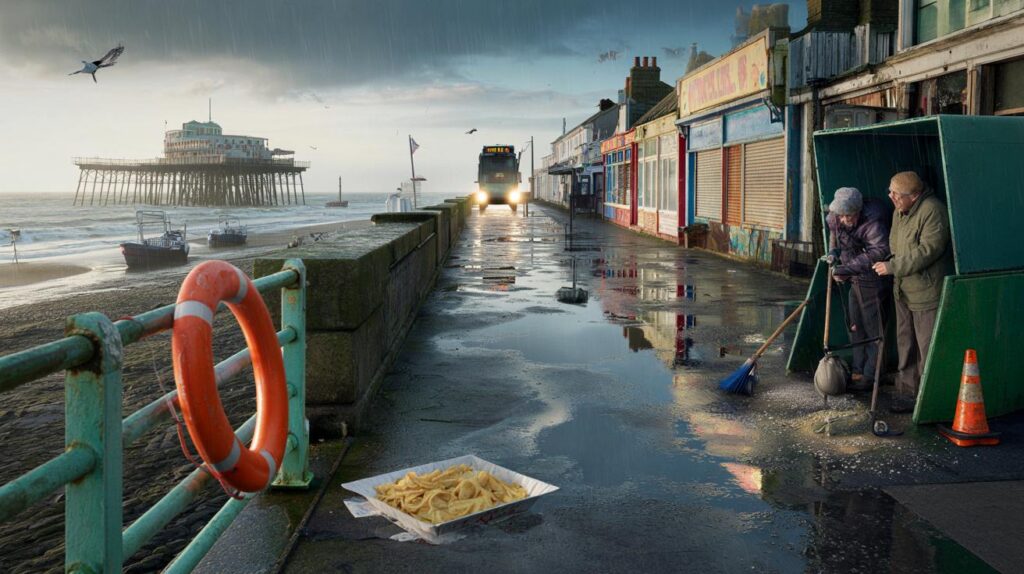
The British coast does this strange thing to memory. You think you’re heading for sweet nostalgia — rock sticks, arcade lights, a breeze that smells like school holidays — then you arrive and the past isn’t there to greet you. It’s boarded up, sold off, or just tired. This trip was meant to be a soft reset. Instead, it turned into a blunt reminder that not every seaside town wants visitors anymore, and some haven’t been wanted by anyone for a long time.
I stepped off the bus beside a rusting shelter, the kind painted council green when people still used phone boxes. The sea sounded close, the wind closer, and gulls circled as if they knew something I didn’t. A family dragged a pram through wet sand while a teenager kicked at a broken cone on the pavement. The funfair sign was missing letters. The smell of vinegar fought with diesel from the fishing boats. A cold zip ran down my back. This wasn’t the postcard I’d promised myself. It wasn’t even a postcard. And then the rain started.
When the seaside dream turns into a shrug
The promenade had the sullen look of a Monday. Paint flaked from railings in strips big enough to pocket. The pier, or what was left of it, reached out like a chewed pencil, ending in a shrug. I passed rows of shuttered arcades with sun-faded posters for bands that never came, and a charity shop window arranged with winter coats in August. A dog barked from a balcony above a closed guest house. A hand-painted sign read “No change given”. I wanted to smile at the small-town cheek of it. I didn’t. **This wasn’t charming decay; it was neglect.**
There were people, just not many. A man in a hi-vis swept sand off the steps in slow, methodical arcs. Two pensioners huddled behind a windbreak, sipping tea from flasks like mischief. A fish-and-chip place was open, the fryer working hard, the radio louder than it should be. I ordered cod and sat on the wall near the lifebuoy, staring at a horizon that looked unfinished. The batter tasted of old oil and the chips needed salt that never came. *I felt like an intruder in someone else’s winter.* We’ve all had that moment when the place you wanted to love doesn’t love you back.
It’s easy to blame weather or season, yet something deeper hung in the air. British coastal towns have seen their industries ebb, their day-trippers drift, their budgets tighten like old rope. The bright parts survive — the one good bakery, the mural that pops — but the bones show. I checked local listings: one theatre event scheduled for late autumn, a “heritage walk” cancelled, a rubbish collection notice that had become community news. The town wasn’t hostile. It was just tired. **I wanted to root for the place, but my feet kept drifting towards the exit.**
If you still go, go differently
Here’s what worked once I accepted the town as it was, not as I wanted it to be. I dialled down the agenda and went looking for one small good thing. A café with steamed-up windows and a bell that actually rings. A quiet jetty where the wind feels like a reset button. Ten minutes in the local museum, reading captions like messages in bottles. That’s it — one thing. Then I took the first side street inland and found a bakery selling yesterday’s buns for pennies and stories for free. The baker handed me a warm paper bag and said, “You’ll want the corner table; it doesn’t wobble.” He was right.
Go early, wander slow, and carry coins. Card machines sulk in places like this, and the smaller the business, the more your fiver matters. Read noticeboards, not TripAdvisor. Talk to the market trader with the permanent squint; ask the bus driver which stop is best for a view. Keep a plan for leaving if the energy dips — a trail into the dunes, a walk to the next village, a train time in your notes. Let’s be honest: nobody actually does that every day. But the one time you need it, you’ll be grateful you did.
People who live here aren’t props for your melancholy. Be kind, spend locally, and keep your camera down when the sadness shows. I found a seam of grace at the RNLI shop, where the volunteer behind the till knew every face, every storm, every name on the plaque dedicated to lost crew.
“We used to be packed on bank holidays,” she told me, counting out change like a ritual. “Now it’s quieter. We manage. We always do.”
- Buy something small: postcards, a badge, a tea towel. It keeps the lights on.
- Find the tide times and watch the water move; it resets your eyes.
- Take the coastal path for one mile. The town softens at walking speed.
- Ask for local fish varieties; learn one new name and order it once.
What lingered after I left
The bus back rolled in late, headlights cutting the mist like a cheap stage show. I sat near the window where the heater worked and watched the town slide by in soft focus. The mural looked braver from a distance. The closed arcades looked gentler. I won’t pretend I didn’t feel relief as we pulled away. I did. Yet a part of me stayed with the woman in the lifeboat shop and the baker with the steady hands. There was dignity at work there, and a kind of small, stubborn hope.
Maybe that’s the lesson of a forgotten seaside town: it’s not a theme park missing its paint; it’s a community carrying weather and time. The last thing it needs is pity pictures. The first thing it needs is presence, scrutiny, and a little money spent with names, not brands. I still wouldn’t book a week there. I’d book a morning. I’d bring a thermos and a friend who laughs at rain. I’d pick up litter on the way to the bus stop and leave with the wind in my sleeves. And maybe, just maybe, I’d feel lighter.
| Key points | Details | Interest for reader |
|---|---|---|
| The seaside myth can crack fast | Boarded arcades, tired piers, thin events calendar | Sets expectations and reduces disappointment |
| Shift your approach | Find one good thing, talk to locals, carry coins, plan an exit | Practical way to salvage a tricky day |
| Leave lightly, not loudly | Spend small, skip pity photos, walk the coast path | Feel better about your trip and your footprint |
FAQ :
- Which UK seaside towns feel “forgotten” off-season?Smaller resort strips with closed piers and limited transport tend to quieten sharply between September and May; go expecting empty promenades and patchy opening hours.
- Is it still worth visiting a run-down coastal town?Yes for a day trip with a flexible plan — short walks, local chats, and a single standout stop can make it worthwhile.
- How do I find the good bits without relying on ratings?Read village noticeboards, ask bus drivers, and look for steamed-up cafés with locals inside; those rooms carry the town’s pulse.
- What should I pack for an off-season seaside visit?Layers, a windproof, small notes and coins, a thermos, and shoes that don’t mind sand and puddles.
- What’s a respectful way to photograph places in decline?Focus on textures, light, and landscapes; avoid people’s hardship and private property, and spend a little in return for your images.



Did you visit in peak season at all? Kinda hard to judg a town on one wet afternoon.