
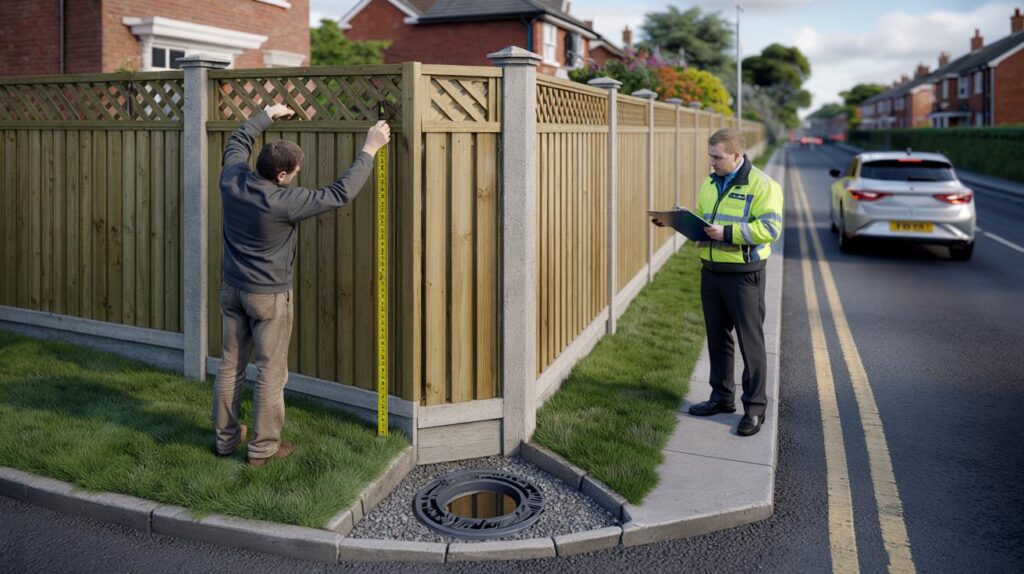
Homeowners are rushing to check boundaries after a spring rules refresh left many unsure about heights, permissions and risks.
Quiet upgrades to planning rules in May mean garden boundaries now sit under clearer limits, but there are new traps. A fence too high, or one that blocks drains, can now invite attention from councils and, in the worst cases, a four‑figure penalty.
What changed in May and why it matters
The Town and Country Planning (General Permitted Development) (England) Order 2015 was amended in May to tidy up how householders replace or install gates, fences and walls. The refresh did not revolutionise garden law, but it sharpened the lines. You now have less room for interpretation about height, position and what counts towards the total.
Two numbers do most of the work: 1 metre at the front by a highway, 2 metres everywhere else on domestic land.
The rules apply to homes across England under “permitted development”, which allows many minor changes without making a planning application. Step outside those limits, and you move into full permission territory.
The height rules at a glance
| Location | Maximum height without planning permission | Notes |
|---|---|---|
| Next to a road or its footpath (front boundary or side on a corner plot) | 1 metre | “Adjacent to a highway” usually means the boundary touches land used by vehicles or its footpath. |
| Any other boundary (back garden or sides not by a highway) | 2 metres | Includes fences, walls, gates and any trellis fixed on top. |
| Within the curtilage of a listed building | Permission usually required | Permitted development rights are restricted in these settings. |
Does a trellis count?
Yes. A decorative trellis fixed to a fence forms part of the total height. A 1.8m panel plus 0.4m trellis equals 2.2m, so it needs permission unless you are below a 1m front limit or 2m elsewhere.
When you must apply for planning permission
You will need permission if your proposal exceeds the height limits, sits within the setting of a listed building, or if your area is covered by an Article 4 Direction removing permitted development rights. That can happen in conservation areas and on some estates. Corner plots often catch people out, because the “side” fence can be classed as adjacent to a highway.
Measuring is from ground level where the fence stands. Artificially building up soil to raise the base does not avoid the limit. If levels differ on either side, planners will look at the natural level and the visual effect.
Put simply: over 2m at the back or over 1m by a road means you should speak to your council first.
Fines and enforcement: where £5,000 enters the picture
Breaching planning rules usually triggers an enforcement process that can force you to lower or remove the fence. That is painful and costly, but it is not the fine most people fear. The headline figure — up to £5,000 — arises if your fence creates a statutory nuisance, for example by causing flooding or blocking drains. Councils can issue an abatement notice. Ignoring it can lead to prosecution and a fine that stings.
A fence that causes flooding or blocks drains can attract a statutory nuisance fine of up to £5,000.
You also risk legal action if your structure intrudes over a neighbour’s land, damages their property, or creates a hazard next to a highway. Insurers may take an interest if damage results.
Who owns a fence between neighbours?
Ownership is not decided by myths such as “the left-hand fence is yours”. Check your title deeds and the Land Registry title plan for “T” marks and covenants. If records are silent, look at who paid for and installed the fence and how it has been maintained. A calm chat across the boundary line often resolves it faster than letters do.
If a fence straddles the boundary, you may have a party fence. Replace or alter only with agreement. Keep any new structure wholly on your side, including posts and concrete footings.
Practical steps before you buy panels this weekend
- Measure from natural ground level to the top of the highest element, including any trellis.
- Sketch your boundary and mark distances to the footpath or carriageway if you are on a corner or fronting a road.
- Check your council’s website for Article 4 Directions, conservation area status and how they interpret “adjacent to a highway”.
- Look up your title register and plan for ownership clues and restrictive covenants.
- Speak to your neighbour early. Agree height, finish and maintenance access.
- Locate drains and inspection covers. Keep clear to avoid blockages and nuisance claims.
- Choose robust posts and fixings. High winds topple under‑spec’d panels and bring liability.
- Keep sight lines safe near driveways. Drivers and pedestrians need visibility.
Three common scenarios, solved
Back garden privacy: You plan 1.8m panels with a 0.3m trellis along the rear boundary. Total is 2.1m. That exceeds the 2m limit, so you will need permission or you must drop the height.
Front picket by a footpath: A charming 1.2m picket on the front boundary next to the pavement exceeds the 1m limit next to a highway. Apply, or trim to 1m.
Corner plot side fence: Your side boundary faces the road. Even though it feels like a side fence, it is adjacent to a highway, so the 1m limit applies without permission.
Money and time: what to budget for
Application fees vary, but a householder application in England typically costs around £258. Councils usually decide within eight weeks. If they refuse, you can appeal, redesign, or reduce the height to fit permitted development. Factor in materials and labour: a 1.8m timber panel might run £30–£60, posts £15–£40, concrete gravel boards more. Galvanised or composite systems cost more but last longer and need less maintenance.
Key definitions that trip people up
- Adjacent to a highway: your boundary touches land used by vehicles or its footpath. Corner plots often qualify.
- Curtilage: the land immediately surrounding your house that you use as part of the home.
- Permitted development: works allowed without applying for planning permission, provided you keep within the stated limits.
Extra checks that save hassle later
Run a quick wind‑load sanity check. A solid 2m panel acts like a sail. In exposed spots, consider slatted designs that let air pass, deeper post foundations, and stronger fixings. Treat timber to extend life and reduce early replacements that can restart neighbour disputes.
If you are near protected trees or roots, ask the council’s tree officer for advice. Digging post holes within root protection areas can damage trees and trigger separate breaches. Where drains run near the boundary, specify gravel backfill and keep access to inspection points clear, reducing the risk of blockages that could bring that £5,000 problem to your door.



So my 1.8m panel plus a dinky trelis means trouble now?
Helpful explainer. The 1m next to a highway vs 2m elsewhere finally makes sense. I’d forgotten trellis counts toward total height. For corner plots, am I right that the “side” can be classed as adjascent to a highway? Also worth flagging Article 4 Directions—our estate has one and it caught half the street out last year.