
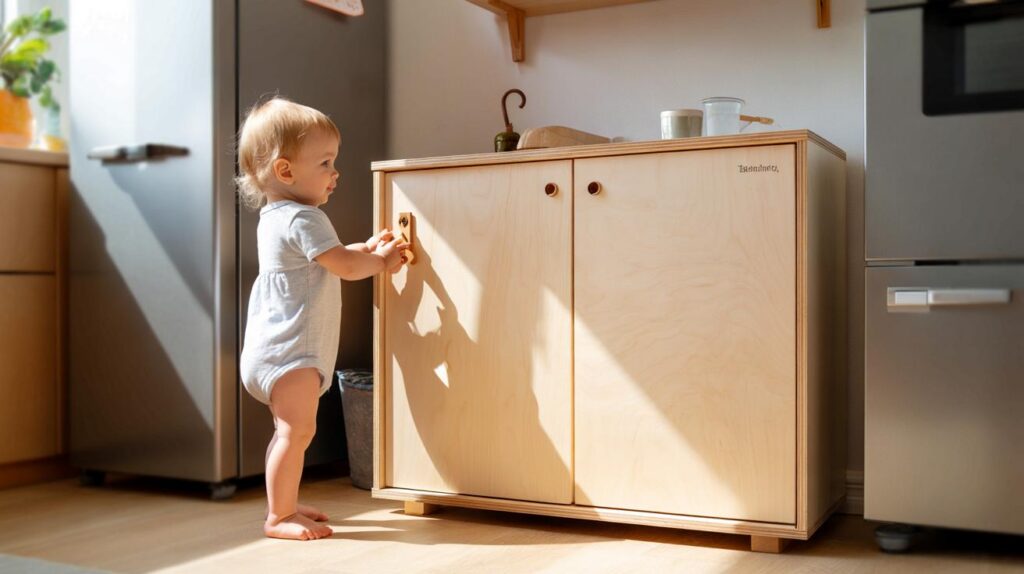
A home with children turns into a maze of tiny hazards fast. Bleach under the sink. Spare screws in a jam jar. Scissors, sprays, batteries that never quite find a safe place. You can babyproof plugs and put latches on cupboards, yet clutter still creeps back. When space is tight, you need storage that’s small, tough, and clever enough to live in plain sight. That’s exactly what one couple built from a single sheet of plywood — a compact, **child-safe** cabinet that looks like it belongs.
The first night I see it, their kitchen is yawning into late evening. A baby monitor glows on the worktop, soft static humming, while two cups of tea go cold on the hob. They’re both standing over a cereal box they’ve torn open flat, sketching rectangles and jotting numbers in pencil like their lives depend on 18 mm. The under‑sink chaos is spread across the floor — cleaners, wire wool, a nest of Allen keys — and they measure the tight corner by the fridge twice, then a third time. The drill is out. The jigsaw too. It smells like fresh pine and a tiny bit of resolve. They’re not DIY influencers. They’re parents who know their kid climbs. The lock was the twist.
Small, sturdy, smart: what it looks like in real life
In the morning light, the cabinet doesn’t shout safety. It sits low and neat, about 800 mm high, 600 mm wide, 400 mm deep, with a soft radius on every edge so tiny hands won’t find a corner. The grain runs vertically, the way you’d expect on something bought, not bodged. Inside, two shelves and a shallow pull‑out tray hold the things you don’t want a toddler to meet: bleach, laundry pods, a box cutter. The doors close with a hush. There’s a magnet key tucked out of sight. It looks like furniture, not a guardrail.
They show me the trick with a grin. You hold the key under a tiny dot on the door and there’s a satisfying click, then a whisper of hinges. Their little boy toddles over and tugs the handle. Nothing happens. He shrugs and sprints back to his duplo. On a Saturday, a friend pops in and asks where all the cleaner bottles have gone. “In there,” they say, tapping the plywood. RoSPA has reported thousands of under‑fives treated each year after accidental poisonings; one more reason this small box quietly matters. It buys you calm in hard‑pressed mornings.
Plywood earns its keep here. MDF would chip and swell near a sink, chipboard would sag, and solid oak would cost half a month’s rent. Birch ply holds screws well, edges round cleanly, and you can sand out the odd oops. The shell is 18 mm thick, joined with glue and screws hidden on the inside, or simple dados if you’re handy. Doors hang on soft‑close hinges, set just high enough to avoid boot skirting. A French cleat or a bracket locks the cabinet to the wall, beating the tip‑over risk that flat‑pack often ignores. It’s a small object with the logic of a seatbelt.
How they built it: a method you can actually repeat
They start with a cut list on paper: top and base 600 x 400 mm, two sides 800 x 400 mm, a back panel just shy of full size to let the wall breathe, two doors 395 x 375 mm each to leave a tidy gap. One sheet of 18 mm birch ply covers it. A track‑guided circular saw makes the long cuts; a sander kisses the edges. Glue the carcass, clamp, then add 40 mm screws from the inside. A 5 mm round‑over bit softens every edge. Three soft‑close hinges per door, a small magnetic catch, and a discreet **magnetic lock** keyed from above adult eye‑line. Two coats of water‑based varnish, no lingering smell.
Here’s what derails people: a carcass that isn’t square, which makes doors fight you forever. Measure diagonals; they should match. People rush hinge placement and end up with a door that rubs. Mark a 2 mm reveal around the frame and stick to it. Forgetting a wall anchor is another classic. It takes five minutes and can save a fall. Sand the edges until they’re an invitation, not a warning. Water‑based finishes dry quicker and won’t stink out your flat. Let’s be honest: nobody does this every day. We’ve all had that moment where the baby nap ends six minutes early and your project becomes a sprint.
You can build this in an afternoon and sleep easier that night. The couple spent under £120: ply £60, hinges and lock £25, screws and glue they already had. Prices fluctuate, yet the idea travels well across budgets.
“We wanted something our kid couldn’t beat, but that wouldn’t beat our small flat,” the dad tells me, wiping dust off his sleeves.
- Core spec: 18 mm birch ply, soft‑close hinges, wall anchor or **anti‑tip strap**.
- Footprint: 600 x 400 mm; height around 800 mm for above‑toddler reach.
- Finish: water‑based varnish; round every edge to a 5 mm radius.
- Locking: magnetic key stored high; optional cam lock for chemicals.
- Fixing: two masonry screws or heavy‑duty plasterboard anchors rated 15 kg+.
Why a tiny cabinet points to a bigger shift at home
Parenthood teaches design by stealth. You start noticing bottlenecks and hazards like a systems engineer doing bedtime. This cabinet is the opposite of panic plastic and single‑use safety doodads. It’s simple, good‑looking, and quietly hard to defeat. It doesn’t fence a child off from the world, it edits the world so kids can roam with fewer landmines. *It felt like drawing a safety line around a life they adored.* And once you build one, you start seeing other micro‑upgrades too — the hook by the door that stops a fall, the bench that hides shoes, the shelf that ends the 7 a.m. scavenger hunt. Small, sturdy, smart spreads.
| Key points | Details | Interest for reader |
|---|---|---|
| Compact, durable design | 18 mm birch ply, rounded edges, 800 x 600 x 400 mm | Fits tight spaces without looking “safety gear” |
| Real child safety | Magnetic lock, soft‑close hinges, wall anchor to prevent tip‑over | Reduces risk from chemicals, tools, and slamming doors |
| Doable build and fair cost | One afternoon, basic tools, roughly £100–£150 | Achievable for renters and first‑time DIYers |
FAQ :
- What thickness of plywood works best?18 mm birch ply hits the sweet spot: strong, holds screws, and edges round nicely without splintering.
- How do I stop it tipping over?Fix it to the wall with a French cleat, angle bracket, or an anti‑tip strap rated for at least the cabinet’s loaded weight.
- Which lock should I choose?A magnetic safety lock hidden inside the door is discreet and hard for kids to beat; add a keyed cam lock if storing chemicals.
- Can I build this in a rental?Yes. Use heavy‑duty plasterboard anchors and fill holes when you leave, or mount to a backer board that spans studs.
- Paint or varnish?Water‑based varnish keeps the grain and cures fast. Paint works too; choose a low‑VOC product and let it fully cure before use.



Love the magnetic lock and the rounded edges; this is exactly the kind of small-smart build I needed in a tiny kitchen. Any tips for hiding screws cleanly inside?
Looks great, but are you sure a hidden magnetic lock stays reliable long-term near the sink? Moisture and metal shavings can mess with magnetc closures. Any maintenance routine?