
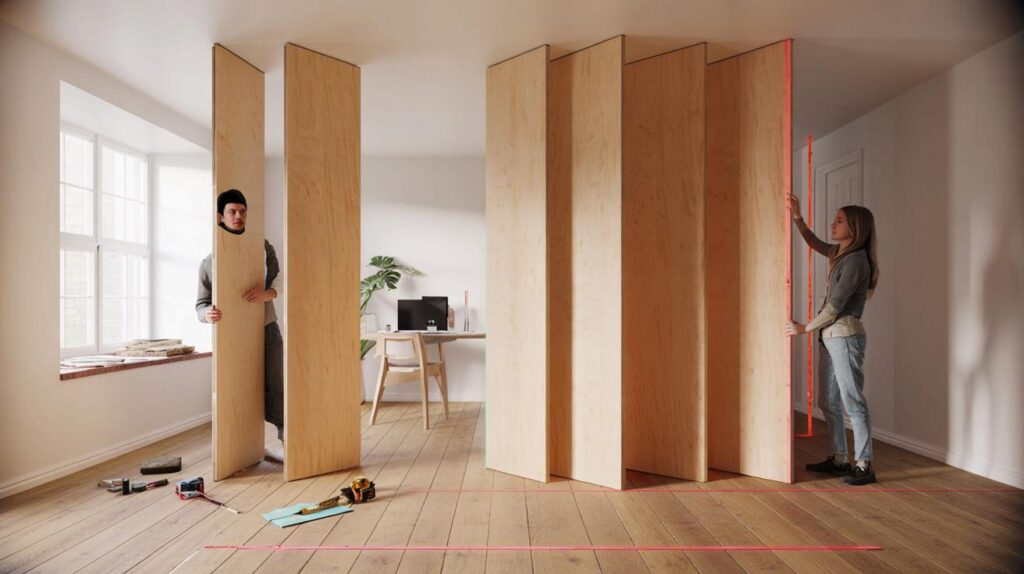
A London couple wanted a room divider that didn’t darken their flat, cost a fortune, or wobble after two months. So they built one from plywood — modern to the eye, rock-steady under hand, and slim enough to steal hardly any space. What they learned is both practical and oddly reassuring.
Saturday, pale light, clatter of a tape on oak boards. The kettle clicked off, the puppy stopped circling, and two people stood staring at an invisible line in the middle of their living room. She wanted a quieter corner to work. He wanted to keep the glow from the south window. They chalked the floor, rolled out a laser line, and lifted the first sheet of birch ply like it might bite. The flat smelled briefly of resin and coffee. Outside, buses coughed. Inside, there was the clean hush of a decision made. Then the tape measure snapped shut.
Why plywood became their best small‑space ally
Plywood gets dismissed as “builder’s stuff”, the backstage material behind the show. In a small flat, it can be the show. It holds a clean line, takes a soft edge, and stays flatter than most budget timbers. The grain warms a room that’s skimmed white. And it’s thin without feeling flimsy, which means you borrow square inches back from the floorplan, not hand them over.
They live in 42 square metres, which is basically a well-behaved shoebox near the Overground. The goal was simple: a work nook that didn’t feel like a cupboard. Using 18 mm birch ply, they cut three panels at 600 mm width and a full-height door panel at 720 mm, leaving 25 mm air gaps as shadow lines. Cost for timber and fixings: about £310. From first cut to last screw: two long afternoons and one late pizza. It felt like opening a new room inside the room.
Stability came from the way the pieces connected as much as the plywood itself. They fixed a slim base cleat to the floor, then locked panels with pocket screws into hidden battens. At the ceiling, rubber-backed compression pads kept everything plumb without chewing the plaster. Those 25 mm gaps were not just pretty: they relieved seasonal movement, let light leak sideways, and made the partition read as furniture, not a wall. The result looked intentional, not improvised.
The method that made it look designed — not DIY
The sketch mattered. They laid masking tape on the floor where the wall would run, then stood in the “future rooms” to test sightlines and sockets. A cheap laser level drew a bright red rule for plumb, and every cut referenced that line. Panels were pre-finished on trestles with a water-based varnish, light-sanded between coats, so the final assembly stayed clean. Order and lightness: that was the whole trick.
We’ve all had that moment when a tidy plan collapses at the first screw. Wood moves, blades burn, and corners surprise you. Let the sheets acclimatise a day in the room. Break sharp edges with 180-grit to stop splinters catching. Pre-drill for pocket screws and use a square as if it were a religion. Let’s be honest: no one does that every day. Do it just this once, and the result will repay you for years.
They told me the calm arrived the moment the first panel stood without a hand on it.
“We wanted it to feel like a piece of furniture that happened to be a wall,” she said. “A kind of quiet frame for our lives.”
Here’s the compact recipe that worked for them:
- 18 mm birch ply, cut into repeatable modules (600 mm wide), edges eased to a soft 2 mm radius.
- Hidden battens and pocket screws for strength, plus rubber pads at the ceiling for gentle compression.
- Matte varnish, two to three coats, to protect without glare; light sanding between coats.
- Shadow gaps of 20–25 mm to release light and movement, and to make the build read intentional.
- Threaded inserts where future shelves might go, so the wall can “grow” with you.
What a plywood partition changes after the weekend
Their living room didn’t shrink. It focused. The nook now holds a desk, a plant that likes indirect light, and the soft noise of work during the day. On Sunday, the same corner hides toys and an overnight bag. The main space feels calmer because it has a boundary. You see less, so you feel more at ease. At night, the gaps glow like a paper lantern and the whole thing reads like a built-in object, not a compromise.
| Key points | Details | Interest for reader |
|---|---|---|
| Modular plywood panels | 18 mm birch ply, 600 mm modules, eased edges, shadow gaps | Clear recipe you can copy room to room |
| Stable, non-destructive fixings | Base cleat, hidden battens, ceiling compression pads | Sturdy without wrecking floors or plaster |
| Design that saves space | Thin build-up, light-sharing gaps, furniture-like look | Gains privacy without losing precious square metres |
FAQ :
- Can a plywood partition really feel stable without anchoring into studs?Yes. A floor cleat and a ceiling compression detail create a rigid frame. Hidden battens and pocket screws lock panels so the assembly behaves as one piece.
- What thickness works best for strength and a slim profile?For full-height panels, 18 mm birch ply hits the sweet spot: stiff, clean edges, still visually light. Go 12 mm only for short spans or decorative screens.
- Will it block sound like a real wall?Not fully. It softens direct noise and improves privacy cues. Add a felt core, acoustic fleece, or double-skin sections if you need more hush.
- How do I finish the edges so they don’t chip?Round over slightly with 180–240 grit, then seal with matte varnish or hardwax oil. Two thin coats beat one heavy one for durability and feel.
- Can I make it flexible for the future?Yes. Pre-install threaded inserts or rails behind key zones. You can add shelves, hooks, or a sliding panel later without starting over.



Love how you made plywood the show, not backstage. The 18 mm birch, pocket-screw battens, and the base cleat plus compression pads feel properly engineered. The shadow gaps look chef’s‑kiss, and pre‑finishing on trestles is genius. Definately bookmarking for my 1‑bed.