
Energy bills are relentless, and hard water leaves its calling card on the one appliance we use without thinking: the kettle. In a kitchen in Kent, a dad squeezed a lemon, tipped the juice into a chalky jug, and watched the white crust dissolve like frost in sun. He swears his meter noticed.
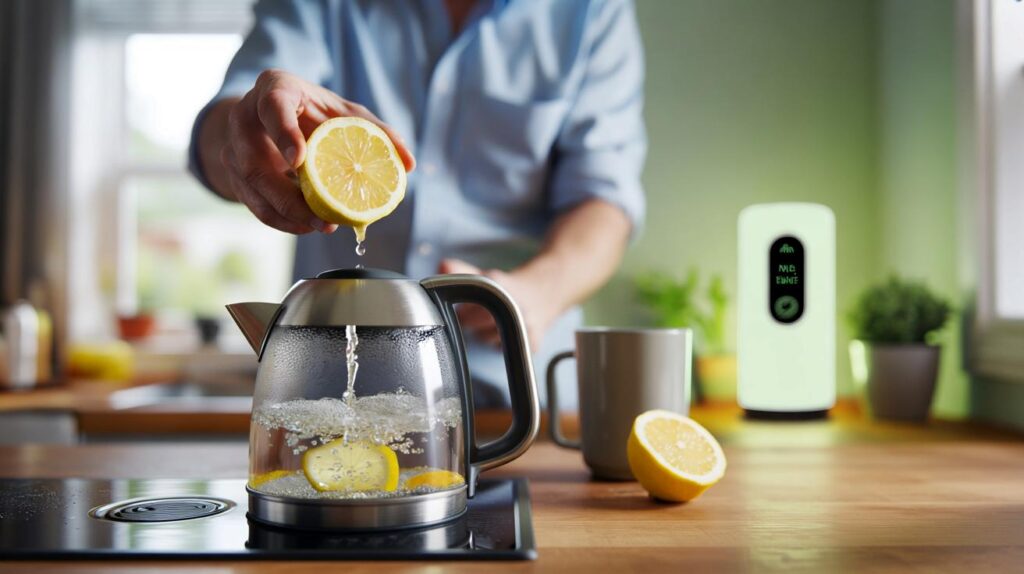
The first time I watched him do it, the kettle looked tired. White furring clung to the element, a crust that made it hiss and grumble as if each boil was a small argument. He held a lemon over the sink, rolled it under his palm, and sliced it open. Juice in. Seeds out. A clean citrus hit rose with the steam, and the kitchen smelled like someone had hidden a garden inside the appliance.
He pointed to the in-home display as we waited. The numbers usually spike when a 3 kW kettle kicks in. This time, they jumped, then settled quicker than I expected. The boil sounded smoother, less angry. The click-off came early. He grinned like he’d found a fiver in last winter’s coat. The meter blinked differently.
A stubborn crust, a simple citrus
In hard-water postcodes, limescale builds with the patience of a mason. Every cup leaves a trace, every trace becomes a layer, every layer steals a little heat. You don’t notice it until you do. The kettle takes longer, the sound turns scratchy, the tea tastes a shade duller. Then one day you look inside and see a coral reef where stainless steel used to be. That’s when the lemons start to make sense.
The dad, Mark, started measuring out of curiosity. Before the clean, a full kettle for family tea took around three minutes thirty and about 0.21 kWh on his display. After a lemon rinse, the same fill hit the boil in roughly two minutes fifty and landed closer to 0.18 kWh. Small change on a screen, real over a week. Four boils a day is normal in his house. That difference trims roughly 0.84 kWh a week, which at UK rates can shave a couple of pounds a month without anyone drinking less tea.
The physics is friendly here. Limescale is mostly calcium carbonate, a poor conductor of heat. It wraps the element and turns your kettle into a jumper. Heat has to push through that crust before the water gets the message. Limescale is an insulator. Engineering guidance often estimates that a millimetre of scale can add around ten percent to the energy needed for the same heat. Citric acid in lemon juice reacts with the carbonate, breaks it up, and the element gets its skin back. Heat moves. Water boils. The meter breathes out.
How to descale with lemon juice (and make it stick)
The method is simple enough to remember while half-asleep. Unplug the kettle. Half-fill with tap water so the limescale is fully covered. Squeeze the juice of one large lemon (or add three tablespoons of bottled juice), and drop the spent halves in for extra kick. Bring it to a boil once, switch off, and leave it to sit for 20–30 minutes. Pour away the cloudy mix, rinse, and boil fresh water twice, discarding both boils. The filter mesh at the spout deserves a quick rub too.
If your kettle is wearing a limestone tuxedo, repeat the boil-and-soak cycle. Glass kettles often show flakes drifting like snow; that’s normal during the clean. For very stubborn cases, a tablespoon of food-grade citric acid crystals in hot water works fast. Vinegar also works, though your kitchen will smell like a chip shop. We’ve all had that moment when the kettle sputters mid-morning and nobody wants to wait. Let’s be honest: nobody actually does that every day.
Mark keeps it breezy. “It’s not a ritual,” he told me. “It’s a lemon I’d otherwise forget in the fruit bowl.”
“After I did it once, I could hear the difference. The kettle sounded young again, and the meter stopped shouting. That’s all I needed.”
- Juice of one lemon, 20–30 minutes soak
- Boil once, soak, rinse, then two fresh boils
- Stubborn scale: add 1 tbsp citric acid crystals
- Clean the spout mesh and lid rim
- Repeat monthly in hard-water areas
It’s not about perfection; it’s about a quick habit that keeps the heavy build-up away, protects the element, and gives you faster tea without thinking.
The bigger picture: pennies, patterns, patience
Energy savings at home rarely arrive as drumrolls. They’re whispers. A second shaved here. A fraction of a kilowatt-hour there. Fold that into a routine and the graph starts to tilt. A kettle isn’t an air-source heat pump, but it is a daily ritual with potential. I didn’t expect a citrus to change the mood of a meter. The effect is local, relatable, almost cheerful. People copy what feels easy.
This isn’t about gadgets. It’s about friction. If the fix is quick, we do it. If the result shows up on a screen, we keep doing it. A lemon isn’t magic, yet it removes a literal barrier between the element and the water. That tiny change touches taste, time, and money. A clean element heats faster. Once you notice the calmer boil, you start spotting other small wins: matching your kettle fill to your mug, cleaning the showerhead, bleeding radiators when they gurgle, swapping a grimy bulb for an LED. Micro-upgrades, macro-comfort.
There’s also the feel-good factor. The kitchen smells like Sunday cooking rather than chemicals. No plastic bottles of heavy-duty cleaner, no warnings beyond common sense. Stainless steel and glass kettles tolerate lemon well; plated or delicate finishes just prefer a lighter touch and quick rinses. Add a sticky note to the inside of a cupboard: “Lemon day.” That’s the scale of it. Small savings stack across a year. Share the trick with a neighbour and it becomes a tiny part of the culture, the sort of thing people pass on with a smile.
| Key points | Details | Interest for reader |
|---|---|---|
| Lemon juice descaling works | Citric acid dissolves limescale on the element and jug walls | Faster boils, nicer tea, less appliance wear |
| Energy use can dip after cleaning | Mark saw ~0.21 kWh → ~0.18 kWh for a full boil | Small per boil, meaningful across weeks and months |
| Quick, low-cost routine | One lemon, 20–30 minutes, repeat monthly in hard-water areas | Easy habit with immediate, visible payoff on the meter |
FAQ :
- Is lemon juice safe for my kettle?Yes for stainless steel and glass. Rinse well afterward. Avoid long soaks on plated finishes and wipe rubber seals promptly.
- How often should I descale in a hard-water area?Every two to four weeks. Softer water households can stretch to every six to eight weeks.
- Can I use bottled lemon or citric acid instead of fresh?Both work. Use 3 tbsp bottled lemon juice, or 1–2 tbsp food-grade citric acid crystals for heavy scale.
- Will this affect my warranty?Manufacturers generally allow descaling. Check your manual and avoid harsh abrasives or immersing electrical parts.
- Why choose lemon over vinegar?Vinegar cleans well but leaves a strong smell and can linger. Lemon is gentler on noses and still dissolves carbonate effectively.



Tried it today—30 min soak, two rinses. Boil time dropped by ~30s. Tea tastes brighter. Nice one.
Are those meter numbers controlled for starting water temp and fill level? 0.21→0.18 kWh might just be less water or warmer inlet. Not anti-lemon, just want proper A/B.