
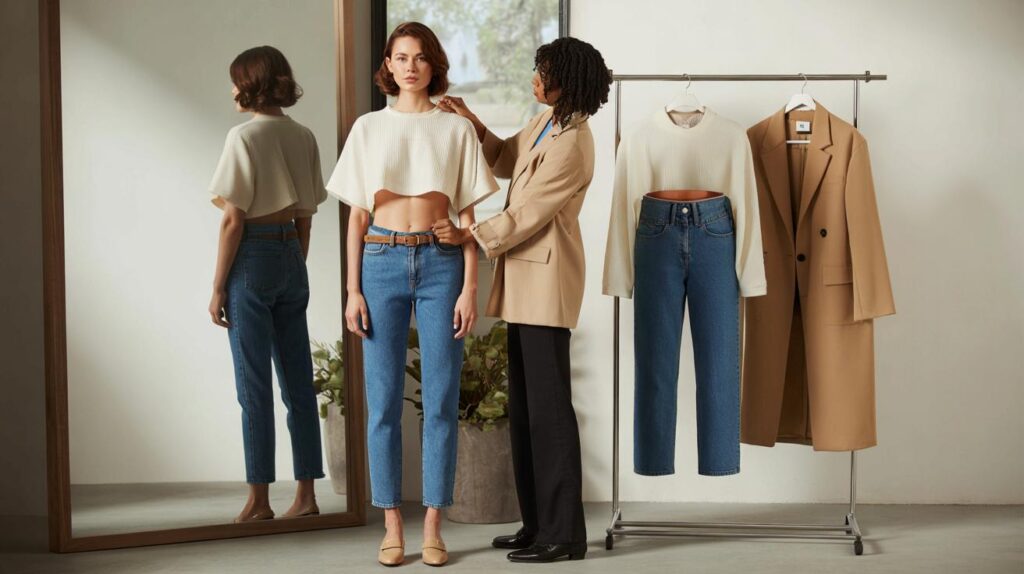
High-waisted jeans had a decade-long grip on our wardrobes. They turned T-shirts into outfits, made trainers look polished, and promised a waist where there sometimes wasn’t one. But in 2026, hems are loosening, tops are rising, and the waistband is quietly sliding down a notch. The shift isn’t dramatic or nostalgic. It’s practical, modern, and surprisingly flattering.
I first noticed it on a grey Tuesday, standing in a cramped styling cubicle with a client who’d sworn she’d never take off her high-waisted favourites. She wriggled into a mid-rise straight pair, looked up at the mirror, and her shoulders dropped like she’d been holding her breath for three years. The T-shirt fell just right, the belt sat where her body wanted it to, and her silhouette suddenly felt less forced. *I could almost hear a collective exhale.* The mirror didn’t lie.
The quiet drop: why mid-rise makes sense now
Mid-rise isn’t a fad; it’s a correction. After years of snatched waists and rib-cage denim, the centre of style gravity is moving back to the hip bones. You notice it in the way a cardigan skims rather than tucks, and how trainers look better with a flash of ankle and a softer waistband line. **Mid-rise isn’t a compromise; it’s a reset.** It keeps proportion without the pinch, and it works with the cropped knits, boxy tees and shorter jackets that 2026 is serving up.
On shoots this spring, I saw the same thing repeating: the mid-rise pairs came back from set with lipstick on the waistband and a queue of assistants asking for product codes. One model in her forties said she could sit on the floor during breaks without plotting her escape route. Another, twenty-two, styled her mid-rise with a micro-cardigan and leather belt, shrugged, and said, “It feels normal again.” We’ve all had that moment where a trend stops feeling like fashion and starts feeling like clothes.
There’s also the proportion game. High-rise can shorten the torso and broaden the hip line on some frames; mid-rise drops the visual equator so outfits breathe. Tuck a shirt half-in, let a jumper kiss the waistband, and your eye reads length rather than constriction. As suiting goes slouchy and shoes get chunkier, that tiny shift stabilises everything above the ankle. High waist didn’t fail us. **Our lives simply changed.**
How to pick the right mid-rise (and love it)
Find your rise in numbers, not vibes. Measure from the crotch seam to the top of the waistband: mid-rise usually lands around 22–27 cm for most women’s cuts (roughly 8.5–10.5 inches). Try three heights within that range and sit down in each pair. If your lower belly relaxes and your shirt hem falls by itself, you’re in the zone. The right pair should meet your natural bend when you hinge at the hips. That’s the sweet spot.
Let’s be honest: nobody actually does that every day. So here’s the quicker trick I use on set. Slip the jeans on, stand sideways in good light, and lift your arms like you’re putting a jumper on. If your top lifts and you don’t see a gap or a wedge of denim slicing your waist, that rise works with your life. Then test your shoes: mid-rise loves loafers, low-profile trainers and ankle boots with a gentle heel. Aggressive platforms can throw the balance off unless your leg is clean and straight.
Mid-rise styling lives and dies by hems and belts. Choose a leg shape that echoes the vibe you want: straight for everyday, gentle wide-leg for elegance, slim kick-flare for a lift. Then edit the top half. A boxy tee ends at the waistband and needs nothing else; a shirt likes a loose half-tuck to keep movement.
“Mid-rise is where your clothes stop fighting your body,” says London-based stylist Amara Quinn. “You get ease without the slump and polish without the squeeze.”
- Measure the rise; don’t guess.
- Test the sit-down feel before committing.
- Match belt width to belt loops for clean lines.
- Let tops skim rather than clamp.
- Hem to shoe: ankle-bone or a whisper longer.
What changed between 2016 and 2026
Work and weekends blurred, and waistbands followed. Remote days meant hours at a desk or at the kitchen table, and high-rise rigs that felt secure at 8 a.m. started to pinch by lunchtime. Mid-rise meets the ribcage less, which means breathing more. Denim mills clocked the memo and dialled in softer weaves, a touch of stretch, and waistbands that curve instead of bite. You feel it most when you exhale. Quiet relief is a trend, too.
Silhouette cycles also swung. After the clean, nipped shapes of the late 2010s, we slid into oversized outerwear, plump trainers, and cropped knits. A waistband parked just below the navel restores length between bust and hip, so the whole outfit reads balanced rather than boxy. Pair a mid-rise with a shorter blazer and the lapel falls where it should; add a trench and the belt sits in conversation with the jean, not shouting over it. The eye likes order. This is that.
Body diversity matters here. High-rise can be magic on some shapes, but it’s not an equaliser. Mid-rise gives curved tummies room, suits long torsos without climbing, and doesn’t punish short waists. **When a waistband meets you where you are, you stand differently.** I’ve watched clients straighten, soften, and stop fussing with hems the second they switch. Clothes shouldn’t demand performance. They should follow.
There’s a subtle psychology in the shift, too. High-rise came with a certain discipline: the tuck, the cinch, the posture. Mid-rise says, “Wear it and get on with your day.” That doesn’t mean sloppy. It means ease with intention. Keep the denim clean, the belt confident, and the top considered. You’ll look done without looking done up.
Between you and the waistband, fabric is the third player. Look for mid-weight denim with a little give—enough to move, not so much it bags by tea time. If you like structure, choose a cotton-rich mix and a contoured waistband; if you prefer drape, a tencel blend reads softer and swishes with ankle boots. Wash matters too. Mid-blue earns its keep, ecru freshens everything, and a deep indigo with tonal stitching clears the smart-casual hurdle at a glance.
If you’re curious where to start, raid your own wardrobe first. Try your favourite tees, that striped knit you wear on repeat, the trench you actually grab. Slip on a mid-rise and run your normal day for ten minutes: reach, sit, walk, fetch keys, check your phone, tie your shoe. If nothing shifts or digs, you’ve got your everyday pair. If your top fights the waistband, choose a hem length that meets it and moves with you. Easy wins are always hiding in plain sight.
For the belt question—which always comes—think proportion. A slim leather belt cleans up a straight leg and frames a tee like a picture. A thicker, matte style anchors a wider leg without shouting. If your loops feel empty, thread something through; if your outfit feels overdone, let the waistband breathe. The quiet details are the ones people clock without knowing why.
Trainers and mid-rise are a happy marriage. Low profiles keep the line sleek; a subtle platform lifts without bulk; boots want a hem that touches the top line or clears it deliberately. Crops should show the ankle bone and stop. Full-length trousers need a whisper of break or none at all. These tiny choices make mid-rise read modern, not middle-of-the-road.
Now about pockets and practicality, because they matter once you leave the mirror. Mid-rise often places front pockets where your hands naturally land, which is why they feel intuitive. The smartphone test—slip it into your back pocket, sit, and stand—should pass without a clunk at your lower back. If you feel the phone wedge under your waistband, the rise is probably too high for your day-to-day.
One last styling curveball: tucking. A full tuck with mid-rise is cleaner than you think if the top is light and the jeans are smooth. Half-tucks are your friend—left or right, never both—because they draw a soft diagonal across the torso. Untucked works when the hem hits the waistband and stops. It’s not about rules. It’s about rhythm.
On the editorial side, I’ve seen brands nudge their size charts to reflect reality. Rise descriptions are clearer, contoured waistbands more common, and inseam options broader. That means a better fit off the rail and fewer compromises at the tailor. If you do nip and tuck, take the hem first; changing length often fixes what you thought was a waist problem. Tailors are magicians with a single centimetre.
And yes, if you adored your high-rise, keep them. Fashion isn’t a custody battle. Rotate. Let mid-rise take weekdays and movement; save high-rise for a sharp shirt and heels when you want that cinched kick. Variety builds a wardrobe that works in real life, not just in your head or on a grid.
Mid-rise feels like getting your hands back. Your tops sit naturally, your belt is a choice not a crutch, and you stop negotiating with your waistband every time you sit down. The look is current without the costume-y edge that trends can bring. It reads grown-up, easy, and quietly put-together. The best part? You’ll wear them more, with more of what you already own. That’s the real upgrade.
| Point clé | Détail | Intérêt pour le lecteur |
|---|---|---|
| Mid-rise resets proportions | Waistband sits just below the navel, lengthening the torso | Outfits look balanced with cropped knits and boxy tees |
| Fit by measurement | Target a 22–27 cm rise; test the sit-down feel | Quick, repeatable method to avoid returns |
| Style it simply | Clean hems, considered belts, minimal tucks | Instant polish without effort or discomfort |
FAQ :
- What exactly counts as mid-rise?Typically a front rise around 22–27 cm (8.5–10.5 inches), sitting a touch below your navel on most bodies.
- Will mid-rise make my legs look shorter?Not if the hem and shoe are right; a straight or kick-flare with an ankle-bone hem keeps the line long.
- Can I still tuck my tops?Yes—try a loose half-tuck or a full tuck with lightweight fabrics for a clean, modern shape.
- What shoes work best with mid-rise jeans?Loafers, low-profile trainers, ankle boots with a small heel; avoid bulky platforms unless the leg is streamlined.
- Are high-waisted styles “over” now?No. They’re part of the rotation. Mid-rise is simply the everyday hero for 2026 wardrobes.



Loved this breakdown—mid-rise finally makes sense beyond trend talk. The point about dropping the visual equator so outfits breathe is spot on, and the 22–27 cm guidance is helpful. I swapped one high-waist pair for a mid-rise straight and my tees sit better, belts stop fighting, and I don’t feel corseted at my desk. Not giving up high-rise forever, but this reads like a reset, not a downgrade. Also, the ‘hem to shoe’ note saved me from chunky platform chaos.
Is this really about comfort or just the trend cycle spinning again? Feels like we’re being nudged every few years—low, high, now mid. My torso is short; high-rise actually balanced me. Convince me mid-rise won’t definately make me look boxier and shorter, tbh.