
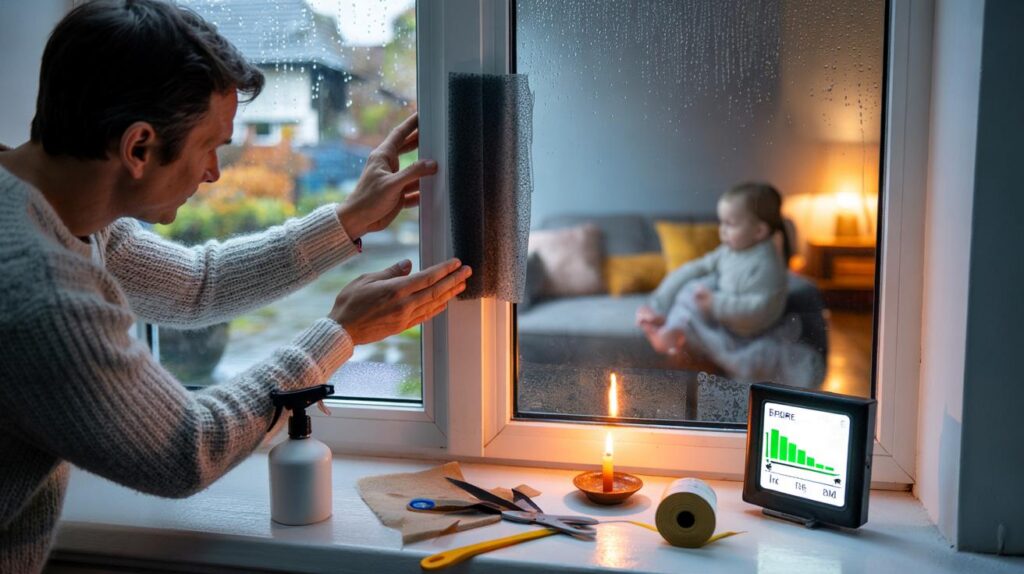
High bills don’t always come from big problems. Sometimes it’s the tiny gaps you stop seeing that slowly drain your money and your heat. This is the story of one dad, one draught, and a simple fix that changed autumn at home.
I met Dan on a wet Tuesday, the kind that hangs like a heavy coat over the estate. He was standing by the living-room window with a mug going cold and a grin he couldn’t tuck away. Condensation had been a winter ritual here: towels on the sill, the tumble-dryer arguing with the boiler, kids wrapped in hoodies for breakfast. He’d done what most of us do—turned the thermostat up a degree, then another, and hoped the bill wouldn’t bite. It did. The change came from something almost embarrassingly small. Not new windows, not a shiny heat pump, not even smarter habits. Just a thin black line running quietly around the frames. The fix was a £9 strip of rubber.
When a father notices the draught that everyone else forgets
Dan didn’t start with a plan. He started with a feeling. The room never quite warmed up, even when the heating clicked on like clockwork. You know that ghost of cold that hangs around your ankles? That. He held a tissue by the window and watched it twitch. The curtain lifted the way a dog lifts an ear. Autumn had moved in by the millimetre. In that moment, the windows stopped being just windows. They were tiny open doors to the street, and he was paying for the privilege.
He tried the candle test first. Flame wobbled along the hinge side, then flattened near the lock. The seals had that tired, greyed look—flattened foam, brittle rubber that cracked if you pinched it. He checked every frame the same way, one hand on the latch, one eye on the flicker. His smart meter graph told a similar story: gas spiking earlier, running longer, never hitting the cosy plateau. He compared October to last year. Same weather, same routines, a good chunk more usage. Not a disaster. A slow leak of pounds and heat.
Once you see infiltration, you can’t unsee it. Warm air escapes. Cold air slides in. The boiler thinks the house is larger and leakier than it is, so it cycles longer to hit the same setpoint. That’s how a 3 mm gap can behave like a hole in your coat. The rubber seals that used to flex and press tight had aged out; compression set is the dull phrase that explains it. Swap them, and the contact line is restored. The lock pulls the sash in, the seal deforms, the air stops slipping through the path of least resistance. *It’s not glamorous work, but it’s an instant change you can feel with your cheek to the frame.*
How he replaced the seals without turning the house upside down
Dan started small: one window, one afternoon. He popped the old foam strip out with a butter knife, then rolled it off like chewing gum from the frame. He wiped the groove with warm soapy water, then a quick pass of isopropyl on a cloth. He measured the gap with the oldest DIY tool in Britain—a bank card. If the card slipped easily around the closed sash, he needed a thicker profile. He picked EPDM rubber in a P-profile for the larger gap, E-profile for the snug ones, and self-adhesive V-strip for the hinge side. Cut clean, corners mitred, pressed into a dry channel. Close, listen, breathe. Silence.
Here’s the rhythm he fell into: open the window; peel off the spent seal; clean until the cloth stays white; dry; offer up the new strip without removing the backing to test the bend; mark the corners; cut in one confident stroke; peel a little at a time; press with a thumbroll; close and lock. Don’t rush the corners. Don’t stretch the rubber. He left trickle vents as they were, because stale air and damp are thieves of comfort too. Let’s be honest: nobody does that every day. He did three windows in an hour once he’d found his pace.
He told me the win was part comfort, part maths. He logged boiler run time across two cool snaps a week apart and saw about a 12% drop after sealing the worst offenders. Not a laboratory test. Real life. The living room hit 19°C faster, and the kids sat on the floor again, not on the sofa with their toes tucked under them. The soundproofing felt better too. He spent just under £30 on strips and a small tube of clear silicone for a stubborn corner on the bathroom window. “It felt like cheating,” he laughed. “Like I’d been paying a cold tax for years without noticing.”
“If a window closes without you needing to lean on it, the seal is probably wrong,” Dan said. “When it’s right, there’s a gentle resistance. A soft ‘thunk’. Then the draught is gone.”
- Spot the gap: tissue test, candle test, or a damp hand along the frame.
- Match the profile: E- or P-profile for uPVC, V-strip for hinge sides and timber sashes.
- Prep matters: clean, dry, and never stretch self-adhesive seals during application.
- Keep ventilation: don’t tape over trickle vents; watch for condensation after changes.
- Check doors too: letterbox brush, threshold seal, and a simple door snake can add up.
What the savings really look like once the warmth stays in
The numbers won’t be the same for every house. Dan’s semi uses gas for heat, a three-bed with uPVC windows that saw two decades of British weather. After resealing the main rooms, his October bill eased by about £24 compared with similar temps last year, even with a lively six-year-old discovering hot chocolate. That’s not a miracle. That’s the kind of small, reliable win that stacks. Over a full season, the curve is gentler. A boiler that idles less. Rooms that don’t lose their edge of warmth the minute the flame goes quiet. One tweak, fewer overcorrections.
There’s a simple logic. Reduce uncontrolled air leaks and your heating system stays within a smaller thermal envelope. The thermostat stops chasing a moving target, so overshoot drops. That often means you can nudge setpoint down half a degree without feeling it at the sofa level. Dan said the big surprise was sleep. The kids’ rooms no longer swung from stuffy to chilly by 3am. Windows still breathed through trickle vents, which kept condensation in check. And yes, he kept a carbon monoxide alarm near the boiler because fresh air still matters when you tighten the shell. Comfort and safety are teammates here.
We all know that moment when you pull a curtain and feel that sneaky ribbon of cold. It’s a tiny betrayal. You don’t need to turn into a building physicist to fix it. Think like water: find the path of least resistance and put a soft dam in the way. Rubber. Foam. A clean surface. Test one room, live with it a week, and only then carry on. You’ll start listening to your windows like they’re instruments being tuned. And the house will play a calmer note. That’s when your heating finally feels like it belongs to you.
| Key points | Details | Interest for reader |
|---|---|---|
| Small gaps leak big money | Flattened or cracked seals let cold air in and warm air out, forcing longer boiler cycles | Actionable reason to check frames before splurging on new windows |
| DIY fix in an afternoon | Choose the right profile (E, P, V), clean thoroughly, cut clean, don’t stretch adhesive | Confidence to try a low-cost upgrade with quick comfort gains |
| Measured, real-life impact | Dan saw around 12% lower gas use across similar cool spells after resealing | Practical expectation setting, not hype, with a family-home lens |
FAQ :
- How do I know which seal profile I need?Close the window on a bank card; if it slides freely, pick a thicker P-profile. For tighter gaps, E-profile works. Use V-strip on hinge sides or where timber meets timber.
- Will sealing make my home damp?It can if you block ventilation. Keep trickle vents open, use extractor fans when cooking or showering, and watch for new condensation in the first week.
- Can I do this on timber windows?Yes. Clean the rebate and consider a non-adhesive compression seal in a routed groove. For quick wins, self-adhesive V-strip along the meeting rail helps.
- How much does it cost for a typical three-bed?Between £20 and £60 in materials, depending on how many frames and profiles you need. Most of the cost is time and a bit of care at the corners.
- Do I need to tell my landlord or freeholder?For removable seals on existing frames, usually not. If you’re altering frames or routing grooves, ask first. Keep packaging to show it’s reversible.



Tried this today on our draughty lounge window and the bank card test was a dead giveaway. Swapped in EPDM (E on the tighter frames, P on the worst gap) and got that lovely soft “thunk.” Cost me £18 and a cuppa. Early smart meter glance shows ~10% less gas over two cool evenings. Thanks! 🙂
I’m curious about the 12% drop: did you weather-normalise with degree days? Same occupancy, same cooking/drying patterns, and identical thermostat schedule? Not doubting seals help, just that without controls it’s easy to confound the experiement. Any boiler cycle counts, flow/return temps, or setpoint logs before/after to compare?