
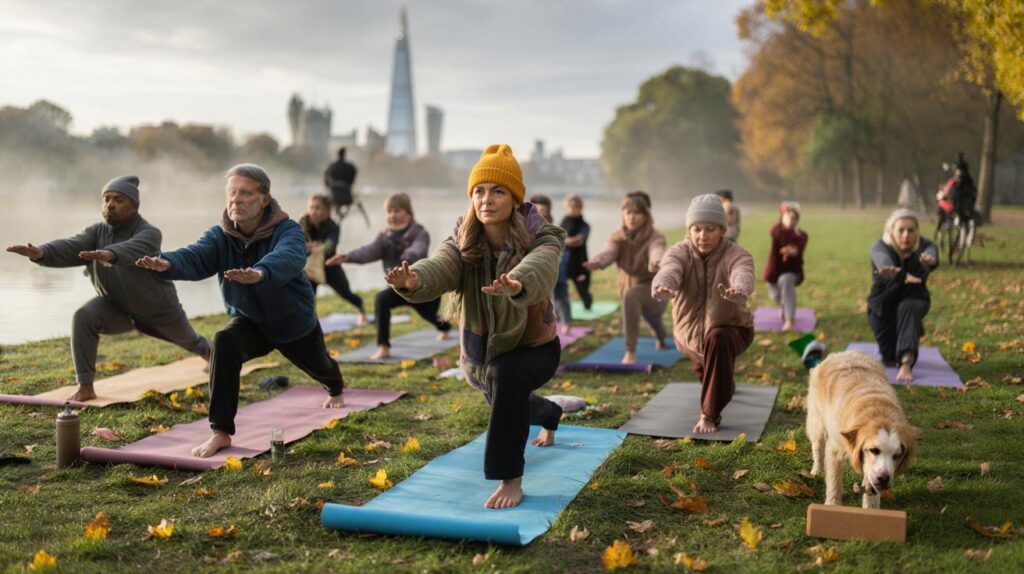
Autumn 2025 has arrived with inbox pings, early darkness and that low hum of unease that sits behind the ribs. Commutes are wet, meetings pile up, sleep gets patchy. Your feed talks breathwork while your calendar laughs. The gap between what we know we “should” do and what we can actually fit in feels wider than the Thames. A London fitness coach thinks the answer might be as simple as rolling out a mat under a tree, jacket zipped, breath turning to mist.
The park smells of damp leaves and coffee. A dozen mats make a soft grid on the grass, each one anchored by a bottle or a shoe, just in case the wind gets playful. A coach in a bright beanie moves through the group, voice low and steady, like someone reading the tide. Cyclists hiss past. A labrador investigates a block and is gently negotiated away. Then the first long exhale drifts up and the noise of the city tilts. Something changes.
Why a chilly park beats a warm studio this autumn
Outdoor yoga tangles your senses back into the present. The air is cool on your cheeks. The ground is uneven, so your feet talk to your brain again. Leaves move in your peripheral vision, which nudges your nervous system to scan, settle, scan, settle. *For a moment, the world gets quiet.* This isn’t esoteric. It’s the body clocking light, space and texture, and deciding the sabre-toothed emails can wait. **Stress lives in the body**, so the body becomes the door out.
“Mark”, 38, works in product and has spent the year ricocheting between deadlines and energy drinks. He tried one session at lunch in Clissold Park “as a dare,” he laughs. He kept returning because the shift was immediate: standing in Tadasana, watching a plane thread the grey, he noticed his shoulders drop all by themselves. A large UK study found people who spend around 120 minutes in nature each week report higher wellbeing. Mark didn’t clock the minutes. He clocked the feeling on the walk back.
There’s simple physiology here. Daylight hits the eyes and tunes your internal clock, making afternoon slumps less brutal and sleep more likely to show up on time. Peripheral vision widens, which calms the threat response. Breathing slower in the cold air lengthens your exhale, nudging the vagus nerve like a friend tapping your shoulder. Muscles co-contract a little on uneven ground, so balance work becomes smarter, not harder. Your brain reads horizon plus rhythm as “safe”. **Slow is strong.**
How to start outdoor yoga in October and actually enjoy it
Try the “5-3-5 park flow” when the clouds behave. Five intentional breaths, three shapes, five minutes of rhythmic walking. Stand with feet hip-width, inhale through the nose for four counts, sigh out for six. Repeat five rounds. Flow three poses: Chair with weight in heels, Low Lunge with fingers brushing the grass, Warrior II with eyes soft on a far tree. Finish with a five-minute walk, arms swinging, counting steps to four. You’ll come back changed, even if the to-do list hasn’t.
Layers are your friend. Start cool so you don’t overheat, then peel a hat or fleece as you warm. Go for traction, not perfection: a slightly older mat grips well on damp ground. Keep the shapes smaller than you would indoors. The ground might be lumpy, and that’s fine. Don’t chase a sweaty flow when the air bites; favour strength holds and spinal mobility. And keep it short. Let’s be honest: nobody really does this every day. Two or three times a week is plenty to shift your mood.
Common wobbles? People tense their jaw when the breeze picks up. Soften it. Others force deep backbends when the body isn’t warm; swap in cat-cow waves and slow twists. Some stare at their phones between poses and lose the thread. Park yoga works because it steals your attention back. **Cold air can be your ally** if you treat it like a coach, not a punishment.
“You don’t need incense or perfect silence,” says Sofia Grant, a London-based fitness coach who runs free park flows at lunchtime. “You need a patch of grass, a sky to look at, and a breath you can hear.”
- Park kit: light base layer, warm top, beanie, grippy mat, small towel.
- Warm-up: 60 seconds of brisk walking and ankle circles before you flow.
- Cues that help: soften jaw, heavy heels in Chair, long reach in Warrior II.
- Breath pattern: in for four, out for six, like waves on shingle.
- Time window: late morning or early afternoon to catch the better light.
- Phone on airplane mode. Your brain will thank you later.
What this does to your autumn brain
Autumn asks for different energy. Less sprint, more stride. Outdoor yoga respects that. It’s not an escape from life; it’s a way of staying in it without drowning. After a few weeks, people often notice they ruminate less on the walk home. Decisions come quicker. The edge blurs. We’ve all had that moment where the day feels like wet wool, heavy and clingy; one rhythmical session in the park can wring it out just enough to move again.
There’s also a small social current that runs through these sessions. A nod to the runner looping past. A smile from the dog owner. A shared eye-roll when the drizzle starts and nobody leaves. Those micro-moments are underrated. They remind your system that you’re part of a scene bigger than your inbox. And something else happens when you look up at a skyline in Warrior II. The city becomes a backdrop, not a cage. That’s a subtle, powerful reframe.
The practice doesn’t need to be perfect to work. You might do ten minutes by a tree between calls. You might go full sequence on a Sunday and lie in Savasana with your beanie pulled over your eyes. You might stop halfway because the clouds get bossy. It still counts. Your body loves rhythm. Your mind loves horizons. Your week loves one pocket of outdoors that belongs to you. What would change if that pocket showed up more often?
| Key points | Details | Interest for reader |
|---|---|---|
| Light and horizon reset | Daylight tunes your body clock; looking far eases threat response | Better sleep cues, calmer afternoons, clearer head |
| Simple outdoor flow | 5-3-5 method: five breaths, three poses, five minutes of walking | Easy to try today, no special gear, real-world friendly |
| Cold as a coach | Cool air deepens exhale; uneven ground sharpens balance | Fast stress relief, smarter strength without overdoing it |
FAQ :
- Isn’t it too cold for yoga outside?Not if you dress in light layers and keep the shapes contained. Cold air can actually help lengthen your exhale, which calms you down.
- What if I’m a complete beginner?Stick to simple poses like Chair, Low Lunge and Warrior II. Focus on breath and balance. Two short sessions a week will teach you plenty.
- When’s the best time in autumn?Late morning or early afternoon gives you better light and slightly warmer air, which helps with mood and concentration.
- Do I need special gear?A grippy mat, a warm top or beanie, and a small towel are enough. Choose shoes you can slip on and off without a faff.
- What if the ground is wet or uneven?Embrace it. Use smaller ranges of motion, keep heels heavy, and place the mat on the driest patch you can find. Wobble is part of the training.



Love this. The 5-3-5 park flow is actually doable between meetings, and the “cold as a coach” bit clicked—my exhale got longer without trying. Thx for the clear cues (heavy heels, soften jaw). Defnitely stealing the beanie + grippy mat combo this week.