
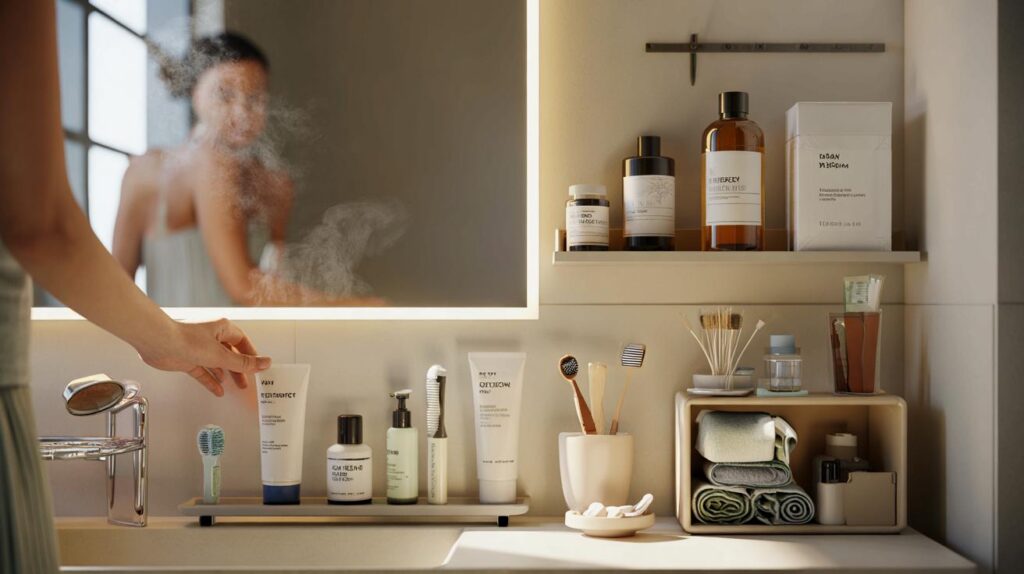
Mornings slip through our fingers in the bathroom: lids go missing, bottles topple, and the thing you need is always behind the thing you don’t. A home organiser’s trick — arranging shelves by how often you reach for each item — quietly shaves minutes off the rush. It’s not about rainbow labels or decanting into pretty jars. It’s about reach, rhythm, and reality.
Steam curled from a hot shower while a toothbrush clinked in a mug. On the shelf, a jumble of face serums, travel shampoos and dead hair ties formed a small city, the capital being chaos. A home organiser named Lucy Hall watched a family of four in a semi in Bristol do the morning dance: dad patting pockets for floss picks, mum kneeling to rummage behind a tower of bath bombs, a teenager conducting a frantic search for the “good” moisturiser. It felt like the bathroom was sending them on a scavenger hunt before breakfast. Lucy didn’t pull out a label maker. She asked one question: “What do you reach for every single day?” Then she moved one shelf and started a quiet revolution. She started at eye level.
Put the daily things where your hands land
Lucy swears the biggest bathroom upgrade isn’t a new vanity. It’s placing the things you use daily where your hands naturally land. That sweet spot is eye-to-chest height, centre front, no lids to unscrew, no basket to drag out. **Frequency beats aesthetics every single morning.** If your toothpaste lives behind spare candles because that’s where there’s space, you’ve accidentally designed a micro obstacle course. You can feel it in the way you sigh.
She mapped the family’s habits with a pen and a cuppa. Toothpaste, favoured moisturiser, cotton buds, razor, deodorant — all “daily”. Hair mask, bath oil, whitening strips — “weekly”. Travel minis and guest bits — “rare”. Then she timed the morning. Before, the family clocked 17 minutes of stop–start faff for two people to get ready. After moving the “daily five” to the prime zone and pushing weeklies high and rares low, it dropped to 9. No stopwatch needed to notice the calm. Mum said it felt like a cleared table before dinner.
There’s a simple physics behind it. We default to what’s within easy reach and within line of sight. If daily items live in the “costly” zones — too high, too low, too hidden — you pay in time and tiny frustrations. In design terms, reduce friction by shortening the reach and cutting the steps. In life terms, make the path to toothpaste the shortest path in the room. That’s the logic: fewer moves, fewer decisions, fewer sighs.
Sort by frequency, not by category
Empty your shelves. Group items by how often you truly touch them, not by brand or category. “Daily” is anything you used in the last 72 hours. “Weekly” sits under that. “Occasional” is everything else — guests, spares, special treatments. Now rebuild from the middle out: daily items front and centre at eye-to-chest height, weekly on the top shelf or back row, occasional either highest, lowest, or in a labelled caddy. Put lids in a small dish. Store duplicates together. You’ve just created a bathroom that behaves like a helpful shop front.
Trays and risers are your secret weapons. Use a narrow tray for the “daily five” — toothpaste, moisturiser, deodorant, razor, cotton buds — so the whole routine slides out as one. Add a small riser for tiny bottles so nothing hides behind anything else. If you have children, designate a lower “gold zone” for them with just their essentials. Let scent and skincare fans keep their collections, but give them a higher “display shelf” so the daily lane stays clear. Let’s be honest: nobody really does that every day.
Labels help only after layout does the work. The real shift is setting a rule: if you use it most days, it has a front-row seat. Small daily wins come from ruthless access, not prettier containers. Lucy calls it “one reach living” — one reach, one action, done. She puts it like this:
“You shouldn’t have to move three things to brush your teeth. Organising is less about looks and more about removing the next annoying move.”
- Gold zone: eye-to-chest height, centre front — daily items only.
- Silver zone: top shelf or back row — weekly treatments and tools.
- Bronze zone: lowest shelf or a closed box — guests, spares, travel.
- 60-second reset: slide the daily tray back to square one each evening.
- Colour dots for families: one colour per person on lids and labels.
- Overflow rule: when the spare bin is full, pause buying.
Common slips — and the kinder fixes
We’ve all had that moment when a slick of conditioner takes out three bottles and a toothbrush like dominoes. The culprit is nearly always depth. Deep baskets and deep shelves create blind spots where stuff vanishes. Go shallow and narrow. Use standing file sorters for hair tools. Mount magnetic strips for nail clippers and tweezers. If you must stack, stack only things you use weekly. Save the prime zone for the uncaps-and-go items.
A big time thief is mixing people’s daily kits. Create a clear lane per person: a mini tray each, a dot sticker each, even a narrow caddy each if you share a small shower room. Keep duplicates where it counts — a razor each, a toothpaste each if that stops the “who moved it?” chorus. And if your mirror cabinet is deep, bring items forward with a low riser so labels face you. That tiny tilt matters when you’re half-awake.
Decanting looks lovely until it becomes homework. If a pump bottle makes you refill twice a week, skip it. Keep original packaging for anything used fast, and save decanting for slow movers like bath salts. A wipeable tray beats a basket that traps drips. Store backup stock together in a labelled shoebox on the highest shelf, and pull from there. That way, you notice when you’re on your last tube instead of discovering a forgotten third one behind the bleach.
Make it stick in real life
Routines survive when they respect your hands, not your hopes. Put a tiny bin at arm’s length so floss picks don’t wander. Keep a flannel hook at child height so towels don’t live on the floor. Swap fiddly jars for flip lids. If everything flows with your natural movements, you stop policing the system. The shelf runs itself. And that’s the point: more time for breakfast, fewer small arguments, less rummaging. **The bathroom you reach for without thinking gives you time back you can spend elsewhere.**
| Key points | Details | Interest for reader |
|---|---|---|
| Organise by frequency | Daily items in the gold zone, weekly in silver, occasional in bronze | Shaves minutes off the morning without buying new furniture |
| Create “one reach” setups | Use shallow trays, risers, and clear lanes per person | Less rummaging, fewer spills, faster reset at night |
| Tame depth and overflow | Go shallow, label spares, keep overflow high and out of the way | Prevents duplicates and the “where did that go?” spiral |
FAQ :
- How do I decide what’s “daily” if my routine changes?Audit a single week. Anything you touch four or more times goes in the gold zone. Rotate seasonals twice a year.
- I’ve got no shelves, just a tiny mirror cabinet.Create tiers with a low riser, and add a narrow tray on the basin for the daily five. A magnetic strip on the cabinet door holds tools.
- What about shared bathrooms with teens?Give each person a slim caddy and a colour dot. Daily caddies live in the gold zone; everything else has a higher home.
- How often should I reset the system?Do a 60-second reset at night. Once a month, sweep out weeklies and check the spare bin. That’s enough.
- Are lazy Susans safe for glass bottles?Use a rubber-lined turntable and keep it for weeklies. Daily glass goes front and still to avoid spinning mishaps.



Tried the “daily five” tray last night and our morning went from chaos to calm. The “one reach” rule actually works. Never thought moving toothpaste forward would save 5 min. Cheers, Lucy!