
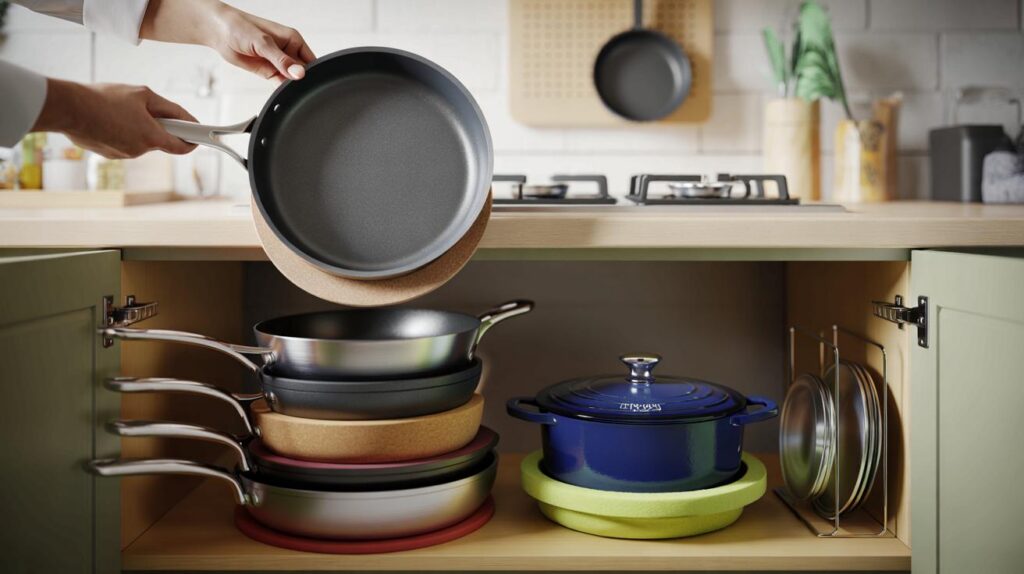
Saucepans nesting like Russian dolls sound tidy until the top one wobbles and kisses the non‑stick below. That soft hiss of metal-on-coating is the sound of money disappearing — and cupboard space going with it. There’s a kinder way to stack, and it starts with what you put between the pans.
It’s Saturday morning and the cupboard under the hob groans like it knows the job ahead. I reach for one frying pan and three others come with it, clanking like cymbals at the school play. A faint grey scuff on the non‑stick catches the light. That little flaw looks almost shy, but it’ll only grow.
We’ve all had that moment when you swear a stack was stable, then the lids slide and the whole lot avalanches at your toes. In a small flat, space is precious — but so is a pan that actually releases an egg. I rang a kitchen expert with a simple brief: save the coating, save the space, save my sanity. The fix sits in your sock drawer.
Why pans get scratched in stacks (and how to stop it)
Scratches don’t come from nowhere; they come from micro‑movement. Even a gentle nudge makes the base of a heavy pot act like sandpaper against a delicate non‑stick. Rivets, rolled rims and exposed steel rings are the quiet culprits that chew at coatings while you’re reaching for the colander.
In a cramped London galley kitchen, a friend showed me her “calm cupboard” trick. She’d cut circles from an old wool jumper and dropped one between each pan. The next time she pulled a skillet, it came away like a book from a shelf — no shudder, no scrape. Three months on, the mid‑priced non‑stick still looked almost new, and the cupboard didn’t sound like a drum kit.
Materials matter. Non‑stick is soft by design, stainless is tougher but can stamp its texture into a coating, cast iron is weighty and its seasoning hates abrasion, enamel chips when knocked at the rim. Heat also plays a role: a warm pan against a cool one can create stick‑slip friction that etches tiny lines. The stacking rule of thumb is simple: soft surfaces don’t like hard neighbours without a cushion. Put a barrier between unlike materials and let weight sit on weight, not on coatings.
The expert method: safe stacks in tight cupboards
Start on the counter. Group pans by material: non‑stick, stainless, cast iron, enamel. Dry every piece fully, including the rim and under the handle, then pair each pan with a soft separator — felt pad, thin cork trivet, silicone liner, even a folded tea towel cut to size. Stack largest to smallest with handles alternating left-right to lock the pile, and park lids vertically in a file organiser rather than on top. **This simple habit turns a wobbly tower into a quiet, stable library of pans.**
Little frictions cause big scars, so change the moves. Don’t slide a pan off the stack; lift it straight up, pad still stuck to its base. Avoid topping a non‑stick with stainless or cast iron; let the heavier pan live beneath. Cool pans before nesting, and wipe stray salt or grit from the base before they meet again. Let’s be honest: nobody does that every day. So set a minimum rule you will keep — pads between every pan, and lids stored on their own.
“Think of separators as seatbelts for cookware,” the expert told me over a crackly line. “You don’t need them until — you really need them.”
“If you won’t buy pads, raid your drawers. Paper plates, felt from an old jumper, even coffee filters cut into circles — they all create that safe, low‑friction buffer.”
- Cut‑to‑fit felt circles for non‑stick and enamel.
- Thin cork or silicone trivets under stainless bases.
- Pool‑noodle sleeves along the rim of a Dutch oven for stackable edge guards.
- Tension rods or a magazine file to stand lids upright.
- Stick‑on bumpers under pan bases to stop skating in deep drawers.
The tidy‑kitchen mindset that frees space without sacrificing pans
Space grows when you stop stacking lids on pans. Park lids vertically in a rack, set a divider to separate frying pans from saucepans, and give cast iron its own short pile with thick pads. *One shelf planned this way feels twice as big, because every grab is a single movement.* You’ll cook more when the cupboard doesn’t argue back.
If you’re fighting a corner cabinet, go vertical. Slim pan racks turn the stack on its side, which takes the pressure off coatings. A shallow pull‑out tray creates a “no more digging” zone for everyday pans, while less‑used stockpots live in the back with jumbo pads. **A pegboard on a free wall is a quiet hero — it lifts your best pans out of the scratch zone entirely.** Keep a small envelope of spare separators in the cupboard so a washday doesn’t break the system.
There’s also a tidy ritual after washing that pays back. Dry rims first, then the base, then drop a separator on while the pan is still on the counter. Place it into the stack like a book returning to a shelf: straight in, click, done. If the cupboard feels cramped, remove one pan you rarely use and store it elsewhere. **Space isn’t only what you add — it’s what you edit.** Small, repeatable moves are what keep your pans young.
| Key points | Details | Interest for reader |
|---|---|---|
| Use soft separators | Felt, cork, silicone, tea towels, paper plates cut to size | Protects coatings instantly without buying new gear |
| Stack by material and weight | Heavy under light; avoid stainless on non‑stick; separate cast iron | Fewer scratches, longer pan life, calmer cupboard |
| Store lids vertically | File organisers, tension rods, or a dedicated rack | Frees shelf space and stops wobble‑inducing lid slides |
FAQ :
- What can I use if I don’t have pan protectors?Cut circles from an old jumper, fold tea towels, use paper plates or large coffee filters. They’re soft, thin and easy to wash or replace.
- Is it safe to stack cast iron?Yes, with thick pads and minimal weight on top. Keep enamelled cast iron separate or fully cushioned to protect the rim and enamel.
- Why do my non‑stick pans scratch so fast?They’re softer by design. Sliding, lid rubbing, and stacking mixed materials without a buffer create micro‑abrasions that build into visible scars.
- Should lids sit on the pans in storage?Better to stand them up in a rack. Lids slide and grind on rims, which leads to chips, squeaks and unstable stacks.
- Do vertical racks really save space?They do. Turning pans on their side reduces footprint and weight stress, and makes it a one‑hand grab instead of a tower lift.



Saved my non‑stick. Definately switching to vertical lids.