
Designer bouquets feel like a splurge. Supermarket flowers feel like a compromise. A London florist says the difference isn’t price — it’s what you do in the first five minutes after you get them home.
It was raining on Columbia Road, the kind of soft, sideways London rain that turns pavements into mirrors. Inside a narrow studio that smelled faintly of eucalyptus and coffee, florist Amelia Hart dumped a crinkly supermarket sleeve onto the table and started cutting, quick and calm, like she’d done it a thousand times. “People think cheap flowers have to look cheap,” she said, flicking cellophane into the bin with a laugh you could hear over the kettle, “but the trick starts before you even get home.” The stems clinked against a chipped jar, a little mess building, her hands moving in a steady spiral. She wasn’t arranging. She was editing.
Why supermarket flowers look flat — and how to see them differently
Most supermarket bunches come packed to survive a lorry ride and a fluorescent aisle, which is why they’re bulky, tight, and oddly uniform. The sleeves force everything upright, the foliage is generic, and the colours are loud so they pop under strip lights, not daylight. The first upgrade is to stop seeing a “bunch” and start seeing raw materials. Once Amelia tears off the plastic, she sorts by type and tone, not by what came together. That mental shift — from consumer to editor — is where the designer look begins.
A few streets from her studio, I watched a woman tuck a £5 bunch of pink roses and yellow lilies into a tote, then hesitate at a puddle. We’ve all had that moment where a cheap bouquet looks hopeful on the till receipt and oddly sad in a vase by day two. Amelia gets it. She used to work the early shift, grabbing stems on her way home, experimenting until a pattern emerged. “If you treat them like ingredients,” she told me, “you stop fighting the bunch and start styling the room.” Her clients noticed, and then they started asking how.
Designer bouquets look expensive because they look intentional. They have breathing space, a clear colour story, and a shape that’s wider than the vase. Supermarket bunches try to do everything at once — too many colours, too many heights, filler everywhere. Amelia’s logic is ruthless and kind: remove the noise, repeat the nicest thing, and shrink the scale so the flowers feel abundant. You’re not adding luxury; you’re removing distraction. The result tricks the eye, and the eye is what sets “designer” apart from “did my best”.
The trick: split, spiral, and shrink
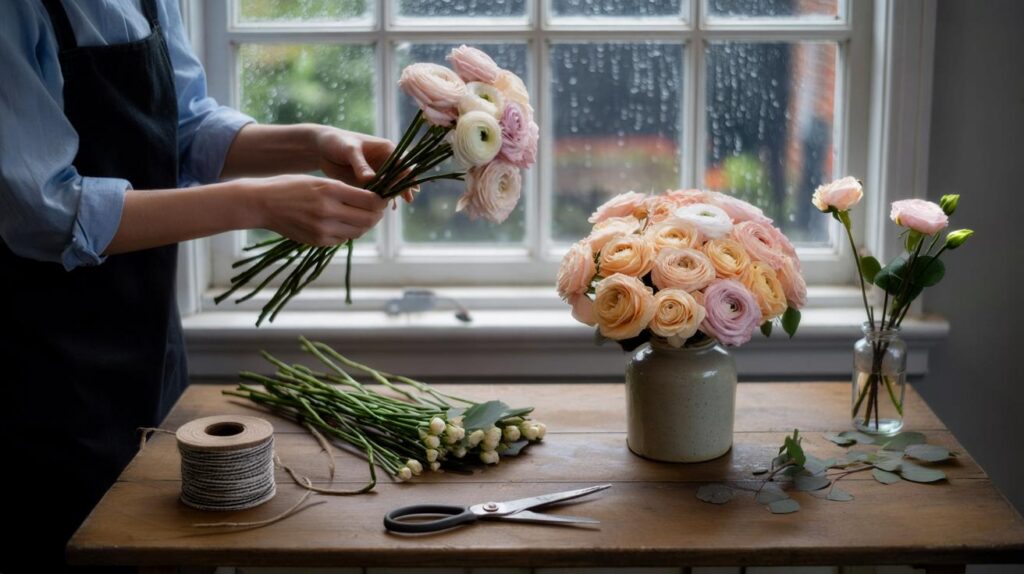
Amelia’s trick starts the moment you get home: split the bunch, spiral the stems, and shrink the height. Tip everything onto a table, peel off leaves below the waterline, and separate by variety and colour. Pick a tight palette from what you’ve got — say whites and greens, or peach and blush — then build a small hand-tied spiral from just two or three elements, repeating them for rhythm. Cut the stems short so the blooms sit just above the vase lip, and let the bouquet spread wider than it is tall. The vase does half the styling for you. A jam jar suddenly looks chic when the flowers are compact and intentional.
Common missteps? Keeping everything tall, using every stem, and trusting the sleeve shape. Don’t. Keep the heroes, ditch the shouty bits, and cluster similar stems together rather than dotting them around. Reflex roses with your thumbs so they open like teacups; pull chrysanthemums into larger heads by gently teasing the petals. Let foliage be a collar, not a hedge. Let’s be honest: no one really does that every day. That’s fine. Do it on a Sunday, when the radio’s low and the sink is already wet. Your Tuesday self will thank you.
Amelia calls the method “split, spiral, and shrink” because names stick, and a named habit happens more often. She splits every bunch into a main vase and two tiny ones for the hallway or bedside, spirals her key stems by repeating them, and shrinks the overall height so everything looks generous. Shorter stems look richer.
“Expensive is a feeling,” she told me, tucking a shy ranunculus into the curve of a rose. “You get there by editing, not spending.”
- Split: separate by variety and colour, keep a tight palette.
- Spiral: repeat your best stems, turning the bouquet in your hand.
- Shrink: cut shorter so the bouquet is wider than tall.
- Support: use a tape grid or a pinch of chicken wire in the vase.
- Style: place leftovers in tiny vessels for instant scattered luxury.
Small upgrades that change everything
Spend a pound on florist tape and make a simple grid across the vase mouth; it keeps stems where you want them and creates instant air gaps, which read as expensive. Swap the big glass cylinder for a squat jar, a stoneware jug, even a teacup for single stems. Colour is your hidden budget. Choose one mood — cool whites with eucalyptus, or warm peaches with soft greens — and stick to it. Tuck one fragrant stem near the rim so the scent hits when you walk by. If a bloom bruises, pluck it and float it in a bowl. Waste becomes atmosphere.
Water matters more than people think, but the trick isn’t a chemistry set. Lukewarm water wakes sleepy supermarket stems, and a clean vase slows that swampy smell. Recut stems at an angle and give them space like you’d give a guest a good chair. If something flops, cut it shorter and move it forward. If a colour jars, banish it to a bud vase in the loo where it will suddenly look intentional. You’re styling feelings, not floristry exams. And yes, change the water tomorrow. Or don’t. This is flowers, not tax.
Amelia’s last nudge is practical and generous: buy one “special” stem to lead the bunch, then let the supermarket do the heavy lifting for the rest. A single garden rose, a dinner-plate dahlia, one foxglove — the star sets the tone; the cheaper stems provide the chorus.
“I’d rather see five stems done beautifully than twenty fighting for attention,” she said, tying twine round a stubby bouquet with fingers stained green. “Edit with love. The flowers notice.”
- One hero stem guides the eye.
- Odd numbers beat even for natural rhythm.
- Cluster, don’t scatter, for richness.
- Leave gaps. Air is a design tool.
- Tiny vases multiply the sense of abundance.
There’s a quiet magic in taking something ordinary and letting it glow. The ritual is simple enough to teach a child and rich enough to satisfy a stylist: spill, sort, repeat, trim. You’ll start to notice how your room changes when the bouquet sits low and wide, how a £6 sleeve can carry a dinner. You may find yourself buying flowers differently, hunting for tone, shape, and mood rather than bargains alone. And then you’ll text a friend a photo, because you can’t help it. That’s how good tricks travel.
| Point clé | Détail | Intérêt pour le lecteur |
|---|---|---|
| Split, spiral, shrink | Edit the bunch, repeat key stems, cut shorter | Turns a cheap sleeve into a designer-looking arrangement in minutes |
| Colour editing | Pick one palette and remove clashing tones | Instant cohesion that reads as expensive without extra cost |
| Small tools, big impact | Tape grid, chicken wire, squat vase, odd numbers | Easy hacks that add structure, air, and rhythm |
FAQ :
- How do I make supermarket roses look fuller?Gently “reflex” each rose by rolling back the outer petals with your thumbs, then cut the stems short so the heads sit just above the rim.
- What vase shape makes flowers look expensive?A squat, wide-mouthed vessel creates a low, abundant silhouette that feels luxe and effortless.
- Do I need special tools to try the spiral technique?No. Your hands are enough, though a little florist tape across the vase mouth helps hold the angles.
- Which colours are easiest to style from a mixed bunch?Whites and greens are forgiving, or pick a warm story like peach and blush and set aside the rest for tiny vases.
- How can I make them last longer without fuss?Recut stems on day one, change water the next day, and move them away from direct sun or a hot radiator. That’s it.



Tried the split–spiral–shrink trick today and my £6 bunch suddenly looked ‘designer’. Shorter stems really do feel richer—who knew? Definately keeping a squat jar on standby. Thanks, Amelia! 🙂 Also love the “one hero stem” idea to lead the chorus.