
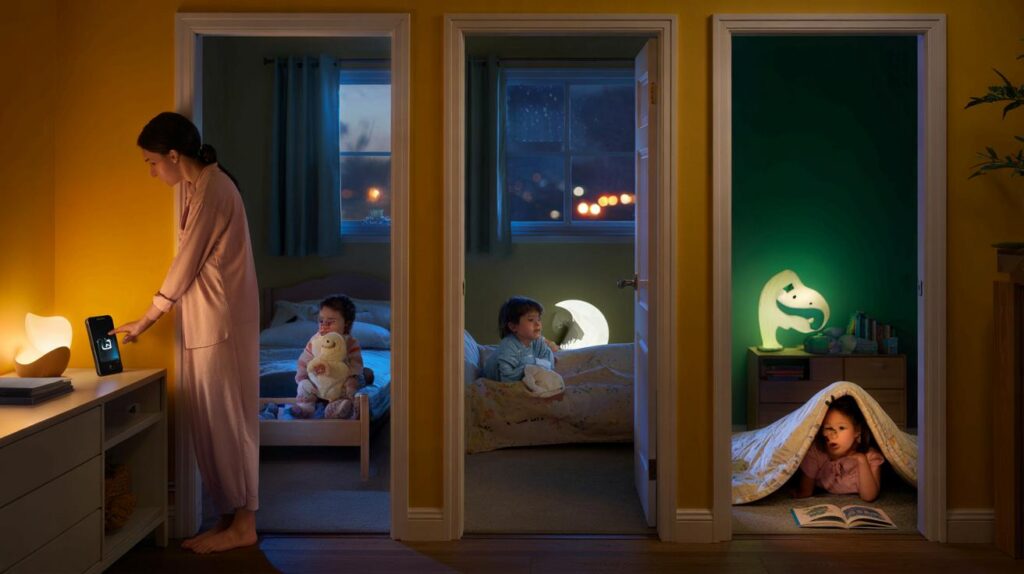
Three children, three different bedtimes, one frazzled mum. The nights were long, the requests endless, the yawns contagious. Then she built a simple bedtime playlist — and the house exhaled.
The hallway light is dim, a dinosaur night lamp glows on the landing, and Laura — a mum of three from Leeds — taps play on her phone like she’s lowering a stage curtain. Her toddler’s cuddle toy squeaks once. Her eight-year-old fidgets in a book fort. Her middle child whispers a last question about the moon. The first notes are barely there, as soft as breath on a windowpane. A kettle clicks off in the kitchen, nobody notices. A slow pulse begins to stitch the rooms together. We’ve all had that moment when the day doesn’t want to let go, and neither do our kids. The playlist does the letting go for them. And then, at 7:42, silence.
Why a bedtime playlist can succeed where routines stall
Laura swears the playlist works because it removes decisions, not because it’s fancy. The same sounds arrive in the same order, and her children lean into that predictability like a familiar blanket. There’s less “one more story?” and more deep, automatic breathing.
On the worst week — heatwave, hay fever, everyone overtired — she started the sequence at bathtime rather than in bed. The kids dawdled, then drifted, like boats catching the same tide. She didn’t change their rooms, their pyjamas, or the lighting. She just changed the soundtrack and the order it arrived in.
Here’s the quiet magic: repetition tells a child’s nervous system what to expect next. When the brain recognises a pattern, it loosens its grip. The key is to make the signal simple and kind — **slow, safe, predictable** — until the whole evening becomes a soft ramp rather than a cliff. *Music is a metronome for moods.*
The exact playlist — and how to use it without overthinking
Laura’s method is precise but easy: 45 minutes total, three movements, strict order. First, a gentle ambient track with a heartbeat-like pulse (10 minutes). Then, instrumental lullabies and simple piano pieces (25 minutes). Finally, rain or brown noise at low volume (10 minutes) to blur any creaks or sibling whispers.
She sets volume at 30–40% and uses a five-second crossfade so there’s no jolt between tracks. No lyrics until the room is almost dark, no sudden crescendos, no shuffling. Let’s be honest: nobody actually does that every day. Aim for most nights, and forgive the rest. Keep tempos in the **60–70 BPM** pocket, which the body reads as resting pace.
“I thought I needed a stricter routine,” Laura told me, “but it turned out my kids needed a softer one. The playlist became the soft part.”
- Ambient opener: “Weightless” by Marconi Union or any 60–70 BPM drone/strings pad (10 mins).
- Piano calm: Erik Satie’s “Gymnopédie No.1”, Debussy’s “Clair de Lune”, Yiruma’s “River Flows in You” (pick 2–3, ~12 mins).
- Instrumental lullabies: “Brahms’ Lullaby”, “Twinkle, Twinkle”, “Hush, Little Baby” on music box or guitar (10–12 mins).
- Nature close: “Rain on Tent” or brown noise at very low volume (10 mins).
- Settings: 5s crossfade, volume 30–40%, phone face-down on airplane mode outside the room.
A softer night ahead
You don’t need a new lamp, blackout blinds, or a parenting epiphany to try this tonight. You need an order, a tempo, and a promise to keep the sound gentle even when the day wasn’t. After a week, the playlist will feel like a warm-up act your children recognise just by the first bar.
Some nights won’t bow to any soundtrack. A cough will interrupt, a worry will wander in, a sibling will crack a joke at the wrong moment. Still, you’ll have a map. And maps reduce panic. If your evenings have become negotiations, borrow Laura’s simple rig: beginnings that whisper, middles that sway, endings that hush.
The loveliest surprise is what the quiet gives back to you. A cup of tea you drink hot, a hallway that sounds like night, a door you close softly because you can. Try it as written, then shape it to your home. **One calm night can reset the week**.
| Point clé | Détail | Intérêt pour le lecteur |
|---|---|---|
| Structure en trois mouvements | Ambience, piano/lullabies, nature noise | Donne un chemin simple à suivre sans réfléchir |
| Paramètres techniques | Volume 30–40%, crossfade 5s, tempo 60–70 BPM | Évite les sursauts et cale le corps sur un rythme reposant |
| Rituel répétitif | Mêmes sons, même ordre, mêmes signaux | Crée une association “musique = dodo” qui s’ancre en une semaine |
FAQ :
- How long should the playlist be?About 45 minutes works for most families: enough time to wind down without drifting into wakeful background radio.
- Can I include songs with lyrics?Keep lyrics for the middle section only and choose whisper-soft vocals; words tend to hook young brains when they should be letting go.
- What if my kids share a room and like different songs?Choose neutral instrumentals and nature sounds; let each child pick one lullaby on alternate nights to feel seen.
- Does device type matter?Any speaker is fine; place it outside the doorway or on a shelf, facing away, to diffuse sound and lower the urge to chat to it.
- How soon will it work?Many parents notice change within three nights; give it seven consistent evenings to become a cue rather than a novelty.



Saving this for tonight, thx! My two alwys ask for “one more story” — maybe music wins.