
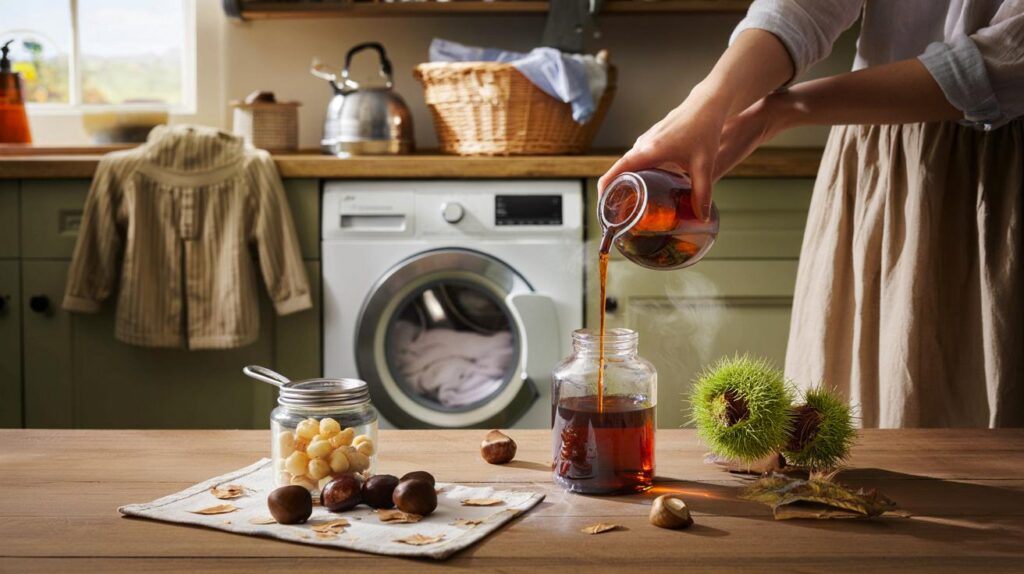
Plastic jugs stacking under the sink. Skin getting itchy after a “spring meadow” wash. Prices creeping up with every shop. Then autumn arrives, the pavements go glossy with horse chestnuts, and someone in your neighbourhood chat shares a trick you can actually use. One mum boils a kettle, cracks a few conkers, and swears her laundry has never been cleaner or cheaper. No fuss. No perfume fog. No plastic guilt.
The kettle clicks off in a hum of ordinary Saturday. On the table: a tea towel speckled with shell flakes, a glass jar of pale-brown pieces, the sweet, wet smell of leaf-litter that clings to conkers. She shakes the jar, pours hot water, and the liquid turns a soft amber, not quite tea, not quite cider. Twenty minutes later, she strains it into a bottle, kisses a child’s muddy school jumper, and tips the warm brew into the washing machine drawer. The drum thuds, spins, settles into its rhythm. When it opens, the jumper is bright again, the mud now memory. She smiles at the nothingness of the scent. And at the price.
The conker hack a British mum swears by
In a country that keeps conkers in the collective pocket like a lucky charm, turning them into laundry liquid feels both cheeky and right. The trick hangs on saponins, the natural soap-like compounds tucked inside horse chestnuts. Rattle them in hot water and they ooze gentle suds that lift everyday dirt. No neon labels. No mystery ingredients you can’t pronounce. Just a handful of brown shells from the pavement and a kettle that was already on.
Take Maya in Leeds. Two kids, a terrier with boundary issues, and a laundry basket that never sleeps. She started brewing “conker soap” last autumn, after stumbling across a forum post and an empty bottle of detergent on a Sunday night. Now she chops a small batch on a weeknight, pours boiling water on top, and keeps a jar in the fridge. She figures she runs roughly 250 washes a year. Knocking even 20p off each load adds up to a new winter coat by Christmas.
There’s a science simplicity behind it. Saponins act like tiny shuttles that bond with water on one end and oils on the other, helping rinse grime off fibres. Hot water extracts them quickly from chopped conkers, the way tea pulls tannins from leaves. Strain out the bits, pour the liquid, and you’ve got a low-foam cleaner that’s gentle on most cottons and blends. It won’t shift motor oil or fix a red-wine disaster, yet it shines with school uniforms, gym kits, linens, and that endless rotation of socks. Because it’s mild, colours keep their calm and scents stay quiet.
How to brew chestnut washing liquid at home
First, pick the right chestnuts. You need horse chestnuts—conkers—not the sweet edible kind. Horse chestnuts wear a matte, spiky shell and have a large pale spot; sweet chestnuts have a pointy tip and a hedgehog-like burr. Gather 10–12 conkers per wash day, rinse them, then crack and chop into small dice. Spread to dry if you want to store them. For a fresh batch, put roughly 100 g of chopped conkers in a jar, cover with 500 ml of hot water, and let steep 20–30 minutes. Strain well. Use about 150–200 ml for a normal load.
Hard water? Add a teaspoon of washing soda to the drum for extra lift, or run a 40°C cycle rather than cold. Whites looking dull? Every few weeks, refresh them with a scoop of oxygen bleach in a separate wash. If you’d like a light scent, add two or three drops of essential oil to the drawer—but skip this for baby clothes and sensitive skin. The fresh brew keeps in the fridge for three to four days. For longer, freeze in ice-cube trays and pop three or four cubes straight into the drum.
Let’s be honest: nobody preps laundry potion every single day. Batch it on a Sunday night, keep it chilled, and you’re set. We’ve all had that moment where the bottle is empty and the uniform is not—this is your smirking Plan B that costs pennies. I caught myself smiling at the quiet alchemy. Keep the pulp out of plumbing by straining through a cloth, not the sink mesh. And keep conkers out of mouths: they’re not food, and pets should steer clear.
“I thought it would be one of those internet hacks that photographs better than it performs,” Maya told me, holding a clean PE top. “Then I ran five loads in a week and… it actually works.”
- Use horse chestnuts (conkers), not edible sweet chestnuts.
- Chop small for better extraction; steep 20–30 minutes in hot water.
- Strain thoroughly; dose 150–200 ml per load.
- Store in fridge up to four days or freeze in cubes for easy use.
- Great for everyday laundry; pre-treat heavy stains separately.
What this tiny ritual says about the way we wash
There’s something disarming about a household job becoming more seasonal, more local, and less loud. Conker soap is not performative eco-perfection; it’s a practical tweak that feels oddly grounding. It cuts plastic, trims bills, and pulls you outside for ten minutes between showers to pick a few glossy marbles from the grass. It also invites conversations with kids about trees, textures, and what “clean” actually means when it isn’t smothered in perfume. One small jar, one short steep, and laundry becomes less chore, more choice. Share it with a neighbour. Trade a handful of conkers for a smile. That’s how habits travel.
| Key points | Details | Interest for reader |
|---|---|---|
| Conkers contain natural saponins | Hot water extracts mild, low-foam cleaning agents from horse chestnuts | Explains why the hack works without synthetic detergent |
| Cheap, low-waste routine | Free foraged ingredient, fridge-stable brew, freeze in cubes for later | Saves money and cuts plastic; easy habit to keep |
| Best for everyday loads | Ideal for cottons and blends; pre-treat heavy stains; whites refreshed occasionally | Helps set realistic expectations and smarter laundry choices |
FAQ :
- Is it safe for the washing machine?Yes. Use well-strained liquid only, poured into the drawer or drum. Keep solids out of the pipes.
- Will my clothes smell like chestnuts?No. The scent is near-neutral once dry. Add a drop or two of essential oil if you want a hint of fragrance.
- Can I wash baby clothes with it?Many parents do. Start with a small load and skip fragrances. Rinse cycle helps if your tap water is hard.
- Does it work in cold water?It cleans light dirt in cool cycles. For better results, extract with hot water and wash at 30–40°C.
- What’s the difference between horse chestnuts and edible chestnuts?Horse chestnuts (conkers) are for washing, not eating. Sweet chestnuts are edible but don’t contain the same cleaning saponins.



Quick question: horse chestnuts are inedible—any chance of resedue being irritant on skin, esp. for babies? I’ll run an extra rinse but would love real-world experiences.