
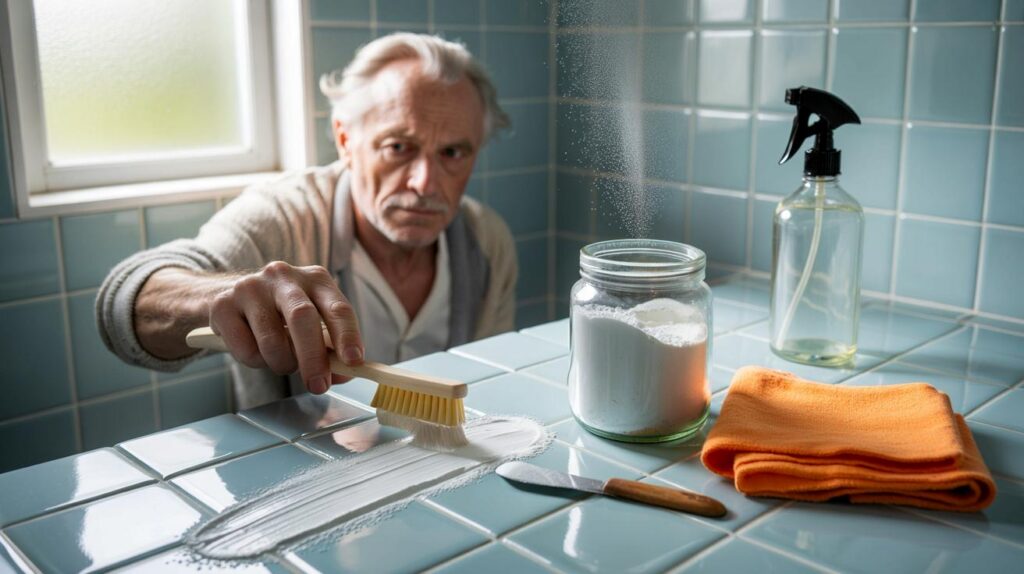
Grout creeps up on you. One spring you’re admiring clean lines between tiles; by autumn they’re grey, pitted, a little sad. In an age of scented sprays and neon bottles, a retired postman from Norfolk swears his bathroom came back to life with the most ordinary thing on a pantry shelf: baking soda.
The kettle clicked off as Peter Cooper, 72, tested the weight of an old toothbrush in his hand. Sun pushed across the small bathroom, catching the pale blue tiles he laid in 1989, back when his knees didn’t argue and he still cycled to work in the rain. He spoke softly to the room, as if it could hear him, set a jam-jar of chalky paste on the windowsill, and pressed a smear along the grout like he was icing a tiny cake. **He didn’t buy anything new.** He didn’t wear gloves that smelt like a swimming pool. He just waited, counted to sixty twice, and started scrubbing. Then the grout woke up.
The small jar that changed the line between tiles
Peter didn’t discover a hack; he remembered something his mother used. He mixed three heaped tablespoons of baking soda with a spoon of warm water until it held its shape like toothpaste, then pushed it into the grout with small, steady strokes. The paste clung, and in the quiet of that late morning, the bathroom felt like a workshop, not a chore zone.
Before this, he’d tried the sharp-smelling gel that promised alpine freshness and “instant white”. He opened a window, coughed, and decided the smell lingered longer than the shine. Years back, a neighbour swore by bleach, but the colour in the grout faded and the rubbery trim went brittle. The day he first went back to baking soda, he kept the radio low and thought, this is just cleaning without the fuss.
There’s a simple reason this works. Baking soda is mildly alkaline and a gentle abrasive, which means it nudges away soap scum and body oils without biting into the grout itself. Fine particles do the rubbing; the alkalinity loosens the film that makes grout look shadowed, not stained. **The result isn’t a harsh “white-out”, it’s a return to the grout’s real colour.** Your tiles keep their dignity.
How he does it, and what he learned
Peter’s method is stubbornly simple. He mixes 3 parts baking soda to 1 part warm water, stirs to a thick paste, and spreads it along the grout lines with a fingertip or a blunt butter knife. Ten to fifteen minutes later, he scrubs with an old soft-bristle toothbrush in short, rhythmic passes, wipes with a damp microfibre cloth, then rinses the cloth and wipes again. For a final lift on really tired grout, he mists white vinegar lightly onto the paste, lets it fizz, and wipes the foam away. Never rush the wipe stage; it’s where the magic shows.
Here’s what he avoids, learned the long way round. Don’t flood the paste with water, or it will run and clean nothing. Don’t press so hard you erode the grout edges; finesse beats force. Let’s be honest: nobody really does this every day. He sets a quiet 30-minute slot every few weeks, and if he misses, he doesn’t scold himself, he just starts again. We’ve all had that moment when you see the bathroom in morning light and think, how did it get like this so fast?
He keeps it friendly and safe. He never mixes baking soda with bleach, not even “a tiny bit for luck”. He skips abrasive pads that can scratch glazed tiles. For mould shadows that resist, he swaps vinegar for a few drops of 3% hydrogen peroxide on the paste, leaves it ten minutes, then wipes and rinses well with warm water. The room smells like nothing in particular afterwards, which is exactly the point.
“I like that it’s quiet,” Peter says. “No sting in your throat. Just you, the brush, and the lines slowly coming back.”
- What you’ll need: baking soda, warm water, a soft toothbrush, a small knife or finger, microfibre cloth, optional white vinegar or 3% hydrogen peroxide.
- Ratios that work: 3 tablespoons soda + 1 tablespoon water for paste; a light vinegar mist only after the paste sits.
- Safety in plain words: **Never mix with bleach, not even a little.** Ventilate, and test a small area if your grout is dyed.
Why this tiny ritual resonates beyond a bathroom
There’s a quiet satisfaction in using something humble, cheap and gentle to solve a problem that nagged at you for months. Peter talks about “standing up a bit taller” after he wipes the last line and sees the room sharpen, as if someone adjusted the focus. The choice feels kind to the home, kind to his lungs, and kind to the budget. *It felt like setting a small corner of life back in order.* More than a tip, it’s a reminder: small, repeatable care can change how a space makes you feel, and that might be the real win worth sharing.
| Key points | Details | Interest for reader |
|---|---|---|
| Baking soda paste restores grout gently | 3:1 ratio with warm water, 10–15 minute dwell, soft-bristle scrub | Simple, low-cost method that avoids harsh chemicals |
| Boost with vinegar or hydrogen peroxide | Light vinegar mist for fizz; 3% peroxide for stubborn mould shadows | Flexible upgrades for deeper stains without expensive products |
| Common pitfalls to skip | Don’t overwater paste, don’t over-scrub, never mix with bleach | Protects grout, tiles, and health while saving time |
FAQ :
- How often should I clean grout with baking soda?Every 3–4 weeks keeps lines bright in most bathrooms; high-traffic family rooms might need a quick touch-up fortnightly.
- Is baking soda safe on coloured or dyed grout?Yes in most cases, as it’s a mild abrasive and base; test a discreet corner first to check for any lightening on heavily pigmented grout.
- Can I use this on natural stone tiles like marble or limestone?Use care: the paste is gentle, but vinegar should be avoided on acid-sensitive stone; stick to baking soda and water, and wipe promptly.
- What if there’s black mould that won’t budge?Try a paste with a few drops of 3% hydrogen peroxide, leave 10 minutes, scrub lightly, then rinse and dry; repeat across days rather than scrubbing hard at once.
- Will vinegar damage a grout sealant?Light, occasional vinegar mist is usually fine on intact sealant; if the sealant is worn or flaking, re-seal first and keep to baking soda and water only.



Loved this—tried the 3:1 paste today and the gentle fizz with a light vinegar mist was oddly satisfying 🙂 My grout defintely “woke up,” just like Peter said. Tip from my run: don’t drown the paste (I did at first—oops). Soft toothbrush + patient wipes = great results.