
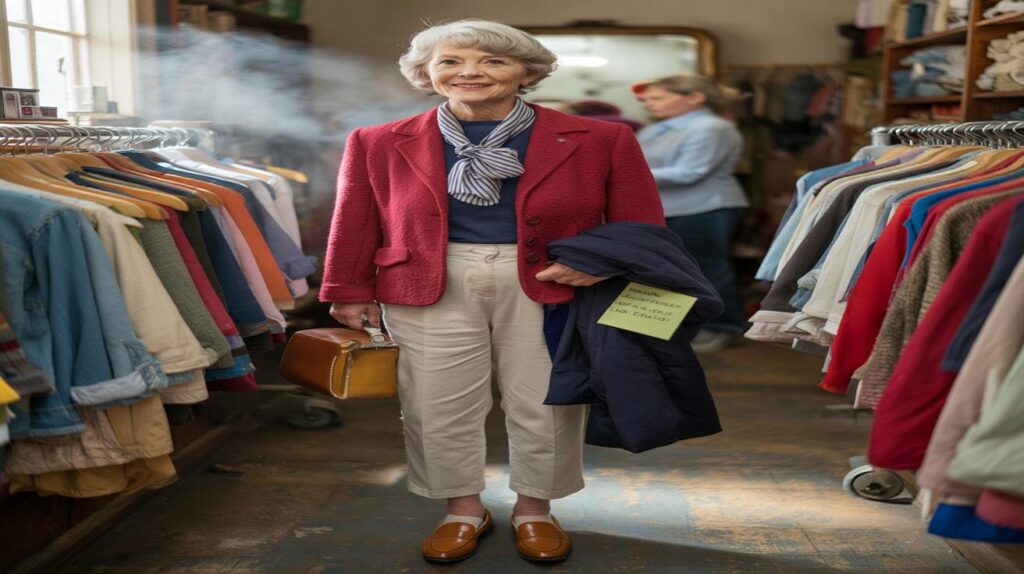
Prices climbed, pensions didn’t, and the joy of getting dressed started to feel like a bill. Then a retiree from the south coast decided to treat second-hand as a new starting line instead of a compromise. What she found wasn’t just cheaper clothes—it was a way to dress like herself again.
The red wool blazer looked smug on the hanger, the kind of confident red you only see on old postboxes and women who know who they are. Margaret, 67, pinched the shoulder seam like a tailor, lifted the collar and laughed at the name on the label. The charity shop smelled faintly of cedar and steam. A volunteer wheeled past a rail of shirts that sounded like cards shuffling.
She tried the blazer with a striped scarf she’d grabbed on impulse. The mirror was a little fogged, the floor a little scuffed, yet she stood taller. “I don’t need new,” she said, “I need right.” Then she checked the price tag and raised an eyebrow.
A wardrobe that starts again without starting over
On the day she retired from teaching, Margaret packed away her lanyard and realised her style had lived on autopilot. Pencil skirts, sensible shoes, a parade of cardigans that could pass any staff-room test. Then the meetings went quiet. Her budget tightened. And the colourful, curious woman underneath asked for a turn.
Second-hand, she discovered, wasn’t about settling. It was a playground. Fabrics with personality. Buttons that had a life before hers. Cuts that didn’t scream this season or last. “We’ve all had that moment where you stare at a wardrobe you bought for a life you no longer live,” she told me, tugging at a silk cuff. “That’s when a charity shop feels like oxygen.”
There’s a reason so many shoppers are turning to resale and swaps. The hunt itself is part of the reward. The stakes are lower; the finds, stranger and better. And you can try on a story, not just a size.
One Saturday in Hove, she found a navy Jaeger coat with a storm flap and a secret inside pocket. It was £25 and needed a press. In the pocket, a miniature shopping list written in fountain pen: milk, nutmeg, stamps. “I love things that have lived,” she said, and slipped the coat over a Breton top. On the bus home, two people asked where she’d bought it. She pointed at the paper bag like a magician revealing nothing at all.
Over three months, she logged her spend: £126 for nine pieces—two shirts, a cardigan, the coat, linen trousers, a scarf, leather loafers, the red blazer, a silk blouse. If she’d bought equivalents new, she reckons the bill would have nudged £600. Research from WRAP suggests extending the life of clothing by even a few months can cut its footprint significantly, which made her feel lighter as well as sharper.
Why does second-hand work so well at this life stage? Time, for one. Browsing becomes pleasure rather than chore. Quality, too: older garments were often cut to last, so the fabrics fall better and the seams mean business. And there’s psychology. A charity shop isn’t pushing a trend; it’s offering possibilities. That loosens the rules. It lets you rediscover your own taste instead of buying someone else’s idea of who you should be.
There’s budgeting logic as well. When you pay less per piece, you can experiment more—try a colour, a collar, a shape—without fear. If it’s not you, it goes back into the donation loop. The whole system feels more forgiving.
How she shops second-hand like a pro (without making it a job)
Margaret has a simple method. She starts with a palette: navy, red, cream, denim. Everything has to work with those. Then the “three-outfit rule”: if a piece can’t make three outfits with what she owns, it stays on the hanger. She runs a fast quality check—fabric label, seams, underarm, hem—then tries it on with movement: sit, reach, twist.
She keeps a small tape measure in her bag. Waist, shoulders, sleeve length. “Numbers don’t argue,” she says. She looks in the men’s section for knitwear and shirts, especially for crisp cotton and roomy cuts. And she carries a photo on her phone of her favourite outfit, to compare proportions. One last habit: she touches everything. Good cloth tells you the truth.
Most mistakes, she says, start with panic-buying or fantasy dressing. “I nearly bought a sequined cape because it looked like a party,” she admits. “But my life is walking the dog and taking the train to see my sister.” She avoids “nearly right” fits. She doesn’t bring home projects she’ll never fix. And she sets a monthly cap on spend—once it’s gone, the hunt pauses. Let’s be honest: nobody really does that every day.
She also gives herself permission to walk out empty-handed. **There’s nothing wrong with not buying; the edit is part of the style.** And when she does buy, she builds around the win. Found a great navy blazer? Then she looks for trousers with the same energy, not a whole new mood. There’s patience in it, and a kind of kindness.
“I stopped chasing ‘young’ and started chasing ‘mine’,” Margaret says. “That’s when my wardrobe began to smile back.”
- Check natural fibres first: wool, cotton, linen, silk.
- Scan hems and cuffs—they tell the truth about wear.
- Try a size up and a belt. Fit can be finessed.
- Photograph outfits you like on yourself. Copy the shapes.
- Keep a tailor’s name in your phone. Small tweaks make big magic.
What second-hand gives you that new rarely does
There’s autonomy. You pick across decades and designers, not just the palette a brand decided for spring. There’s community: volunteers who whisper, “New stock in at four,” and fellow hunters who pass you a jumper that looks like your sort of jumper. There’s sustainability that feels personal rather than preachy. *Changing how you shop can feel like reclaiming a voice, not losing a choice.*
**It also sharpens your eye.** After a few weeks, Margaret could spot quality lining at two metres. She understood shapes that loved her. She learned that a cropped jacket gives her trousers purpose, and that a sharp collar lifts her face. She donated what no longer served and found the result was calmer mornings. Fewer pieces, stronger outfits. More joy per wear.
And then there’s the surprise dividend: compliments. Not the generic “nice top” kind, but the curious, “Where did you find that?” kind. Compliments that start conversations, that spiral into coffees, that make a day ricochet into something bigger. **It’s not just about money saved. It’s life added.**
There are practicalities. Wash on cool and air-dry to protect fabrics. Rotate shoes. Store wool with lavender or cedar. If something needs a small mend, do it the day it arrives home. She uses a clothing rail in the spare room as a staging area: this week’s heroes in front, maybes to the side, donations in a bag beneath. She takes one photo of each outfit she loves, so it’s easy to repeat when energy is low.
For the numbers-minded, the cost-per-wear metric becomes playful. Her £25 coat has been worn 32 times already. That’s 78p a wear and dropping. The red blazer? Worn to a gallery opening, to tea with her old department, and to buy tulips on a windy Wednesday. “Clothes are for days,” she says, “not for waiting.”
There’s a confidence that sneaks up on you when you know the story on your back. It’s quieter than a shopping bag and lasts longer. And it tends to make you kinder with yourself in the mirror. You’re not chasing a look; you’re living in one.
Where this leaves the rest of us
You don’t need a grand makeover. Start with one rail in one shop. Touch cloth. Try one thing you wouldn’t normally try. Bring home only what fits your life today. If it feels like you, you’ll know. If it feels like a future you don’t actually want, place it back lightly and keep walking.
Second-hand can be a way to spend less and feel more. A way to dress your years without disguising them. Some days you’ll find nothing. Some days you’ll find the jacket that nudges your shoulders back. On both days you’ll learn something about your taste that no algorithm can teach.
Margaret says the trick is small changes, repeated—one good shirt, then a better pair of trousers, then the shoes that pull it all together. She laughs when I ask if she’ll ever go back to fast fashion hauls. “Why would I?” she says, tightening the belt on that navy coat. “I get to be surprised, and I keep my pension happy.” The bus pulls in, and she steps up, steady, bright, and a little bit red at the shoulders.
| Key points | Details | Interest for reader |
|---|---|---|
| Shop with a palette and the three-outfit rule | Stick to core colours; buy only if it makes three looks | Reduces clutter and regret, builds a coherent style |
| Quality check in 30 seconds | Fabric tag, seams, underarm, hem, lining | Quickly separates treasures from time-wasters |
| Use cost-per-wear and light tailoring | Track wears; tweak sleeves, waists, hems | Maximises value and personal fit without big spend |
FAQ :
- How do I start if second-hand shops feel overwhelming?Pick one category—blazers, shirts, or knitwear—and browse only that. Set a 20-minute timer. Leave when it rings.
- What brands or fabrics should I look for?Natural fibres tend to age best: wool, cotton, linen, silk. Older British and European labels often signal sturdy construction.
- Is it worth paying for alterations on cheap finds?Yes, if the fabric is good and you’ll wear it often. A £10 hem on a £12 skirt that becomes a weekly staple is smart maths.
- How do I keep second-hand clothes feeling fresh?Wash less, air more. Steam instead of iron when you can. Rotate outfits and lean on accessories—scarves, belts, brooches.
- What if I’m squeamish about pre-loved items?Start with outer layers and scarves. Launder or steam at home. Most pieces have been cleaned; the nose test rarely lies.



Brilliant piece—”I don’t need new, I need right” hit me hard.
The secret pocket note (milk, nutmeg, stamps) got me. Now I want a coat with plot twists and pantry tips 🙂 Also, “good cloth tells you the truth” is going on a tote.