
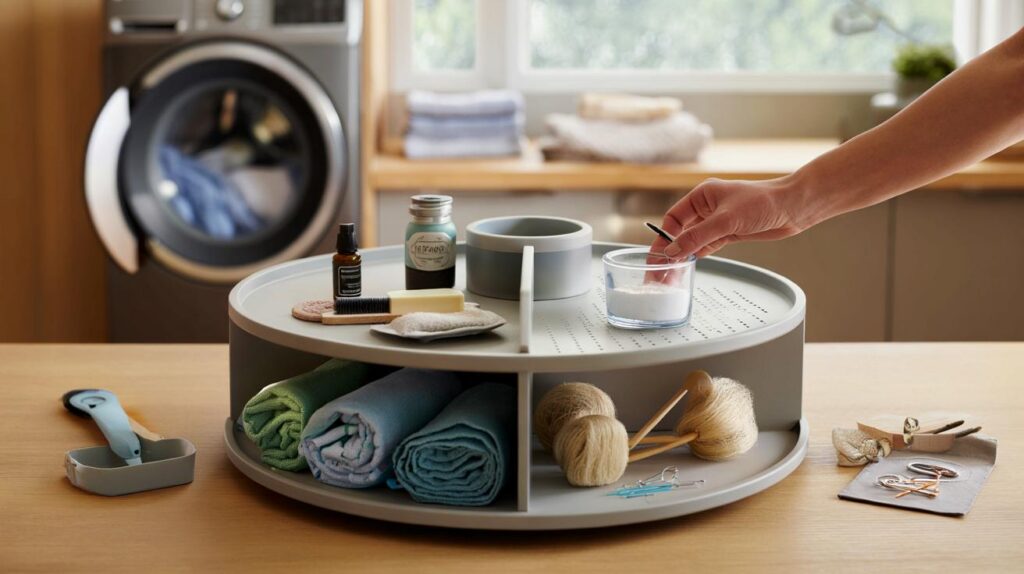
Small rooms don’t fail because of the big appliances. They fail because of the tiny things that drift: pegs, stain sticks, lost socks, lint brushes, batteries for that rogue fabric shaver. A simple rotating organiser — the humble turntable you usually see in kitchens — can gather all that scatter into a calm, reachable circle, and your utility room suddenly behaves like a well-run station rather than a backstage jumble you’d rather not look at.
Saturday morning, drizzle on the window, school kit slumped by the washer like a small animal needing attention. I’m elbow-deep behind the tumble dryer, hunting the stain remover that vaporises when grass meets white polo shirts, while a cascade of pegs pings onto the floor and the dog thinks this is a game. The wash is paused, the rhythm’s gone, and a dribble of detergent slides into a sticky ring under a bottle that’s lived there too long. Then a friend drops off an old two-tier kitchen turntable, the kind that spins with a fingertip, and I dump every wayward small thing into it and give it a gentle nudge. Everything is suddenly there, close, visible. Everything pivoted.
The genius of a turntable in the utility room
Small items are the grit in the gears of home routines, and a rotating organiser takes that grit and gives it a lane. The circle means no dead corners, no reaching past bottles to gamble for the right brush, just a quiet spin that brings what you need into the light and into your hand. There’s a modest drama to it — a miniature stage where stain sticks, mesh bags, lint rollers and odd buttons take their places — and the scene resets with one touch.
In Leeds, Laura measured her before-and-after on a wet half-term week: six washes, all the usual chaos, and a stopwatch taped to the cupboard door like a dare. She swapped a wonky basket and a biscuit tin of pegs for a two-tier turntable with four open pots, labelled by task. Her average “start-to-drum-roll” time dropped from four minutes twenty to just over three, and her swearing at lost dryer balls went to zero. It isn’t lab science. It’s a home hack that makes your weekday wash feel like it’s cooperating.
What’s happening is ergonomics you can feel. A turntable cuts reach distance and lets your eyes scan in arcs, not zigzags, so your brain makes fewer micro-decisions and you keep momentum. Round edges slide into deep shelves where square caddies jam, and two tiers create a gentle hierarchy: daily kit up top, occasional fixers below. Group by moment, not material — everything you touch while treating stains together — and the wheel plays nicely with how working memory likes to work: fewer hops, more flow, less sighing.
Set it up: spin-friendly systems that stick
Pick a diameter that fits your shelf or worktop depth, then choose a two-tier if you can, with a lip to corral strays. Split the circle into four “stations”: stain care, delicates, dryer toolkit, and the household odd-bits that always gatecrash laundry. Decant liquids into small bottles with nozzles, drop pegs and bra clips into open pots, slide mesh bags into a narrow file, and park it all within a shoulder’s swing of the washer door. One-handed spin. One clean grab.
Start lean or the wheel turns into a junk carousel. Keep like-with-like by task, not by shape, avoid lids you’ll forget to put back, and leave a tiny slice empty so new bits have somewhere to land. We’ve all lived that moment when a random key ring and a broken button arrive in your palm and you need a “for now” spot that isn’t the floor. Let’s be honest: nobody actually does that every day. A workable spin forgives the odd flop and still behaves tomorrow.
Professional organisers call it “a circular route for your hands” because the right thing arrives without the rummage.
“If the wheel spins smoothly, people follow it,” says Fiona McRae, who sets up utility rooms in Brighton. “Design the order of touch — treat, load, dry, fold — and put that order on the turntable. The habit writes itself.”
- Stain care: pen, bar, brush, small cloth, bicarbonate jar.
- Delicates: mesh bags, lingerie wash, gentle clips.
- Dryer toolkit: wool balls, lint brush, coil of string for line fixes.
- Odd-bits: measuring scoop, spare buttons, safety pins, tiny sewing kit.
This is about shaving seconds, not manufacturing a showroom. The wheel turns, and your day does too.
When small things stop wandering
The first thing you notice is the quiet. Not saintly silence, just fewer clatters, fewer “where did that go”s, fewer sticky rings blooming under tired bottles because the bottle now has a home that moves with you. The second thing is cheeky: you’ll spin it for the pleasure of seeing what you need appear on cue, like a tiny stagehand tugging the right prop into view, and that little reward keeps the setup alive without you thinking about it. The third thing sneaks up later, when the room itself feels bigger, because the corners are doing a job and the stuff that used to squat on your counter is now in a circle that behaves. A small, ordinary fix that changes how you move, how you decide, how you get on with your day. **Small things stop wandering, and so do you.**
| Key points | Details | Interest for reader |
|---|---|---|
| A rotating organiser removes friction | Spin brings items into reach, reduces rummaging, and keeps workflows linear | Quicker starts, fewer interruptions, calmer routine |
| Group by task, not by type | Four stations: stain care, delicates, dryer kit, odd-bits | Easier decisions, better memory cues, fewer misplacements |
| Choose the right build | Two-tier with lips, sized to your shelf; mix open pots and small bottles | Reliable day-to-day use, no tipping, everything visible at a glance |
FAQ :
- What size turntable works best in a UK utility room?Measure your shelf or worktop depth and aim for 26–30 cm diameter, or 35 cm if you’ve got a deep corner. Leave space so it spins freely.
- Plastic, bamboo, or metal — which material lasts?Plastic with ball bearings tends to glide best in humid rooms, bamboo looks lovely but hates drips, and powder-coated metal is sturdy for heavier bottles.
- How do I stop tall bottles from toppling?Pick a design with a raised rim, add a grippy liner, and park taller bottles toward the centre. **Weight inwards, light things outwards.**
- Will a turntable work in a cupboard?Yes, if the door opens fully and the shelf is deep enough. Low sides help visibility; add labels on the pots so you can grab and go.
- What goes on the top tier vs the bottom tier?Daily drivers up top: stain pen, mesh bag, lint brush. Bulk or backup items below: refill bottles, extra dryer balls, sewing odds and ends.



So it’s just a lazy Susan for laundry? Pegs will definately still escape… unless the lip is high enough. Anyone tried 26 cm on a shallow shelf?