
Targets drift. Teams lose steam. Somewhere between a quarterly plan and a Tuesday afternoon, the goal becomes a spreadsheet no one wants to open. A London team leader found a way to make the finish line feel near again, using something schoolkids do without thinking: drawing what they want to see. Not manifesting. Not mood boards. A clear picture that changed how his people showed up.
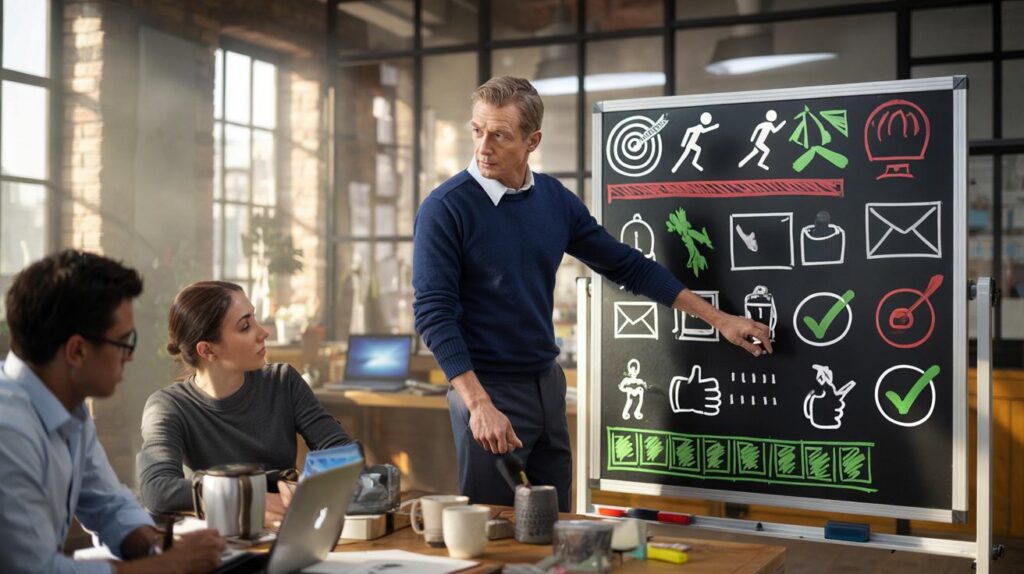
The kettle clicked at 8:47am, the office still yawning awake. Kieran, a compact manager in a navy jumper, rolled a whiteboard to the middle of the floor and sketched a thick black line like a finishing tape, then a cluster of stick figures running towards it. He told his team, “Picture Friday at four. Hear the phones calm. See the green lights.” He paused, pen in the air, as if listening. We were all picturing the same finish line. Phones started ringing for real, and something shifted — not loud, just decide-and-go. **The finish line wasn’t on the calendar; it was on the wall.** He hadn’t told them the secret yet.
When a picture beats a pep talk
Kieran says the drawing wasn’t art. It was a handle. His people had numbers to hit and problems to solve, yet the sketch gave them a scene to step into. Two circles became targets. A scribbled bell meant “deal closed”. He asked each person to add one small symbol for their day — a headset, a thumbs-up, a tiny envelope. The messy mural lived by the door. People touched it like a superstition, and you could see the exhale when the first green tick went up.
The first week they tried it, Nia had a call she’d been dreading. Before dialling, she traced the route on the board with her finger: start, pause, key question, outcome. Ten minutes later she returned, cheeks warm and eyes bright, and drew a fat tick next to her name. The room’s energy rose a notch. They finished the week 12% ahead of their usual pace and hit their service level target for the first time in months. **The scoreboard turned dread into drive.** Small marks, big mood.
Why does this work? The brain leans on images to predict what comes next. A picture of the finish line turns an abstract target into something the body recognises, which quietens the background noise of doubt. When people rehearse a scene in detail — the desk, the greeting, the first question — they reduce decision friction when it matters. There’s also the goal-gradient effect: we speed up as the goal appears closer. A visible path slices the distance. It isn’t magic. It’s fewer unknowns and a nudge of momentum.
The method Kieran swears by
Kieran uses a simple loop he calls “See, Score, Share”. First, a 90-second “future snapshot”: everyone writes a single sentence about the end of the day like a headline they’d be proud to read. Then they draw one icon per priority on a shared board. Finally, they choose a score that’s visible: a progress bar, a stack of sticky notes, three boxes to shade. At 4pm, there’s a two-minute show-and-tell where one person shares the moment their picture helped them decide faster. It’s light. It’s quick. It’s sticky.
People often skip the process and only picture the trophy. That’s when visualisation becomes a poster, not a tool. Kieran asks for sensory detail: what do you hear when it’s going well, what’s on your screen, what’s the first phrase out of your mouth? We’ve all had that moment when the day blurs and we slide into autopilot. This breaks the blur. Let’s be honest: nobody really does this every day. So he treats it like brushing teeth — short, daily, imperfect, and good enough to keep things healthy.
Kieran puts it plainly, then leaves space for it to land.
“The image is the anchor. If the ocean gets choppy, you know where the harbour is,” he told me. “I don’t need perfect drawings. I need pictures that pull people forward.”
He pairs the pictures with simple checks that stop the board becoming wallpaper.
- Make the finish line visible, not just the starting list.
- Choose a score everyone can update without asking permission.
- Tell one micro-story at 4pm to keep the board alive.
- Change the icons weekly so the brain doesn’t tune out.
What sticks after the buzz fades
Week three is where most pep ideas die. With pictures, the novelty dips, then the dividends arrive. Kieran noticed quieter teammates joining in because drawing feels safer than speaking. He also saw fewer “got a minute?” interruptions; people could check the board and know where the team was at. **Motivation loves a picture.** It’s contagious in a way a memo isn’t, because humans copy what they can see.
This isn’t about acting. It’s about rehearsal. Athletes run the race in their head, then the body follows. In a team, the picture creates a shared rehearsal that trims hesitation and makes effort feel coordinated. When a tough morning hits, the board holds the memory of better days. The small rituals around it — the tap for luck, the final tick — keep people connected to the story of their work. The story matters more than the stationery.
I keep thinking back to that first Friday. The sketch had been rubbed, redrawn, laughed at. Still, when the last deal closed, the room went quiet for a beat, as if we’d all arrived somewhere familiar. Not a miracle. Just a clear line to run towards, and enough fresh air to make running feel like choice rather than chase. It’s surprising what a pen and a picture can do when words have run out.
| Key points | Details | Interest for reader |
|---|---|---|
| Make goals visible | Use a shared board with icons, progress bars, and a simple finish line | Turns abstract targets into scenes people can step into |
| Rehearse the process | 90-second “future snapshot” and sensory cues before key tasks | Reduces hesitation and boosts confidence on tough moments |
| Keep it social | Two-minute daily story and a public score everyone can update | Builds momentum, reduces interruptions, creates shared ownership |
FAQ :
- Does visualisation replace hard work?Not at all. It organises effort. The picture reduces friction so work lands where it counts.
- What if my team thinks it’s cheesy?Start small. Use plain icons and one quick win. Skepticism fades when the board helps someone decide faster.
- How long should this take each day?Ninety seconds to picture, one minute to score, two minutes to share. Then back to the real work.
- What if targets change midweek?Redraw the finish line. Let people change their icons. The board is a map, not a museum.
- Can this work remotely?Yes. Try a shared slide or channel where people post a daily icon and progress bar. Keep the 4pm micro-story on video.



Thank you—this turns the vague “hit target” mantra into a scene I can step into. We tested a scrappy board today and our quietest rep added a tiny headset doodle; that small act seemed to unlock her. The “future snapshot” was defintely the unlock. Curious how you keep the icons fresh without it becoming a craft project every week.