
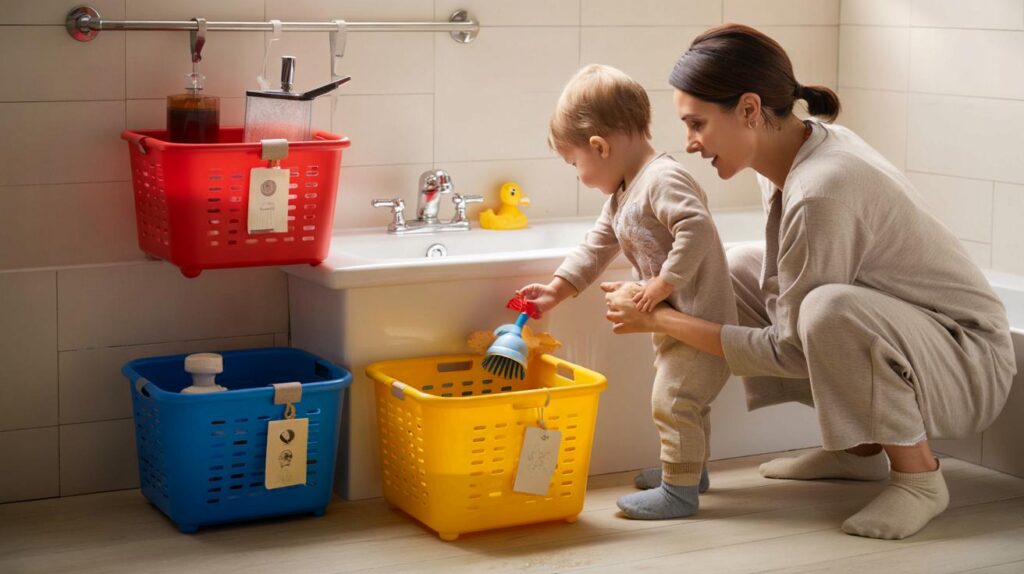
A splashy fix in a small British bathroom: a young mum, a stack of colourful baskets, and the quiet relief of knowing curious little hands won’t find what they shouldn’t. No gadgets, no drilling, just simple colour, reach, and rhythm.
The shampoo slipped, clattered, and skidded toward a pair of socked feet. I watched a toddler’s eyes widen, the kind of fascinated silence that parents learn to read in a heartbeat. The bathroom scooped up every hazard at once: slick floor, shiny razors, fizzing bath bombs that looked like sweets. Steam curled against the mirror as if the room itself was whispering, try me. Then the mum—a 26-year-old with paint under her nails and a calm you only get after a night of bad sleep—squared up with a set of plastic baskets. Bright, cheap, bold as toys. She moved like someone rearranging a traffic system. One shelf at a time. One colour at a time. The room changed, almost invisibly. And she smiled at how fast it happened.
When a bathroom becomes a game you can win
Big parenting wins rarely look cinematic. They look like moving a razor two feet higher or hiding a tablet blister pack behind a folded towel. This bathroom was small, lived-in, the kind of place where towels never fully dry. There was no budget for a renovation. What she had were **colour-coded baskets**, a tension rod, and a hunch that predictability beats chaos every single morning.
Her son—let’s call him Max—had just discovered doors. He’d learned how to twist the handle, toddle in, and aim straight for the forbidden: the blue bottle, the silver shaver, the peppermint-smelling toothpaste that begged to be squeezed. We’ve all had that moment when a quiet house suddenly feels too quiet. That’s when she realised the room was managing her, not the other way round.
So she reversed the rules. Things that look like toys but aren’t got distance and height. Things that are safe became visible and reachable. *The baskets weren’t the point; the system was.* She created a map that a toddler could read without reading: warm colours meant yes, cool colours meant later, grey meant grown-ups only. It felt almost like designing a board game board—clear, bright, and winnable.
Colour, height, and habit: the three moves
First, she chose three basket colours and assigned meanings. Red was “adult stuff”—medicines, razors, hair dye. Blue was “washing gear”—soaps, shampoos, the boring things. Yellow was “kid-safe”—bath toys, a soft brush, a gentle body wash. She hung red high on a tension rod above the mirror, clipped with hooks. Blue sat mid-shelf, behind a small latch. Yellow got prime placement: low, open, and at **eye-level for little hands**.
Next, she made the room narrate itself. Labels helped, but the palette did most of the talking. Yellow stayed where little fingers could grab. She added breathable, quick-dry baskets so nothing stayed damp and mould didn’t creep in. One basket held a roll-up non-slip mat and a silicone drain cover—no metal to pinch, no edges to chew. The reach test was simple: if Max could touch it standing flat-footed, it had to be gentle, chunky, and safe.
The last move was ritual. She did a two-minute sweep every evening, putting the day back in its lanes. Let’s be honest: nobody really does that every day. On the nights it happened, mornings were calmer. On the nights it didn’t, the colours still saved her. Max learned: yellow is mine, blue is boring, red is off-limits. It’s not perfect discipline; it’s muscle memory.
The lived-in details that make it work
For naps and rush hours, she needed friction—tiny hurdles that stop a small hand mid-reach. A cheap childproof band wrapped around the blue basket. A magnetic case for nail scissors sat inside the red one. The yellow basket had holes big enough for water to drain and small enough to keep the rubber duck from vanishing down the plug. She swore by a clear rule: if it’s spillable, it’s lockable; if it’s sharp, it’s high.
There were mistakes. A basket once sagged when the suction hook lost grip mid-shower. She swapped to screw-free adhesive pads rated for wet rooms and learned to stick them on dry, fully degreased tiles. A bag of bath bombs looked too much like sweets, so they moved from blue to red, far up and out of reach. The hair straighteners got a heat-proof pouch and a cooldown tray on the highest shelf. Tiny adjustments, but they mattered when mornings went sideways.
She kept the mood human. The bathroom remained friendly, bright, not a sterile cupboard in disguise. A small plant on a high ledge softened the lines. There was one framed print with big shapes and soft colours, a reminder that “safe” can still feel like home.
“I didn’t want to scare him out of the room,” she told me, running a hand along the yellow basket. “I wanted him to feel where yes lives.”
- Red = Adults only: medicines, razors, hair dye, sharp tools.
- Blue = Grown-up routine: shampoo, body wash, spare toiletries.
- Yellow = Kid-safe: toys, gentle wash, soft brush, rinse cup.
The ripple effects nobody expects
Something subtle shifted. Max began sorting his own bath toys, dropping them in the yellow basket after the rinse. Control is contagious. She felt less like a lifeguard, more like a guide. Showers got faster. Fewer tears. The floor, less of a battlefield.
There’s a wider shade to this: small systems beat big intentions. NHS guidance backs the basics—keep medicines and cleaners high or locked, fit non-slip mats, check water temperature, don’t leave a child alone in the bath. What the baskets added was a visible language the whole household could speak without thinking. Grandparents knew where things went after one visit. Babysitters didn’t ask where the bubble bath lived. The bathroom stopped asking questions.
And the cost? Barely the price of a takeaway. She sourced baskets from a pound shop, hooks from a DIY aisle, and used a leftover curtain rod as the high rail. The outcome was quiet, almost forgettable, which is the goal with safety. The drama is gone because the risk is tucked away. It’s **out of reach, out of mind**.
What’s left in the mirror
Colour did what rules alone rarely manage: it invited a child into the room without handing over the keys. You can build that anywhere—a poky flat, a shared house, a rental with strict landlords. It’s not about perfection, it’s about a pattern your mornings can lean on when your brain is still waking up. The baskets don’t brag. They sit where you left them, catch what you toss, and soundlessly subtract one worry from the day.
| Key points | Details | Interest for reader |
|---|---|---|
| Colour-coded zones | Red for adults, blue for routine, yellow for kid-safe | Instant visual cues reduce “no” policing |
| Height and friction | High rail for hazards, childproof bands on mid-shelf baskets | Simple barriers buy precious seconds |
| Low-cost, high-impact | Pound-shop baskets, adhesive hooks, tension rod | Affordable fix that fits rentals and small spaces |
FAQ :
- How do I start if my bathroom is tiny?Pick two colours, not three. Put hazards high, kid-safe low. Build from there.
- What about medicines and cleaners?Use a locked high box or cabinet. Keep original labels. Check dates monthly.
- Do suction hooks really hold?They can, if tiles are clean and dry. For steam-heavy rooms, swap to adhesive pads rated for bathrooms.
- My child climbs—does this still work?Add a cabinet lock and move anything risky into a lidded, locked container. Remove step stools when not in use.
- Which baskets are best?Breathable plastic or mesh that drains, rounded edges, easy to wipe. Avoid metal that rusts or splinters.



Love the red/blue/yellow system—so simple yet brilliant! 😊 Did you test different shades for low-light mornings? Also curious which adhesive pads you used for wet tiles; the suction ones keep betraying me mid-shower. This feels doable even in rentals—thanks for the inspo!
I get the idea, but I’m wary that colour alone might teach a climber to aim higher. Predictability can turn into a treasure map, no? Wouldn’t a locked, high cabinet for meds/razors be safer than baskets on a rod? Cheap, yes—but is it resiliant when routines go sideways?