
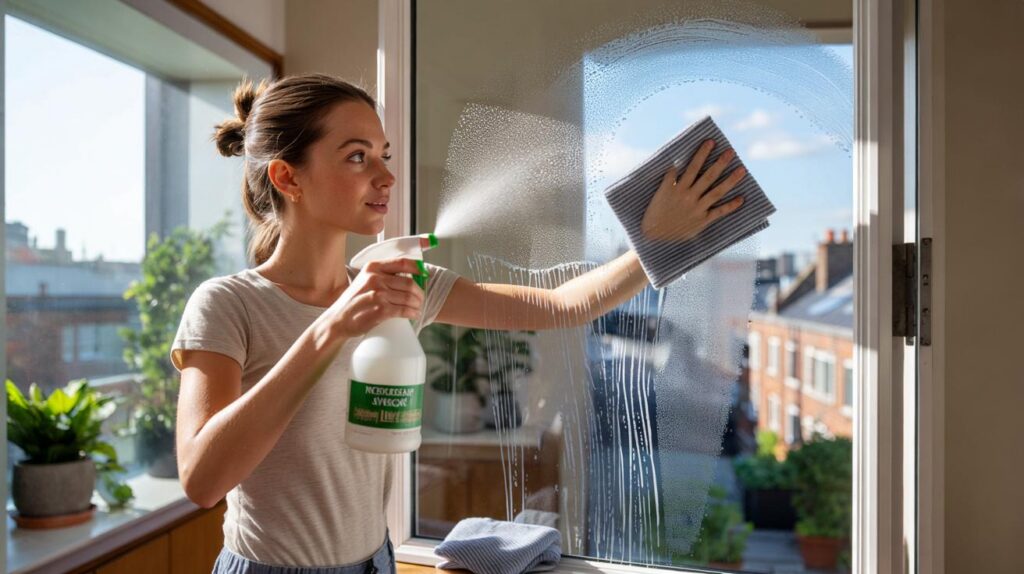
Smudged glass, pricey sprays, and that sharp fake lemon that lingers in your lungs. A young woman swapped it all for plain vinegar from her cupboard — and the streaks simply… didn’t come back.
I first saw her on a grey London morning, sleeves pushed up, hair tied in that fast, improvised knot you do when you mean business. The window was a battlefield of hard-water halos and little handprints. She’d tried the supermarket spray. It foamed, it smelled like an airport restroom, and it left the same greasy ghosts when the light hit. Then she paused, opened a bottle of white vinegar, and poured it into an old spray.
The room changed. Not instantly, but in small, satisfying steps. A mist, a wipe, a quiet squeak. The air had that chip-shop tang, but also something calmer, like the flat exhaled. She moved slowly, almost methodically, and the glass turned into nothingness. Her face reflected back, then disappeared, then became the skyline. No chemicals. No fuss. Just vinegar and a cloth.
And it worked.
Why vinegar won that morning
The first thing she noticed wasn’t the smell. It was the way the smears stopped chasing her cloth around the pane. Sunlight tested the glass and found almost nothing to bounce off. Streaks come from residue that sits on the surface and dries unevenly. Vinegar cut through that film like a neat little key popping a lock. Simple, cheap, quietly effective.
There’s a reason this trick keeps resurfacing on social feeds. A litre of white vinegar in the UK can cost well under a pound, and it covers far more glass than a branded bottle. She told me she’d tried it once after her gran mentioned it over tea. The first go wasn’t perfect, then she adjusted the mix and the cloth. Her second attempt? A pane so clear she forgot it was there and bumped the glass with her mug.
Here’s the unglamorous science. Vinegar is acetic acid, and most window grime is slightly alkaline: dust bonded with skin oils, kitchen vapour, mineral deposits from hard water. Acid meets alkaline, breaks the bond, lifts the film. Streaks are often just product that didn’t evaporate cleanly, or tap-water minerals left behind. Switch to a slightly acidic mix, use the right cloth, and you’re not masking the residue — you’re dissolving it.
The method, exactly as she did it
She mixed one part white vinegar with one part water in a spray bottle. If your tap water leaves spots on glasses, use distilled. For kitchen windows with greasy film, she added a single drop of washing-up liquid, shook once, and called it good. Spray a light mist, not a soak. Work top to bottom. S-shape if you’re using a squeegee, straight lines if you’re wiping. Corners first, centre last. Open a window if you’re sensitive to the tang and let the room breathe.
She used a flat-weave microfibre for the wipe and a second, dry microfibre to buff. Not a fluffy towel. Not a tissue. Old newspaper still works if it doesn’t transfer ink, but microfibre is consistent and fast. Warm day? Wait for shade so the mix doesn’t flash-dry on hot glass. Rainy day? Fine — the vinegar cuts water marks anyway. Let’s be honest: nobody actually does this every day. Do it right once, and you’ll stretch the gap between cleans.
People overcomplicate this and then give up. They spray too much, scrub in circles, and chase the streaks until the cloth is loaded with grime. Use a fresh side of the cloth often. Go around the edges. Then stop. That’s the hidden trick — knowing when you’re done and not undoing your own good work.
“I thought vinegar was just for chips,” she laughed. “Now it’s the only thing that makes the glass look like air.”
- Mix: 1:1 white vinegar to water. A single drop of washing-up liquid for greasy build-up.
- Tools: Two microfibres (one damp, one dry) or a squeegee plus a cloth for edges.
- Timing: Shade, not direct sun. Quick passes. Light pressure.
- No-go zones: Natural stone sills, waxed wood, or delicate metal finishes.
- Finisher: Buff once with the dry cloth. Walk away.
What you see when the glass disappears
We’ve all lived that moment when you clean the window and see your street as if it’s been reprinted in higher resolution. The room looks larger. Colours sharpen. Plants look healthier because the light isn’t being chewed up by smudges. The small win is bigger than it sounds — a tidy edge to start your day. You’ll notice it every time the light shifts across the floor.
There’s also a quiet relief in not lugging home another neon bottle. Fewer perfumes, fewer mystery ingredients, less plastic. Vinegar isn’t glamorous. It works. Use the cheap white kind, keep it away from stone, and test anything precious. If the smell makes you flinch, add a couple of drops of lemon or eucalyptus oil to the bottle and call it your signature mix. It’s domestic science with a soft touch.
Here’s the part that made me grin. She finished, stared through a pane that looked like it had been lifted out, and wrote “Hi” on the bottle with a marker. A little victory flag in a cupboard of quiet tools. The secret wasn’t new, it was just honest. And the view? **Pure, ordinary magic.**
There’s a certain pleasure in the lo-fi fix that doesn’t try to sell you anything bright blue. Vinegar won’t cure every cleaning challenge in your life, but it will make glass behave. The ritual is short and the result is long. You’ll stop apologising for the window when the sun drops. You might even start showing it off.
| Key points | Details | Interest for reader |
|---|---|---|
| Vinegar + water works | 1:1 mix cuts alkaline film and hard-water marks | Cheap, quick, fewer streaks than shop sprays |
| Tools matter | Two microfibres or a squeegee; light mist, top-to-bottom | Professional finish without special gear |
| Timing and limits | Avoid hot sun; keep off stone and waxed wood | Safer, cleaner result with less effort |
FAQ :
- What vinegar should I use?White distilled vinegar is best. It’s clear, inexpensive, and won’t tint the glass. Malt vinegar will work but may leave a smell and colour traces.
- What’s the right ratio?Start with 1:1 vinegar to water. If your glass has serious mineral buildup, go slightly stronger on vinegar for the first pass, then return to 1:1.
- Will it damage my window frames?It’s fine on most uPVC and painted metal. Keep it off natural stone, waxed wood, or marble sills. Wipe any drips right away.
- How do I avoid the vinegar smell?Ventilate for a few minutes and add two drops of essential oil if you like. The scent fades as it dries. **Fresh air does the heavy lifting.**
- Newspaper or microfibre?Both can work. Modern inks are less transferable, so newspaper is less messy than it used to be. Microfibre is more consistent and faster for most people.



Just tried the 1:1 mix with a drop of washing-up liquid on my kitchen window—streeks are gone and the glass looks like air. Microfibre + quick buff was the secret. I was sceptical about the chip-shop tang, but it faded in minutes. Cheers for the step-by-step!