
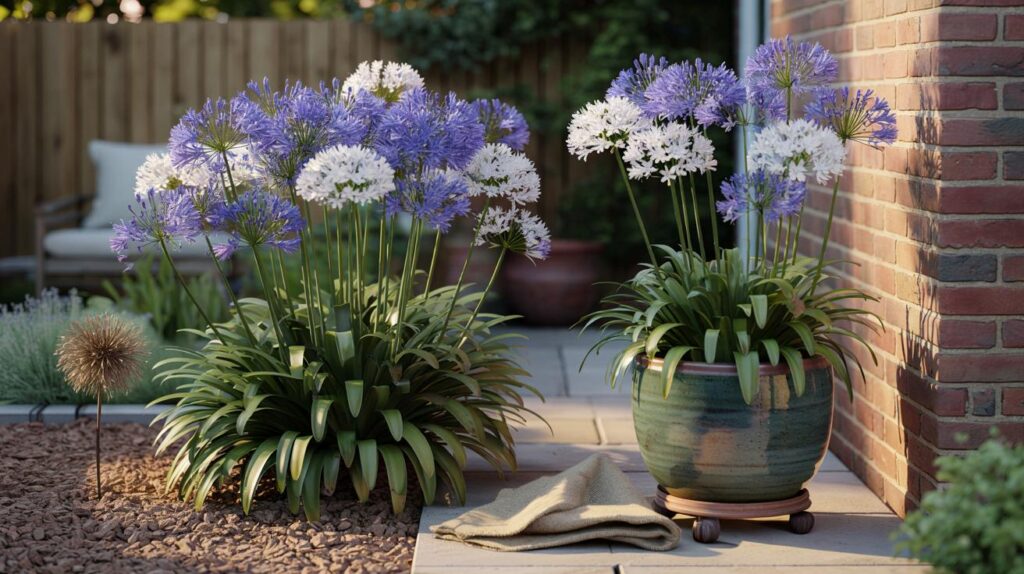
As autumn whispers across patios and borders, a quiet star returns. Your agapanthus can thrive if you follow five truths.
Across Britain, gardeners are eyeing those blue-and-white globes and wondering why some clumps wow while others sulk. The answer sits in five clear rules you can apply this week, whether you grow in beds or in a container by the back door.
Five golden rules for foolproof planting
Give agapanthus 6–8 hours of direct sun, sharp drainage, and a variety matched to your winter, and they pay you back for years.
Match the variety to your winter
Not all agapanthus handle frost the same way. Deciduous kinds drop their leaves and shrug off freezes far better than evergreen types. If you garden where winter bites, look for hardy lines such as the Headbourne group; many plants from this camp cope down to around −20°C once established. In milder districts or in moveable pots, evergreen forms like Agapanthus umbellatus and compact selections such as ‘Peter Pan’ shine with tidy leaves and long flowering spells.
| Type | Winter habit | Cold limit (approx.) | Best use |
|---|---|---|---|
| Deciduous | Leaves die back | −15 to −20°C (established) | Beds in colder regions, exposed gardens |
| Evergreen | Leaves persist | −5 to −8°C (short spells) | Pots you can move, coastal sites, mild towns |
Check the label for mature height and spread. Tall border stars reach 1–1.2 m with flower stems. Patio types sit around 40–60 cm and suit tighter spaces.
Give them sun, shelter and fast drainage
Sun drives flowers. Aim for 6–8 hours of direct light, ideally with a warm south or west aspect. A sun-trap by a wall adds a few precious degrees on chilly nights. Avoid dense shade and wind tunnels. Stagnant winter wet harms roots far more than summer dry spells, so fix drainage before you plant. In heavy ground, raise the bed by 10–15 cm and mix in coarse grit. In pots, use a loam-based compost with at least 20–30% sharp sand or horticultural grit and ensure large holes under the container.
Wet roots in winter kill more agapanthus than frost. Prioritise drainage over cosseting.
Plant on time, water smartly, feed for flowers
Plant in spring when the soil warms. In mild areas you can plant in early autumn, leaving six to eight weeks before the first hard frost. Space plants 30–45 cm apart for compact selections and 50–70 cm for taller strains.
Water to settle the rootball, then keep a steady rhythm. In their first two seasons, give a deep drink about once a week in dry spells; let the top few centimetres of soil dry between waterings. In heatwaves, a large container may need a generous can (8–10 litres) twice a week. Over-watering blunts flowering, so resist little-and-often splashes.
Feed for blooms, not leaves. From April to July, apply a balanced fertiliser modestly, then switch to a high-potash feed every two to three weeks to push bud formation. Avoid nitrogen-heavy feeds after midsummer, which bulk foliage at the expense of flowers.
Keep them tidy and protect at the right moments
Cut spent stems when petals fade in late summer. The plant then diverts energy below ground, setting up next year’s display. Leave the spherical seedheads if you like sculptural winter silhouettes, but remove them before spring if you want to prevent self-sowing.
In cold snaps, help evergreens. Slide containers against a house wall, raise them on feet, and wrap the pot with hessian or fleece when frost threatens. In beds, mulch crowns of deciduous clumps with a 5 cm layer of bark or leafmould once the soil cools, keeping mulch off the neck to avoid rot.
Design for impact, then let them thicken
Agapanthus earn their keep in mixed borders and minimal patios alike. They bring vertical rhythm and a clean silhouette, so use them as repeat markers down a path or as a bold drift in front of grasses. Pair them with blue perovskia, airy verbena, purple phlox, or pastel roses to echo their cool palette. A single, well-grown clump can throw dozens of spheres by year three. In pots, one plant in a 30–40 cm container looks poised and architectural beside steps or on a balcony.
Quick checklist before you buy
- Check the label for type (deciduous or evergreen) and expected cold tolerance.
- Pick sturdy plants with firm, white roots packed in the pot and no mushy crown.
- Choose size with purpose: 3-litre plants bulk fast; 1-litre plants save money but need patience.
- Plan the site: at least 6 hours of sun, free-draining soil, shelter from prevailing winds.
- Budget: three mid-sized plants (£12–£15 each) can fill a 1 m ribbon within two summers.
Common mistakes and quick fixes
Shady beds and lean flowering
Flowers falter in shade. Shift pots to full sun or prune overhang. In beds, replant to a brighter spot or lift and pot for a season while you prepare a sunnier border.
Too much water, not enough air
Leaves yellow and crowns sulk when compost stays wet. Add grit, raise containers on feet, and water in deeper, less frequent sessions. Check that saucers drain freely.
Feeding the leaves, starving the flowers
Strong, dark leaves and few buds point to nitrogen-heavy feeding. Swap to a potash-rich liquid feed through summer and trim watering to avoid lush growth spurts.
Container recipe that works
For a 35 cm pot, mix two parts John Innes no. 3 or similar loam-based compost with one part 6 mm grit and a handful of slow-release fertiliser. Plant so the crown sits just at, or slightly above, the surface. Firm well. Agapanthus flower better when slightly pot-bound, so only step up pot size by 5–7 cm when roots clearly circle the base.
Maintenance that pays back next summer
Divide crowded clumps every four to five years to refresh vigour. Lift in spring, split with a clean spade into chunks with at least two healthy shoots, and replant immediately. Seed is slow and variable, so division keeps the look you chose.
Watch for vine weevils in containers; notches on leaves and collapsing roots are the clue. Knock plants from the pot, pick off grubs, replace compost, and consider biological controls in warm months. Slugs nibble young shoots, so use barriers or traps when growth starts in spring.
Pot-bound within reason, sun-kissed for most of the day, and kept dry in winter: that trio produces the show.
Why this plant suits Britain now
Winters swing between soggy and sharp. Summers can flip from cool to scorching. Agapanthus tolerate those swings when you give drainage, shelter and regular summer water. They also resist many common diseases, and their strappy leaves shrug off short dry spells, which helps as hosepipe bans become more frequent.
Extra help for planning your display
Stagger colours and heights to stretch the season. Early varieties often open in late June, while late forms carry on into September. Mix a taller blue with a mid-height white to avoid a colour block that ends all at once. In small gardens, repeat the same variety for harmony, then weave a contrasting accent in two spots for rhythm.
If you crave numbers, map your space to scale. A 3 m by 1 m front strip fits five tall agapanthus at 60 cm centres, with a low edging of thyme to keep the soil open at the front. In pots on steps, a trio of 30–35 cm containers, spaced 40 cm apart, gives symmetry without clutter. Tally the cost and time: three 3-litre plants, compost, grit and feed come in around £60–£75, and you can plant the lot in under an hour.



Brilliant breakdown. I’d been drowning my agapanthas thinking they were thirsty, but the “wet roots kill more than frost” line hit home. Swapped to loam + grit and raised my containers on feet last week. Already seeing perkier leaves. Thanks for the Headbourne tip too — I’m in Yorkshire, so that matters!