
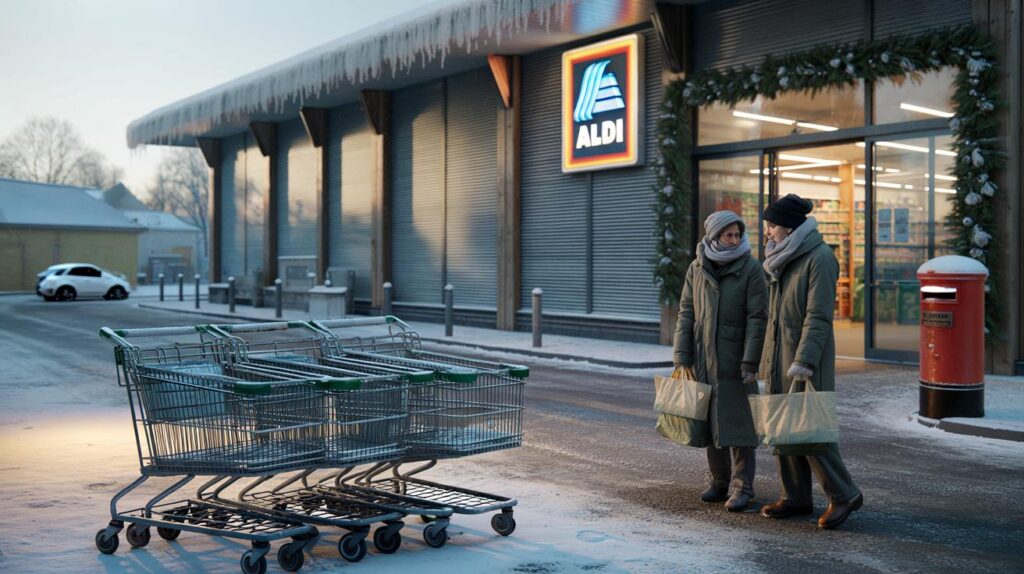
Big basket plans may need a rethink as Aldi reshapes festive trading, nudging households to shop smarter and sooner.
The discounter will pause trading on set days across the country, mirroring a growing move in retail to ringfence family time for staff. Shoppers get more late-night opportunities before Christmas, then a short blackout when doors lock and trolleys stop rolling.
What Aldi has confirmed
Aldi will close every branch on Christmas Day and Boxing Day, then reopen on Saturday, 27 December. Stores will trade as normal from 27 to 31 December. Doors will shut again on New Year’s Day, Thursday, 1 January, before reopening on Friday, 2 January 2026.
The chain operates more than 1,050 stores across England, Scotland and Wales. As the nation’s fourth-largest supermarket, any shift in its calendar touches millions of households. Executives say colleagues deserve protected time with loved ones after a demanding run-up to the big day.
Every Aldi store shuts on 25 and 26 December, then again on 1 January. Reopening dates: 27 December and 2 January.
Key dates at a glance
- Wed 24 Dec: open with extended hours in many locations
- Thu 25 Dec (Christmas Day): closed
- Fri 26 Dec (Boxing Day): closed
- Sat 27 Dec: reopening, normal trade resumes
- Sun 28 – Wed 31 Dec: normal trading (local variations apply)
- Thu 1 Jan (New Year’s Day): closed
- Fri 2 Jan 2026: reopening
Why it matters to shoppers
These closures compress demand into fewer shopping windows. That means busier aisles in the final 72 hours before Christmas, tighter parking, and leaner availability on popular lines. The company plans longer opening hours in the lead-up, giving you more time to stock up on centrepieces, nibbles and fizz.
Fresh items need careful timing. Buy too early and quality dips; leave it too late and shelves may thin. Aldi’s Specialbuys and seasonal displays also draw big crowds. Expect quick turnarounds on value roasts, confectionery tins and party platters.
Plan your fresh-food shop for 22–24 December, then pick up top-ups after 27 December when shelves refill.
Extended hours and queues
Many stores add early openings and late closes in the week before Christmas. Early mornings usually offer faster checkouts and fuller produce stands. Evenings bring calmer aisles after the teatime rush. Use Aldi’s store finder for local hours and consider a midweek visit to avoid the final crush.
Returns, receipts and Specialbuys
Non-food Specialbuys often come with a generous returns window, subject to proof of purchase and condition. Keep paper receipts and digital confirmations together. If you buy gifts late, remember the closure days when planning any exchanges.
How Aldi’s move compares with rivals
Other value chains are taking a similar line. Home Bargains has signalled a three-day festive shutdown, closing at 5pm on Christmas Eve and reopening on 27 December. B&M has said it will close on Christmas Day and reopen on Boxing Day, offering shoppers an earlier return to the aisles. More retailers are expected to publish final timetables as December approaches, and patterns may vary by region.
These decisions reflect a wider shift towards predictable, staff-friendly holiday schedules. Large chains can absorb a day of lost trade by stretching hours beforehand and nudging customers to plan ahead. For shoppers, the payoff is clarity: you know when doors will be locked, and you can organise your baskets around it.
What staff gain
Retail staff shoulder long shifts across December. Protected breaks reduce burnout and help teams return sharper for the post-Christmas restock. This approach also simplifies rota planning and transport, which can be difficult on public holidays with reduced services.
No tills will open on 25–26 December and 1 January, so pharmacy counters, in-store services and parcel points inside stores will pause too.
Your festive checklist
- Book your main shop for 22–24 December. Go early or late to ease queuing.
- Freeze ahead: breads, pastry, pigs in blankets, gravy and stock all freeze well.
- Choose hardy veg: carrots, parsnips and sprouts store well in a cool space.
- Plan dairy: UHT milk and butter freeze; hard cheese keeps longer than soft.
- Leave salads and berries to the final 48 hours for best quality.
- Keep receipts together for any gift returns after 27 December.
- Expect leaner staffing on 27 December morning while shelves reset.
Sample shopping plan for a family of four
| When | What to buy | Why it helps |
|---|---|---|
| By 18–20 Dec | Drinks, tins, snacks, frozen party food | Locks in offers; reduces last-minute trolley bulk |
| 22–23 Dec | Long-life dairy, baking, condiments, hardy veg | Keeps quality; eases pressure on 24 December |
| 24 Dec morning | Fresh meat or fish, bakery, soft fruit, salad | Peak freshness for Christmas Day |
| 27 Dec | Top-up bread, milk, New Year party bits | Restocked shelves; avoids 31 December rush |
What this means for availability and value
Discount chains run lean supply models. Deliveries land often, and products move fast. A short pause can briefly thin lines such as bakery, fresh meat and seasonal confectionery once doors reopen. Expect quick recovery by the afternoon of 27 December as lorries arrive and teams reset displays. Value lines, including own-brand fizz, frozen staples and ambient desserts, tend to hold up well.
Shoppers chasing a specific Specialbuy should note that limited lines may not be replenished immediately after the holiday. If an item matters, try to secure it before 24 December rather than banking on post-Christmas stock.
Travel, payments and accessibility
Public transport runs reduced services on bank holidays. If you rely on buses or trains, aim for early slots on the last trading day before Christmas. Contactless payments speed up queues; keep a backup card or cash in case of local connectivity issues. Car parks will be busy, and some sites may manage traffic — follow staff directions and allow extra time.
A final word on timing and freshness
Think shelf life. A 2 kg turkey crown needs 2–3 days to defrost in a fridge at 4°C. Buy frozen early and move it to the fridge on 22 December for a 25 December roast. Plan milk usage: if your household uses two litres a day, you need six litres for 24–26 December when stores are closed, unless you switch to UHT or plant-based cartons. A simple list on the fridge door prevents double buying and missed essentials like foil, batteries and stock cubes.
Local opening times can vary, and extended hours differ by store size. Check your nearest branch’s timetable before you set off, use quieter windows when you can, and spread the haul over two trips. You’ll save stress, keep quality high, and sidestep the closure days without scrambling.



Three full closure days feels a bit much—what about essentials for vulnerable folks on Boxing Day? Could Aldi partner with local shops or provide limited access for urgent items?